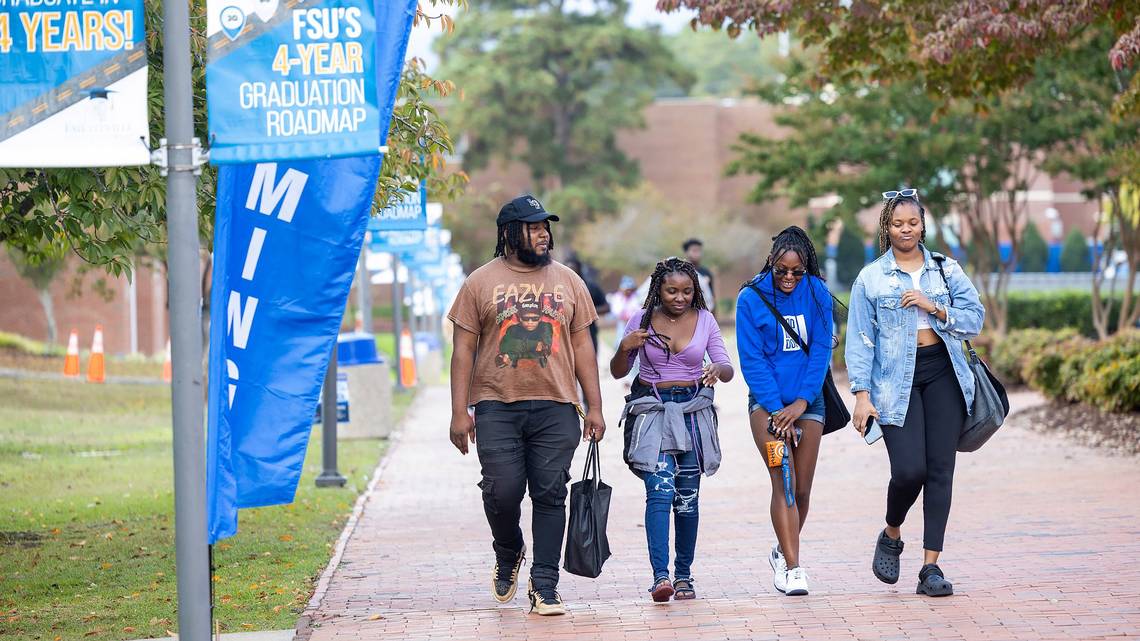
In 2021, Fayetteville State University trailed behind all UNC System schools in graduation and retention rates. When Chancellor Darrell Allison stepped into his role, he knew he needed to do “something radical.”
After implementing a summer-school scholarship offering tuition-free classes and free room and board, more students are staying and graduating on time.
After five years, the program has helped push the university’s 2025 retention rate to a projected 80% from 63% in 2020. The class of 2024’s graduation rate was 19%; now the class of 2026’s rate is projected to be 29%. And Allison said that he believes that the success of the program has reflected positively on the once-struggling institution.
“Fayetteville State was for many students the second or third option,” Allison said in an interview with The News & Observer. “We’re no longer second or third option. And many more of our students are looking at Fayetteville State as a lead option.”
One of the reasons why this program is so important, according to Allison, is because roughly 59% of FSU’s student population receives federal Pell grants.
Additionally, one in eight students are from tier one and tier two counties. The North Carolina Department of Commerce categorizes counties into tiers based on their economic activity, with one being the lowest and three being the highest.
FSU is also one of North Carolina’s four NC Promise schools, which cost $500 per semester for in-state students and $2,500 a semester for out-of-state students. More than 50% of the university’s population is made up of nontraditional, adult learners.
The 30-60-90 Summer Scholarship program is a part of FSU’s mission to keep all students on track with their credit requirements. To reach their senior year, students must take 30 class credits their first year, 60 credits their second and 90 their third.
“[The summer program] has become a fabric of what we do here at Fayetteville State University and consider ourselves a three-semester university,” said Pamela Baldwin, who serves as vice chancellor for strategic enrollment and student success.
‘A sigh of relief’
For Aspen McNeil, taking free summer classes has helped her make up for 18 credits that didn’t transfer to Fayetteville State from her previous university.
McNeil, a junior business student, transferred last year to FSU from St. Augustine’s University, which has been undergoing a years-long accreditation battle that left her searching for another school. McNeil said that FSU welcomed transfer students from St. Augustine, bringing them into a “family environment.”
“When I heard that they have free summer classes — I can make up these credits without going further into debt? — I was like, ‘Yeah, that’s an obvious decision,’” she said. “I’m very thankful for that.”
If McNeil completes her classes this semester and takes more next summer, she said she will be able to graduate just one semester behind.
Camryn Scales, a junior from Fuquay-Varina, said the summer program has helped her to get “back on track” after changing her major.
Scales said the program’s free housing and meals have helped reduce her stress as she takes her classes.
“I never have to worry about going to buy groceries. We have lots of meal options,” she said. “I never have to worry about being hungry.”
“It’s just like a sigh of relief because you don’t have to pay for anything.”
Funding the program
In its list of priorities submitted to the North Carolina General Assembly, the UNC System requested $10 million for two fiscal years across four HBCUs that would go towards completion assistance programs, including Fayetteville State’s. The General Assembly has yet to pass a state budget. But with private donations providing more than 60% of funding, Allison said that he is confident that the program will become permanent.
“I think we’re not only resonating in terms of getting the necessary funding support from our private sector, because they really see how we are moving the needle in terms of of completion, in terms of retention, in terms of students getting across that that goal line of graduation, but also, I think it’s really motivating more of our students to get it done as well,” Allison said.
North Carolina state Rep. Charles Smith, whose district includes FSU, echoed Allison’s confidence.
“The proof is in the pudding,” Smith said. “This is a program that has local support, and that always makes it easier to get funding from the state because it shows the funds are going to be put to good use, and that we’re going to get a return on that investment from the state.”
Last summer, the university received an anonymous donation of $750,000 for the program, contributing to the more than $9 million it has received in funding since its inception.
Nancy Cable, the executive director at the philanthropic organization William R. Kenan Jr. Charitable Trust, said that she’s happy to see the progress that the university is making.
“They’ve made much good use of the funds we’ve provided,” Cable said. “We’re quite proud and honored to be walking alongside of them.”
The summer program’s influence
The success of the program at Fayetteville State, one of the UNC System’s historically Black colleges and universities, has gained praise from at least one other public HBCU.
Winston Salem-State University Chancellor Bonita Brown expressed in a recent UNC Board of Governors meeting that she hopes to improve her university’s summer school program, adding similar aspects to FSU’s program, like free housing, and improving work-study options.
Last year, WSSU’s 365 Summer Scholars program offered tuition-free summer-school classes to 256 students. But just 149 accepted the offer. This summer, even fewer students enrolled, 106 of 382 students who received offers, according to Brown.
Brown inquired about the high rejection rate and said she was taken aback by students’ responses.
“A lot of them said the summer time is the only time I can work to save money for the next academic year. So they can’t go to summer school because they need to work to save for next year,” Brown said in the meeting. “Others said, ‘I can’t afford housing.’”
“We like to lead the way,” Baldwin said. “Across the UNC System, we have really great examples of best practice at all our institutions, and we’re excited and happy to be one example of what is a great best practice.”