With a company mantra of “Building a Better Environment, Building a Better Community,” The Dragon Group wants to put Atlanta at the forefront of green innovation in the construction space.
Launched in 2014, married co-founders Yvonne and Randall Dragon saw an opportunity to support communities impacted by climate change, gentrification, and rising building costs with a company specializing in sustainability consulting and project management for the commercial real estate industry.
“Our mission is to restore, enhance communities while fighting climate change and exposing Black students to entrepreneurship,” Yvonne Dragon, who serves as the company’s chief operating officer and chief strategist, told Capital B Atlanta.
The commercial real estate construction managers and green builders, whose firm, they say, is the only Black female-owned sustainability and construction company in the Southeast, cite the underrepresentation of Black people in the design and construction field as a motivating factor.
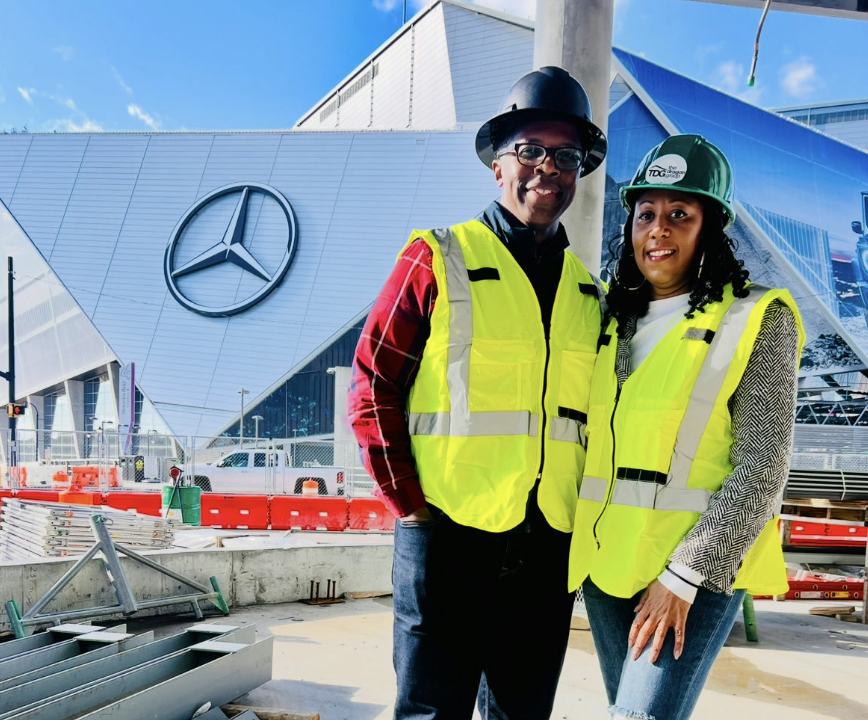
Randall and Yvonne Dragon launched The Dragon Group in 2014. (Courtesy of The Dragon Group)
“We are breaking barriers while improving communities from Atlanta to India,” Dragon said. By using innovative sustainability consulting and green project management services, the Dragon Group wants to build stronger communities by “decarbonizing the built environment.”
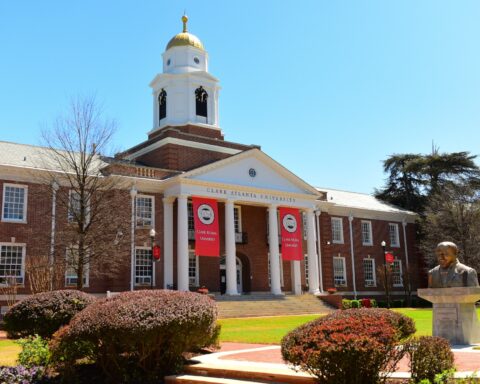
Randall Dragon, who got his MBA from Clark Atlanta University, shared the concerning stats that fuel their business goals in an interview: Buildings are responsible for 40% of all carbon emissions globally. By 2060 the inventory of buildings worldwide will double, and by 2050 all buildings need to be net-zero carbon emissions.
To get their company off the ground, the couple, who live in Buckhead, had to make some tough choices in the beginning.
“Our start-up story is pretty unique, and we did something counterintuitive,” said Yvonne, a Hampton University grad. “We left our jobs six months apart. We took a risk and put all our eggs in one basket. We had a short runway to launch, but we needed time and freedom to build our infrastructure and secure clients, and we could not do that as a side hustle.”
The risk they took — to fight climate change by consulting with building owners, from airport authorities to major corporations, to build greener or retrofit existing buildings with better, greener operating systems — has reaped many rewards for themselves and some of Atlanta’s underserved communities.
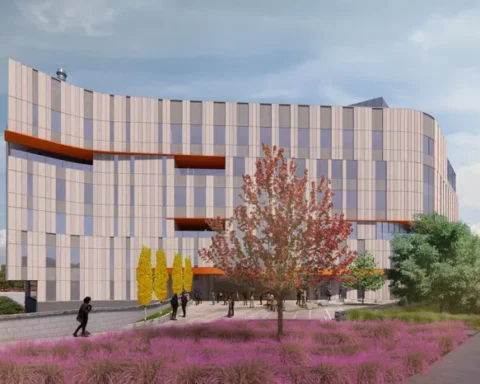
Some of the construction management projects that the Dragons and their team of engineers, scientists, and project managers have developed include a dorm for Morehouse College, four neighborhood clinics for Grady Health Systems, affordable housing complexes, and a Starbucks location.
Sustainability consulting and certification clients include Hartsfield-Jackson Atlanta International Airport, an AC Hotel, four metro Atlanta libraries, and Riverworks Eastern Wharf, a 306-unit multifamily development along the waterfront in Savannah.
For their groundbreaking work, the couple have received several awards, including Georgia Engineer’s A Woman to Watch twice and Kia Motors Change Maker.
Here, Yvonne Dragon, a seventh-generation entrepreneur, explains why Atlanta is a great place for Black business owners and how family history and friends helped paved their road to success. This interview has been edited for clarity and length.
Capital B Atlanta: What have been some of your biggest successes?
Yvonne Dragon: Our biggest success is staying happily married, raising wonderful children, and [running] a thriving business simultaneously. Another success is that we have over 25 projects completed that have impacted over 20 million people while employing 65 interns over the first 10 years we have been in business. We are really excited about current projects: Russell Center for Innovation and Entrepreneurship, Morehouse Student Housing, Morehouse Student Center, and projects at Centennial Yards.
What has been one of the biggest challenges for The Dragon Group?
Our biggest challenge is telling our story so clients and the community know what we are doing, which leads to more awareness, pride, and business opportunities.
Who are your business role models?
Our business role models are our dads. My dad was an entrepreneur for over 20 years, launching and operating an engineering and architecture firm with projects that shaped Atlanta’s skyline, including several buildings at Georgia Tech and several legacy projects from the 1996 Olympics.
Seeking a better future for his family, Randall’s dad moved the family from Grenada and St. Croix to Texas, working on oil rigs. He eventually became a highly sought after master welder.
What was your background prior to launching your business?
Entrepreneurship was normalized for me early on. As an adult, I found out I am a seventh-generation entrepreneur, so it is literally in my blood. Prior to launching TDG with Randall, I worked in economic development building entrepreneurial ecosystems and advising founders. Randall was the VP of sustainability for a major commercial real estate firm when he launched what would become a multimillion-dollar practice within the firm. Prior to that, he worked in the construction industry for over 15 years.
Yvonne Dragon said she and her husband, Randall, “are breaking barriers while improving communities from Atlanta to India.” (Courtesy of The Dragon Group)
Where did you get the funding to launch your business?
Our funding came from F&F Bank: from friends and family. Our friend provided opportunities on our first projects, and we had a bit of seed money from our savings and family to cover our initial living and business expenses.
Why is Atlanta a great place to run your company?
Atlanta is unique in that it has an ecosystem of Black entrepreneurs that work with city and local government to deliver services and build community literally and figuratively.
What’s your advice to other Black entrepreneurs in Atlanta?
Surround yourself with like-minded individuals, and don’t take advice from people who have not had a business or had to cover company payroll.