
Written By Lexx Thornton
About 350,000 Michigan workers who filed for unemployment insurance benefits as far back as March 2020 must return up to $2.7 billion in benefits, Michigan’s Unemployment Insurance Agency said on Sept. 8.
Many of the affected claims were filed during the height of the COVID-19 pandemic, the agency said, but it wasn’t able to request repayments because of a court order in a class-action lawsuit against the agency.
That class-action settlement, which was filed by claimants who received unemployment insurance benefits during the pandemic and then were told they owed money back to the state and, in certain cases, had their wages garnished or tax returns seized, was settled for $55 million in May.
As part of the order from the state judge approving the settlement, a preliminary injunction that prevented the UIA from engaging in collection efforts was dissolved. The pause in collections will be lifted on Sept. 12, the UIA said.
The first payments for affected workers are due two weeks later, on Sept. 29. The UIA said claimants who can’t afford the back payments can apply for a waiver.
“It’s an incredibly difficult position for these people to be in and it’s a difficult position for the UIA because we have a duty to collect this money by law,” Jason Palmer, the director of Michigan’s UIA, said in an interview with the Detroit Free Press on Sept. 8. “We could not collect for essentially five years worth of payments. So we are trying to balance that with empathy and giving people notice and giving them a chance to apply for these waivers and trying to communicate as best as we can.”
During the pandemic, there was a massive influx of unemployment insurance claims as businesses closed their doors and workers stayed home.
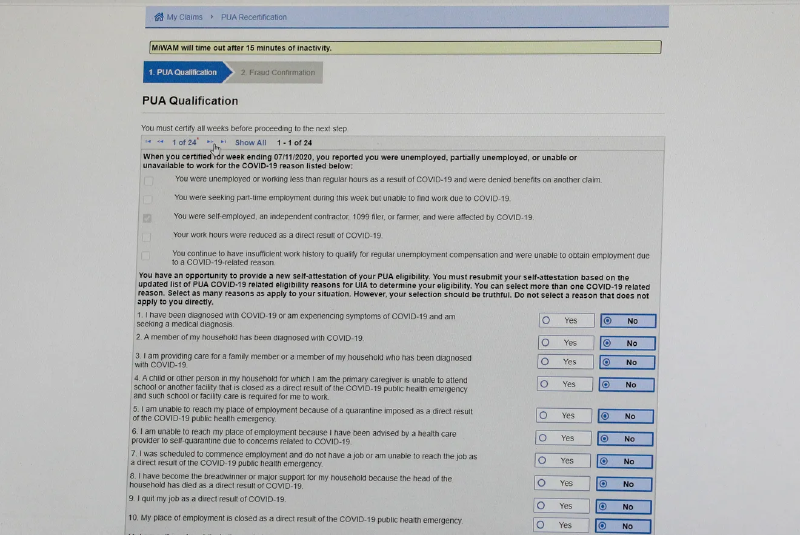
A new form of unemployment insurance was created in the early days of the pandemic when then-President Donald Trump signed the CARES Act into law. Called the Pandemic Unemployment Assistance (PUA) program, this new form of unemployment insurance extended benefits to workers not typically covered by traditional unemployment insurance, such as freelancers, contract workers, and self-employed workers.
The CARES Act also added an extra $600 to traditional claimants’ weekly benefit amount. In Michigan, the maximum benefit amount at that time was $362, so claimants could receive up to $962 until the benefits expired in July 2020. Federal money was reduced to $300 after that.
Nearly 2.5 million people applied for and received at least some of the jobless benefits they qualified for during the pandemic.
Many were denied. Others, as many as 1.83 million claimants, were approved for benefits and received them but were later told they weren’t eligible amid evolving guidance on eligibility from the federal government.
The UIA said those claimants had to pay the money back, and in some cases, the agency clawed back money from those claimants. Collection activities were paused for these claimants, and for any claimant who filed for benefits on or after March 1, 2020, and were told they were overpaid benefits, as part of a court order in a class-action lawsuit against the agency in December 2022.