
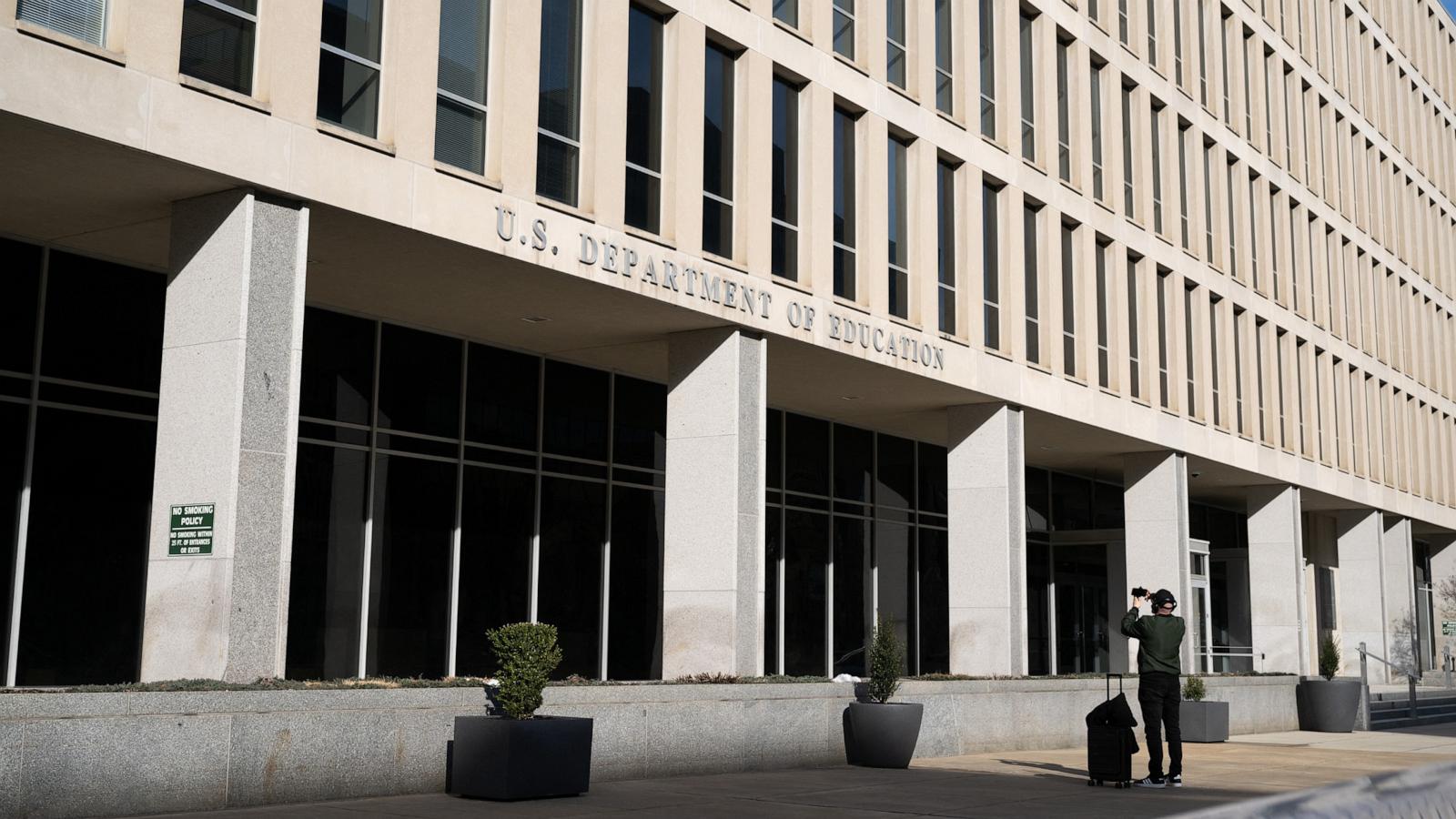
The Trump administration is redirecting nearly $500 million in federal funding toward historically Black colleges and universities and tribal colleges, a one-time investment covered largely by cuts to other colleges serving large numbers of minority students.
The Education Department announced the funding boost just days after cutting $350 million from other federal grants, most of them reserved for Hispanic-serving institutions. Agency leaders said those grants were unconstitutional because they were available only to colleges that meet certain minority enrollment thresholds.
Education Secretary Linda McMahon said the decision was part of an effort to overhaul how federal education dollars are allocated.
President Donald Trump holds a signed an executive order relating to school discipline policies as Education Secretary Linda McMahon listens in the Oval Office of the White House, April 23, 2025, in Washington. President Donald Trump holds a signed an executive order relating to school discipline policies as Education Secretary Linda McMahon listens in the Oval Office of the White House, April 23, 2025, in Washington. Associated Press
Trump Admin Boosts HBCU Funding: What We Know
The changes will redirect money away from “from ineffective and discriminatory programs toward those which support student success,” McMahon said. “The Department has carefully scrutinized our federal grants, ensuring that taxpayers are not funding racially discriminatory programs but those programs which promote merit and excellence in education.”
The department said it would also shift about $60 million toward funding for charter schools and $137 million for American history and civics grants. President Donald Trump in January issued an executive action ordering the agency to repurpose money for charter schools and other school choice initiatives.
Officials said the reallocation represents a 48% funding increase for HBCUs and more than doubles federal funding for tribal colleges and universities.
The shift underscores the department’s use of its authority to repurpose discretionary funds to match the president’s priorities. That authority was expanded under a stopgap funding bill passed by Congress this year giving the executive branch more control over spending.
Trump has long promoted himself as a champion of HBCUs. During his first term, Congress added $250 million a year in permanent funding for the schools. Earlier this year, Trump signed an executive action pledging continued support through an annual White House summit, an advisory board and other initiatives.
The Education Department said the redirected money comes from programs determined to be “not in the best interest of students and families.” The agency has previously argued that minority-serving grants should go instead to programs that do not rely on racial quotas.
A person familiar with the decision said funding would also be pulled from programs supporting gifted and talented education, magnet schools, international education and teacher training. Most of those programs would be eliminated in Trump’s 2026 budget request, the person said, speaking on condition of anonymity because they were not authorized to discuss the matter publicly.
What Grant Funding Was Previously Cut?
Last week’s cuts to the Hispanic Serving Institution program marked a sharp departure from decades of federal support for Hispanic-serving institutions, created by Congress in 1998 after lawmakers found Latino students were enrolling in and graduating from college at far lower rates than white students. Several smaller programs for colleges with certain percentages of Asian American, Black or Native American students were also reduced.
The move drew swift criticism from Democrats, who argued that those programs had long enjoyed bipartisan support and helped expand social mobility for working-class Americans.
A July Justice Department memo backed the cuts, asserting that the Hispanic-serving program is unconstitutional because it is open only to colleges where at least 25% of undergraduates are Hispanic. The department declined to defend the program in a lawsuit filed by Tennessee and Students for Fair Admissions, an anti-affirmative action group.
The suit asks a federal judge to halt the grants altogether. Tennessee argued that all of its public universities serve Hispanic students, but none meet what it called an “arbitrary ethnic threshold” to qualify for funding. As a result, the state contends, its colleges lose out on tens of millions of dollars because of discriminatory requirements.
List of HBCUs and Meaning Explained
Historically Black Colleges and Universities (HBCUs) are institutions of higher learning established before 1964 with the principal mission of educating Black Americans. They continue to provide critical access to education, cultural identity, and upward mobility for underrepresented students.
Alabama – Alabama A&M University, Alabama State University, Bishop State Community College, Gadsden State Community College, J.F. Drake State Community and Technical College, Lawson State Community College, Miles College, Oakwood University, Shelton State Community College, Stillman College, Talladega College, Tuskegee University
Arkansas – Arkansas Baptist College, Philander Smith College, Shorter College, University of Arkansas at Pine Bluff
Delaware – Delaware State University
District of Columbia – Howard University, University of the District of Columbia
Florida – Bethune-Cookman University, Edward Waters University, Florida A&M University, Florida Memorial University
Georgia – Albany State University, Clark Atlanta University, Fort Valley State University, Interdenominational Theological Center, Morehouse College, Morehouse School of Medicine, Morris Brown College, Paine College, Savannah State University, Spelman College
Kentucky – Kentucky State University, Simmons College of Kentucky
Louisiana – Dillard University, Grambling State University, Southern University and A&M College, Southern University at New Orleans, Southern University at Shreveport, Xavier University of Louisiana
Maryland – Bowie State University, Coppin State University, Morgan State University, University of Maryland Eastern Shore
Michigan – Lewis College of Business (Pensole Lewis College of Business and Design)
Mississippi – Alcorn State University, Coahoma Community College, Hinds Community College at Utica, Jackson State University, Mississippi Valley State University, Rust College, Tougaloo College
Missouri – Harris-Stowe State University, Lincoln University
North Carolina – Bennett College, Elizabeth City State University, Fayetteville State University, Johnson C. Smith University, Livingstone College, North Carolina A&T State University, North Carolina Central University, St. Augustine’s University, Shaw University, Winston-Salem State University
Ohio – Central State University, Wilberforce University
Oklahoma – Langston University
Pennsylvania – Cheyney University of Pennsylvania, Lincoln University of Pennsylvania
South Carolina – Allen University, Benedict College, Claflin University, Clinton College, Denmark Technical College, Morris College, South Carolina State University, Voorhees University
Tennessee – American Baptist College, Fisk University, Lane College, LeMoyne-Owen College, Meharry Medical College, Tennessee State University
Texas – Huston-Tillotson University, Jarvis Christian University, Paul Quinn College, Prairie View A&M University, Southwestern Christian College, Texas College, Texas Southern University, Wiley College
Virginia – Hampton University, Norfolk State University, Virginia State University, Virginia Union University, Virginia University of Lynchburg
West Virginia – Bluefield State University, West Virginia State University


