
Following the Civil War, historically Black colleges and universities (HBCUs) were founded to provide educational access for African American students who were regularly denied admission to long-standing institutions of higher education. The nation’s first HBCU, Cheyney University of Pennsylvania, was established February 25, 1837, and it laid the groundwork for a system of institutions created to educate newly freed and formerly enslaved people.
Today, there are more than 100 HBCUs across the United States. These institutions are not only centers of academic excellence, but also pillars of the community, producing a significant share of Black professionals, including 80% of Black judges and 50% of Black doctors and lawyers, among high-ranking numbers in other professions.
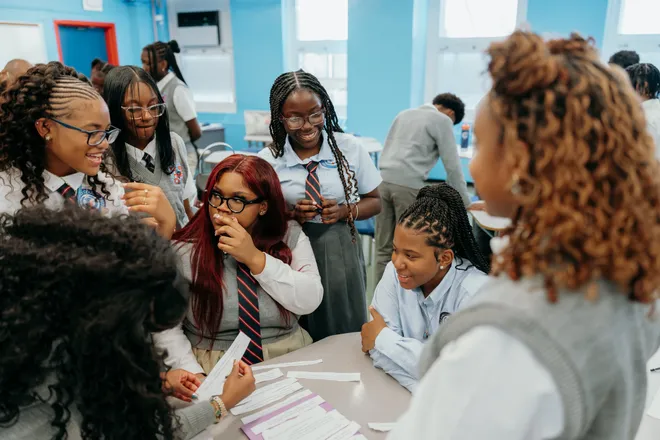
One of the most impactful components of the HBCU model is early exposure to cultural pride, identity, purpose and opportunity. Carrying that philosophy forward is Asya Johnson, Ed.D., founder, creator and principal of HBCU Early College Prep School, a first-of-its-kind HBCU-focused high school located in Jamaica, Queens, which opened its doors on September 4, 2025. Through a unique partnership with Delaware State University (DSU), a historically Black public university, the school has created a direct pipeline that allows students to earn up to 64 college credits toward an associate degree in Liberal Arts at no additional cost while in high school, as well as acceptance into the university upon high school graduation—positioning them for long-term academic and professional success.
“Delaware State University is an ideal partner because of its deep commitment to supporting students both academically and personally. There’s a genuine sense of community on campus, and their success coaching model pairs rigorous expectations with strong relational support,” Johnson says. “That balance reflects exactly what we want our scholars to experience as they take on college-level work, and aligns closely with the culture we’re building at our school.”
Many share those sentiments, including Isaiah James, a junior at DSU majoring in accounting with a minor in finance and banking. When asked why he chose the university, his answer is simple: accountability.
“Being at DSU, all my peers hold me accountable,” James says. “My advisers, my professors, and my mentors hold me accountable for everything I do.”
For Josephine Yeboah Van-Ess, Ed.D., superintendent for New York City’s Queens South High Schools, the launch of HBCU Early College Prep represents the kind of opportunity she wishes had existed when she was in high school. A native of South Jamaica, Queens, Van-Ess now serves the same community that raised her, an experience that deeply informs her leadership and vision for student success.
“A school like HBCU Early College Prep would have been life-changing for me,” Van-Ess says. “A school with rigorous, culturally responsive teaching would have strengthened my confidence and academic identity. Mentorship from educators who understood my background would have shaped my sense of possibility, and graduating with an associate degree would have provided both a competitive advantage and real financial relief for my family.”
She adds that expanding access and opportunity for young scholars remains central to the district’s mission — mirroring the promise, legacy and tradition of the HBCUs the students hope to attend.
“Our scholars have tackled real issues like voter suppression and presented their work to elected officials, showing both academic growth and civic engagement,” Johnson says. “Just as important, we prioritize students’ social and emotional development by teaching them how to manage stress, learn from setbacks and build habits that will help them persist in college and beyond.”
Paying it forward isn’t just a value, it’s a core responsibility HBCU alumni live by, and HBCU Early College Prep School is a powerful example of that commitment in action. As James plainly put it, “After you graduate, there are always people who want to pour back into the HBCU they came from.”
With Johnson, a DSU alumna, at the forefront alongside the support and leadership of Van-Ess, the school embodies the principles of reinvestment, legacy and collective empowerment that define HBCU culture. In the words of Van-Ess, “Representation and cultural affirmation are central to meaningful learning. When students see themselves reflected in their teachers and curriculum, it reinforces: ‘I am seen, I matter, I belong and I can succeed.’”


