
By Ajong Mbapndah L
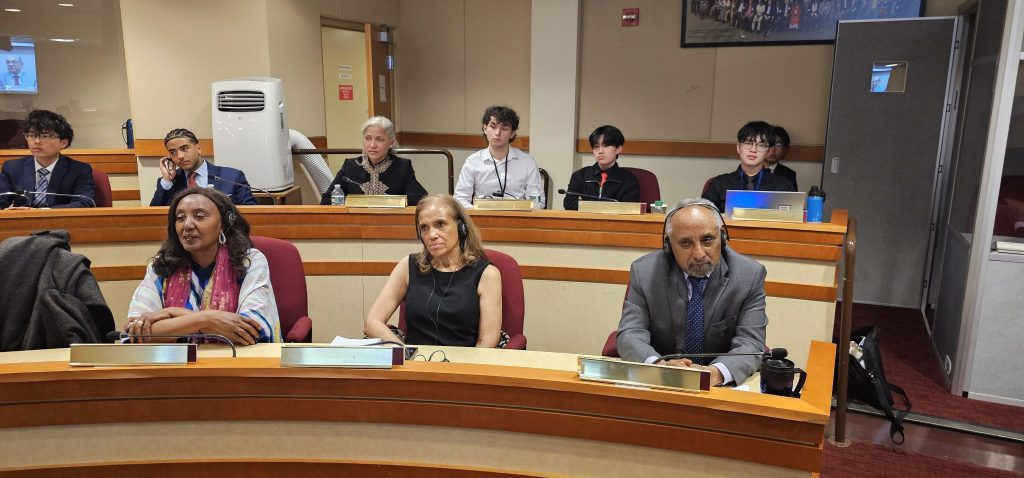
Stakeholders gather at the closing session of the Angola–HBCU initiative in New York, setting the stage for the Pan-African Higher Education Conference in Luanda
In the quiet authority of a room filled with diplomats, scholars, and global partners, a powerful idea took center stage—one that seeks not merely to educate, but to transform continents. On April 10, 2026, in New York, the third and final cohort of the Angola–Historically Black Colleges and Universities (HBCU) Higher Education Program and Satellite Campus Initiative concluded with a sense of momentum that was both tangible and far-reaching. What unfolded was not simply the closing of a program, but the crystallization of a vision steadily redefining how Africa positions education at the heart of its development future.
Supported by senior figures including H.E. Mohamed Fathi Edrees of the African Union Mission at the UN, Angola’s Minister of External Relations Téte António, Professor Hannah M. Salassie, and Ambassador Kwesi Quartey, the initiative has matured into a dynamic platform for education diplomacy—one that directly confronts the intertwined challenges of conflict, governance, and the exploitation of critical minerals in Africa’s Great Lakes region. Central to its coherence and continuity has been the leadership of Dr. Rita Cooma, who served as organizer and facilitator across all three sessions, shaping the dialogue from its earliest stages into a structured, outcome-driven process. Working alongside Ambassador Mathis Mwemba, her stewardship ensured that each convening built deliberately on the last, transforming a series of engagements into a unified strategic trajectory—one that now extends toward the upcoming summit in Angola in June 2026.
By the time Téte António rose to deliver his keynote, the room had already been primed for ambition. His remarks elevated the conversation from institutional collaboration to continental strategy. He framed education diplomacy not as an abstract ideal, but as a national and regional imperative—one that must align with Africa’s economic priorities in critical minerals, infrastructure, and industrialization. In a candid assessment, he acknowledged that the global rush for critical minerals has too often intensified conflict, particularly in the Great Lakes region, where illicit exploitation continues to fuel instability and human rights abuses. Yet within that challenge lies an opportunity. Africa, he argued, must move decisively from being a supplier of raw materials to becoming a global hub of knowledge, innovation, and value creation. Education is the bridge between those realities.
This framing gave sharper meaning to the initiative’s core ambition. Africa’s vast mineral wealth—essential to the global energy transition—has historically generated limited local benefit. What the Angola–HBCU partnership proposes is a structural shift: embedding higher education within the critical minerals value chain so that African nations can develop the expertise to process, regulate, and innovate within their own economies. It is a vision in which geology meets engineering, policy intersects with entrepreneurship, and universities evolve into anchors of industrial ecosystems.
A unified vision emerged, positioning education as a central driver of peace, innovation, and sustainable development on the continent
The journey to this point has been deliberate. Earlier engagements in December 2025 and January 2026 laid the intellectual groundwork, positioning higher education as a catalyst for peace, security, and sustainable development. Under the careful coordination of Dr. Rita Cooma, these sessions were not isolated discussions but interconnected steps in a broader design—each one refining priorities, strengthening partnerships, and moving closer to implementation. By this third convening, the dialogue had matured into a strategic framework, shaped in part by earlier contributions such as the presentation of Dr. Brian Stevenson. His concept of an Angola–HBCU Collaborative Higher Education Ecosystem introduced a practical architecture that integrates universities, industry, and government into a cohesive system capable of delivering both academic excellence and tangible development outcomes. His emphasis on scalability, sustainability, and alignment with national priorities helped move the initiative beyond vision into action.
That systems-oriented thinking resonated throughout the session, reinforced by voices such as Dr. Vickie Coleman, who described the initiative as the culmination of years of strategic engagement under a ten-year framework launched in 2022. The urgency, she suggested, lies not in further dialogue but in execution—building systems that can sustain economic growth, foster innovation, and create opportunity across generations.
The institutional backbone of the initiative reflects both credibility and historical depth. Leading HBCUs—including Lincoln University, Tuskegee University, and Delaware State University—joined a broader network of academic and strategic partners, bringing with them not only technical expertise but also a legacy rooted in resilience and the transformative power of education. Their engagement represents more than collaboration; it signals a reconnection of intellectual and cultural ties between Africa and its diaspora, restoring a shared sense of purpose across continents.
Participants engaged in forward-looking dialogue aimed at transforming Africa’s vast resource wealth into locally driven value creation
Yet perhaps the most compelling expression of the initiative’s potential lay in its tangible innovations. During the session, Dr. Steve Ayanruoh presented his groundbreaking “Hospital in a Box” concept—a portable, scalable healthcare solution designed to deliver essential medical services to underserved communities. In its simplicity and practicality, the model captured the essence of what the Angola–HBCU partnership seeks to achieve: the convergence of education, technology, and entrepreneurship to address real-world challenges. It is education not as theory, but as action—an engine for solutions that improve lives.
What began as a bilateral partnership is now expanding with unmistakable momentum. Interest from countries such as Algeria, Equatorial Guinea, and Namibia points to a broader continental embrace of the model. The initiative is evolving into a pan-African platform, reflecting a shared recognition that Africa’s development must be anchored in human capital, regional integration, and knowledge-driven growth.
At its core lies a profound belief in Africa’s greatest asset—its people. With one of the youngest populations in the world, the continent faces a defining choice: whether to harness this demographic advantage or risk deepening instability. By investing in higher education, research capacity, and skills development, the Angola–HBCU partnership seeks to address that challenge at its root, creating pathways for young Africans to thrive within their own economies.
The emphasis on academic and cultural exchange reinforces this vision. The movement of students, faculty, and researchers across continents fosters not only knowledge transfer but also mutual understanding, challenging outdated narratives and positioning Africa as an active contributor to global knowledge production. It is a recalibration of relationships—one grounded in partnership rather than dependency.
Momentum is now firmly directed toward the next phase. The upcoming Pan-African Higher Education Conference in Luanda, scheduled for June 17 to 19, 2026, will bring together universities, governments, and international organizations including UNICEF. Building on the foundation laid across the three New York sessions, and under the continued coordination of Dr. Rita Cooma, the summit is expected to formalize partnerships, expand participation across the continent, and transition the initiative into a fully realized pan-African platform.
The high-level gathering of diplomats, scholars, and global partners marks a pivotal moment in advancing education diplomacy for Africa’s development.
There is also a deeper symbolism at play. In reconnecting Africa with institutions shaped by the African diaspora, the initiative acknowledges a shared history marked by both adversity and resilience. It affirms that the intellectual and cultural contributions of people of African descent have always been interconnected—and that through education diplomacy, those connections can be renewed with purpose and direction.
As the final moments of the session unfolded, what lingered was not the conclusion of a program, but the emergence of a movement. From the strategic clarity of Téte António to the architectural vision of Dr. Brian Stevenson, the practical innovation of Dr. Steve Ayanruoh, and the sustained coordination of Dr. Rita Cooma, the Angola–HBCU initiative now stands as a compelling model for how education can drive transformation at scale.
Across Africa, the future is no longer being imagined in isolation. It is being built—deliberately, collaboratively, and with growing confidence—in spaces where ideas translate into systems, partnerships into action, and education into lasting impact.