
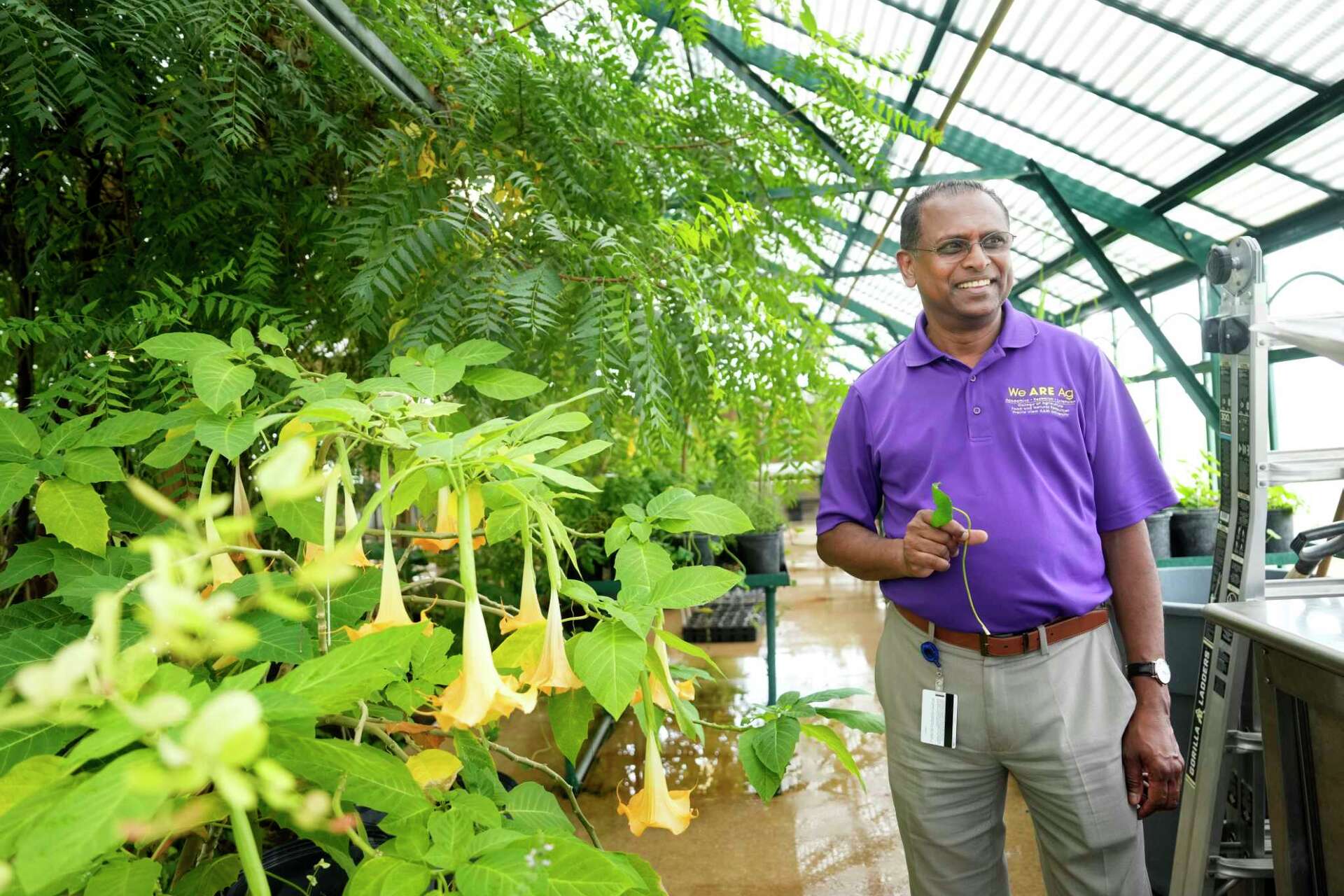
By Melissa Phillip/Houston Chronicle
Aruna Weerasooriya, professor of Plant Sciences, talks in a greenhouse at Prairie View A&M University in Prairie View, Wednesday, March 26, 2025.
Melissa Phillip/Houston Chronicle
Prairie View A&M University and Texas Southern University are on a mission to elevate their national research profiles, and a new consortium of historically Black colleges and universities is helping in the effort.
The two Houston-area schools were among the 15 HBCUs to publicly launch the Association of HBCU Research Institutions on Wednesday. The group, known as AHRI, wants to boost funding for HBCUs and amplify their collective and individual impacts on American research — including in high-need or fast-moving areas like public health, agriculture, technology and space exploration.
Faran Atkins, a freshman from Alvarado, prepares to milk a goat at the Prairie View A&M University’s International Goat Research Center in Prairie View, Wednesday, March 26, 2025.
“All of these grand challenges that exist, we want to contribute to those in meaningful ways with expanded capacity,” said Prairie View A&M President Tomikia P. LeGrande, who is also the AHRI board’s vice chair. “We’re doing that now, but if we had a little more investment and a little more support, we could do great things — even greater things.”
LeGrande and other leaders said they hope the initiative will give their schools more visibility, helping them draw more grants, recruit more research faculty and doctoral students, add physical research infrastructure on their campuses and amplify student research.
It will also give them a ready-made structure for collaborations, making it easy to pair the member institutions together for research, LeGrande said. AHRI is considering partnerships that aid students in summer research opportunities, as well as ways the universities can collaborate to strengthen their curricula.
The consortium was created with help from the Association of American Universities, a group of 71 of the most prestigious research universities in North America.
Harvard University is also providing technical assistance to AHRI, plus a three-year, $1 million grant from its “Harvard & the Legacy of Slavery Initiative.” That effort began out of a 2022 report that aimed to reckon with the Ivy League institution’s ties to slavery.
More funding needed
Garcia James, a sophomore from Westmoreland, Jamaica, works with soil samples in the Core Lab at Prairie View A&M University in Prairie View, Wednesday, March 26, 2025.
Melissa Phillip/Houston Chronicle
AHRI is meant to elevate the research standing of HBCUs, which were historically underfunded by their state legislatures and the federal government. Those disparities put many HBCUs behind predominately white institutions in research expenditures, as teaching and building infrastructure took priority, LeGrande said.
HBCUs still receive comparatively less in federal research and development funding. They get an average share of less than 1% of federal R&D funding, despite making up 3% of all four-year institutions, according to a 2025 report by the Center for American Progress and the Thurgood Marshall College Fund.
In 2023, 17 of the country’s 43 federal agencies that distributed R&D funding to universities didn’t allocate to HBCUs at all, the report also found.
No HBCUs are currently members of the Association of American Universities. Only one HBCU, Howard University, does the highest possible level of research in the country, giving it a coveted “Research One,” or “R1” designation in the Carnegie Classification of Institutions of Higher Education.
Howard University, a private school in Washington, D.C., is the only HBCU to have R1 status. Thirteen of the partners, including Prairie View and Texas Southern, have R2 status, designating a high level of research activity.
LeGrande said she believes the universities are moving fast in their quest to become R1. The 15 members of the consortium make up about 50% of competitively awarded federal funding among HBCUs, she said.
In 2025, Prairie View counted $53 million in research expenditures, and at TSU, an amended budget showed $52 million in research grant spending that year.
“Research is one of the most powerful ways universities create opportunities, solve problems, and improve lives,” Michelle John, TSU’s vice president for research and innovation, said in a news release. “AHRI creates an important framework for collaboration among HBCUs that are expanding their research missions. For Texas Southern, this initiative aligns directly with our commitment to research excellence, innovation, and our strategic goal to reach R1 status.”
Research goals
Renovated interior spaces are toured inside the new Institute for Urban Public Health and Housing Equity at Texas Southern University’s W.R. Banks Child Development Center on Tuesday, Oct. 15, 2025, in Houston.
Raquel Natalicchio/Raquel Natalicchio / Houston Chr
AHRI will serve as an advocacy arm for the HBCU research efforts, helping raise visibility with private organizations in an uncertain federal space.
Advertisement
Article continues below this ad
Last year, the Trump administration redirected almost $500 million in funding away from minority-serving institutions to HBCUs and tribal colleges, but those are one-time funds. (Prairie View received $12 million from the reallocation, LeGrande said.)
The White House has also de-emphasized equity research, terminating hundreds of millions of dollars in grants last year that involved topics like diversity, equity and climate change.
Though HBCUs are instrumental in societal research that affects Black communities, LeGrande said that “trying to reduce this work to a DEI moniker is not what we’re interested in.” Prairie View initially lost a number of grants amid the federal funding upheaval, but the university appealed and only lost three grants, she said.
“We don’t ever have to say that this research is about specifically the Black community,” she said. “What we have identified is a gap in the literature, a gap in existing research that leaves out a perspective, and we want to contribute that perspective to improve health for America, in rural communities, in low-income communities.”
The other partners in the consortium are Howard University, Clark Atlanta University, Delaware State University, Florida Agricultural and Mechanical University, Hampton University, Jackson State University, Morgan State University, North Carolina Agricultural and Technical State University, South Carolina State University, Southern University, Tennessee State University, Virginia State University and the University of Maryland Eastern Shore.
Wayne A. I. Frederick, Howard University’s interim president, is also interim president of the consortium. David K. Wilson, president of Morgan State University, is board chair. The group technically formed in 2023 but went public with the initiative on Wednesday.
“AHRI marks a powerful new chapter in the HBCU research landscape, bringing institutions that have too often worked in isolation into sustained collaboration with one another and with the country’s leading research universities,” said Ruth Simmons, senior adviser to the Harvard University president on engagement with HBCUs and former president of Prairie View.