
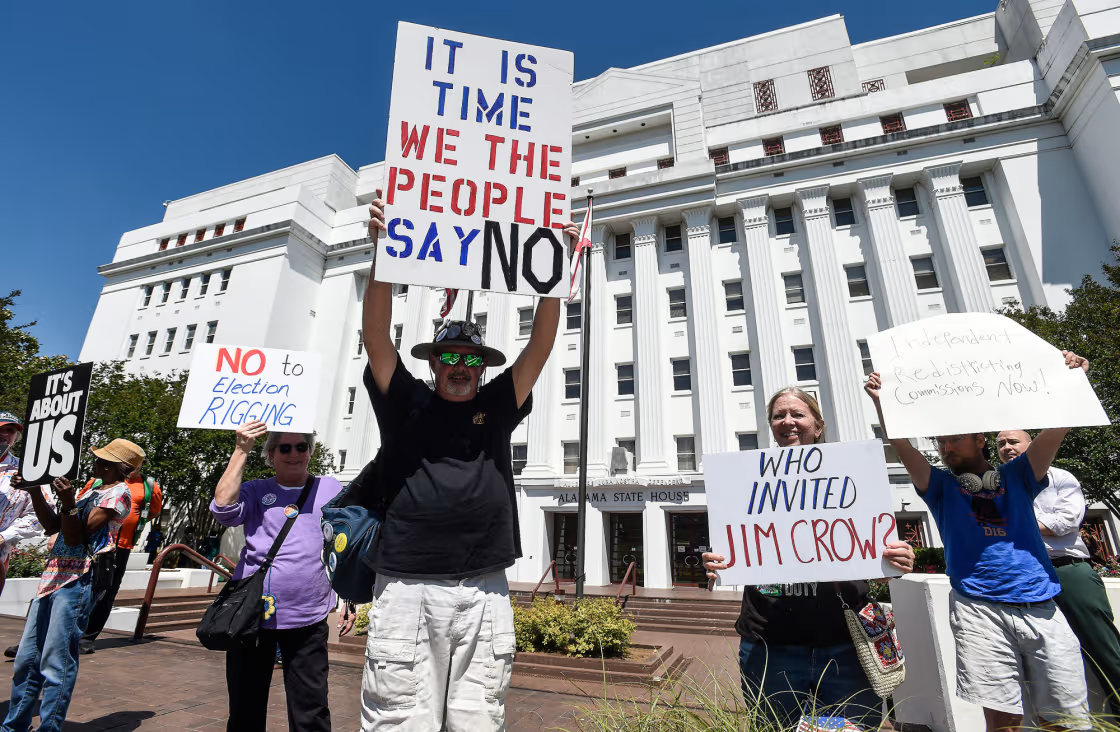
WASHINGTON — The Supreme Court on Monday removed an obstacle to Alabama’s using a new congressional map in this year’s election that would eliminate one of the state’s two majority-Black districts.
The court, over the objection of its liberal members, sent litigation over the Republican-drawn map back to the lower court, which could speed up the state’s effort to use its map.
The state has been battling civil rights plaintiffs over its congressional map for years, with a focus on whether a second majority-Black district was required to comply with the 1965 Voting Rights Act.
The latest flurry of court filings came in light of the Supreme Court’s ruling on April 29 in a case from Louisiana that undermined a key provision of the law, making it much easier for states to draw districts that dilute minority voting rights.
The court fast-tracked the Alabama case a week after a similar decision in the Louisiana dispute. Both decisions are a boon to Republicans, who are locked in a redistricting war with Democrats triggered by President Donald Trump, with control of the House at stake.
In a dissenting opinion, liberal Justice Sonia Sotomayor said the court action was “inappropriate and will cause only confusion as Alabamians begin to vote in the elections scheduled for next week.”
The Alabama litigation includes a claim that the state’s favored map intentionally discriminates against Black voters, a finding that may not be affected by the Louisiana ruling, Sotomayor added.
Alabama’s appeal of the lower court ruling that invalidated its map was on hold at the Supreme Court while it decided the Louisiana case. As soon as the ruling was issued, Alabama Attorney General Steve Marshall asked the justices to act quickly on its appeal so the state can move forward with using its preferred map.
The Legislature has already passed legislation, signed into law by Republican Gov. Kay Ivey, that would push back the state’s primary elections, which were originally due to take place May 19.
The Alabama litigation dates to the map the state drew immediately after the 2020 census, which included one majority-Black district. The state, which has a population that is more than a quarter Black, has seven congressional districts.
Civil rights plaintiffs successfully challenged that map, winning a surprising ruling at the Supreme Court in June 2023.
The state then sought to try again, drawing a new map — the one the state currently wants to use — that still included one majority-Black district, but the Supreme Court rejected that effort, too, in September 2023.
That led to a court-drawn map with two majority-Black districts’ being used in the 2024 election. Democrats won both races.