
By Bill Barrow
Same fight. New generation.
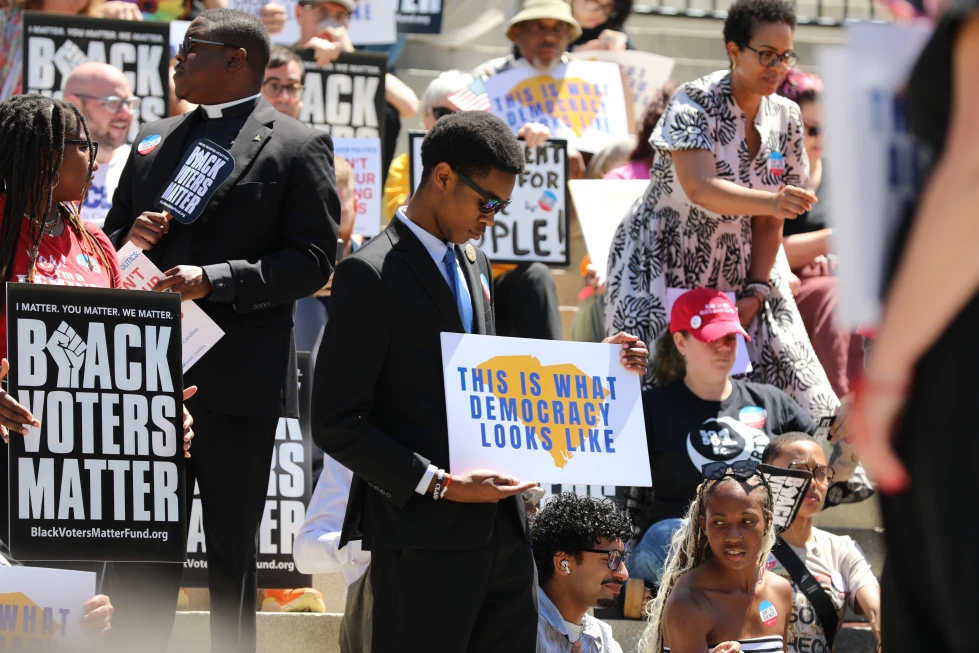
That’s the mantra of a multiracial group of civil rights leaders and activists organizing opposition to a mostly white conservative alliance dismantling the Voting Rights Act and political districts that allowed Black and other nonwhite voters to choose more of their elected leaders for the last half-century.
“We have to respond as quickly as possible,” NAACP President Derrick Johnson said in an interview. “The real question,” Johnson told The Associated Press, “is how do we as a country really address the effort to shrink us backwards into a 1950s reality?”
Johnson’s 117-year-old association, which was at the forefront of legal and legislative fights for Black political rights in the 20th century, is among scores of groups coming together Saturday in Alabama for a rally and tribute to the Civil Rights Movement that helped bring about the 1965 Voting Rights Act. They plan events in Selma, where voting rights advocates were attacked by white law enforcement officers on Bloody Sunday, and Montgomery, where a rescheduled march concluded two weeks later.
Unlike 61 years ago, the Alabama events are not the pinnacle of a protracted movement. Instead, civil rights activists hope they serve as a catalyst for a renewed crusade after the U.S. Supreme Court, two weeks ago, further weakened the VRA by no longer allowing race to be considered in how congressional and other districts are drawn.
They acknowledge difficulty in countering a white-dominated conservative network entrenched in the White House, Capitol Hill, federal courts and many state legislatures of the Old Confederacy, where a majority of Black Americans still live.
The VRA “was the foundational nucleus of the Civil Rights Movement,” said Jared Evans of the Louisiana-based Power Coalition for Equity and Justice. “They’ve taken that from us,” he said, with the recent Louisiana v. Callais decision on congressional districts and the earlier Shelby v. Holder decision in 2013 that rolled back federal oversight of election procedures in states and localities with a history of discrimination.
Georgia Sen. Raphael Warnock, who is senior pastor of Atlanta’s Ebenezer Baptist Church, where the Rev. Martin Luther King Jr. once preached, said from his pulpit that the result is “Jim Crow in new clothes.”
Warnock pointed to King and the last voting rights movement. “We need political power. We need economic power. We need personal power,” he said, assuring parishioners that “your adversaries know that your voice matters” because they’re “bending over backwards” to diminish it.
Evans reached further back into history to say what must happen next.
“Our response must be and will be a second Reconstruction period,” Evans said.
Some Democrats want an answer from Congress
The ultimate goal, organizers said, is to win more elections, sway policy fights and protect diverse political representation at all levels.
U.S. Rep. Terri Sewell, a Black lawmaker who represents Selma, Alabama, said an immediate priority is to “reform and reintroduce” Democrats’ flagship voting bill, the John R. Lewis Voting Rights Act.
Sewell, whose seat ultimately could be threatened under redistricting, said Democrats want to “completely” eliminate partisan gerrymandering.
She also said the legislation would “bring back pre-clearance,” the requirement for certain federal approvals that the court struck down in Shelby.
“We need to come up with a modern-day formula for showing just how egregious the behavior of these state actors is,” Sewell said.
The Supreme Court ruled in Callais that states do not have to draw majority nonwhite districts under the Voting Rights Act and, in fact, should not consider race at all when drawing boundaries. By arguing that the law’s remedies to combat discrimination had themselves become racist, the decision allows states to redraw heavily Black districts that have historically elected Democrats while arguing that the designs are based on party interests, not race.
President Donald Trump praised the decision as “a BIG WIN for Equal Protection under the Law, as it returns the Voting Rights Act to its Original Intent, which was to protect against intentional Racial Discrimination.”
Groups mobilized for redistricting sessions
Many of the same groups who’ll be in Alabama on Saturday have already gone to Southern statehouses, where white Republican lawmakers moved swiftly to redraw congressional districts after Callais.
Alabama and Louisiana lawmakers reverted to a single majority-Black district, each scrapping a second district that had been ordered by lower federal courts under now-reversed VRA interpretations. Tennessee lawmakers gutted a majority Black district by splitting greater Memphis into three different sprawling districts — itself an obvious racial gerrymander the court had previously forbidden, Evans said.
Anticipating the Callais outcome, Florida and Texas proceeded with redistricting before it came down. Georgia Gov. Brian Kemp, a term-limited Republican, has called a June session to redraw congressional lines for the 2028 cycle. Mississippi and South Carolina have delayed the matter for now.
South Carolina state Senate Majority Leader Shane Massey was among the few white Republicans who pushed back against GOP redistricting plans. He said that not even pressure from Trump could sell him on disenfranchising Black South Carolinians instead of doing what’s best for his state.
Other white conservatives are still talking openly about ousting Reps. Jim Clyburn and Bennie Thompson, the only Black U.S. House members from South Carolina and Mississippi, respectively.
Evans, the Louisiana activist, predicted the fight ahead won’t just be about congressional representation.
“Look for them to go after state house and state senate seats — and then it will be the local level,” he said, adding that “it’s going to be an entire erasure of Black representation.”
The issue is more than a partisan Washington fight
Heavily minority districts drawn under the VRA before Callais nearly always elect Democrats. Black Americans have overwhelmingly aligned with the party since President Lyndon B. Johnson signed the Civil Rights Act and Voting Rights Act, sparking a decades-long migration of most white Southern politicians to the Republicans. Latino and Hispanic voters still lean Democratic in most places as well.
The immediate fight shapes the midterm campaign scramble for control of the U.S. House during the final years of Trump’s presidency. Trump initially pushed Republican-run states to redistrict to protect the party’s fragile House majority.
But Johnson, the NAACP leader, said all voters should see more than partisan warfare or a regional battle over race.
Beyond party allegiance, Johnson argued, white conservatives want to curtail a range of rights “depending on how you pray, depending on who you love,” while also pushing economic policies that punish workers across racial and ethnic lines. From legislation to the confirmation of federal judges who decide constitutional questions, those policy outcomes start with election results.
“It’s not a Black problem,” Johnson said. “That’s an American problem.”
There is no singular movement or leader yet
Evans, Johnson and others acknowledged the complexity in harnessing disparate organizations and galvanizing voters on issues like redistricting and gerrymandering. But they insist the brazen nature of Republicans’ course has spurred engagement.
Johnson said he was on an organizing call in Mississippi this week that had 8,000 participants. Evans pointed to packed hallways in the state Capitols in Baton Rouge and Nashville, respectively.
The NAACP and allies have challenged new maps in multiple states, despite Callais. Many groups want to spur midterm turnout among Black voters, and others are disenchanted with white conservatives’ maneuvers in racially diverse places.
Johnson stressed the need for perseverance.
The 1954 Brown v. Board of Education decision was seismic, with a unanimous court declaring segregated public schools unconstitutional and reversing 19th-century precedents denying Black Americans’ fundamental rights.
But it took 17 years — and many more court battles — for it to be implemented in most Southern school districts. Fights over mandated student busing continued beyond the South. It was a decade after Brown before Congress and Johnson enacted the movement’s seminal laws.
There’s no clear leader of a modern movement.
Johnson said it’s worth remembering that even with King at the helm before his assassination, “there was tension around strategy” in the 1950s and 1960s.
But even “through that tension, through many episodes, we were able to get directly in the right place.”