
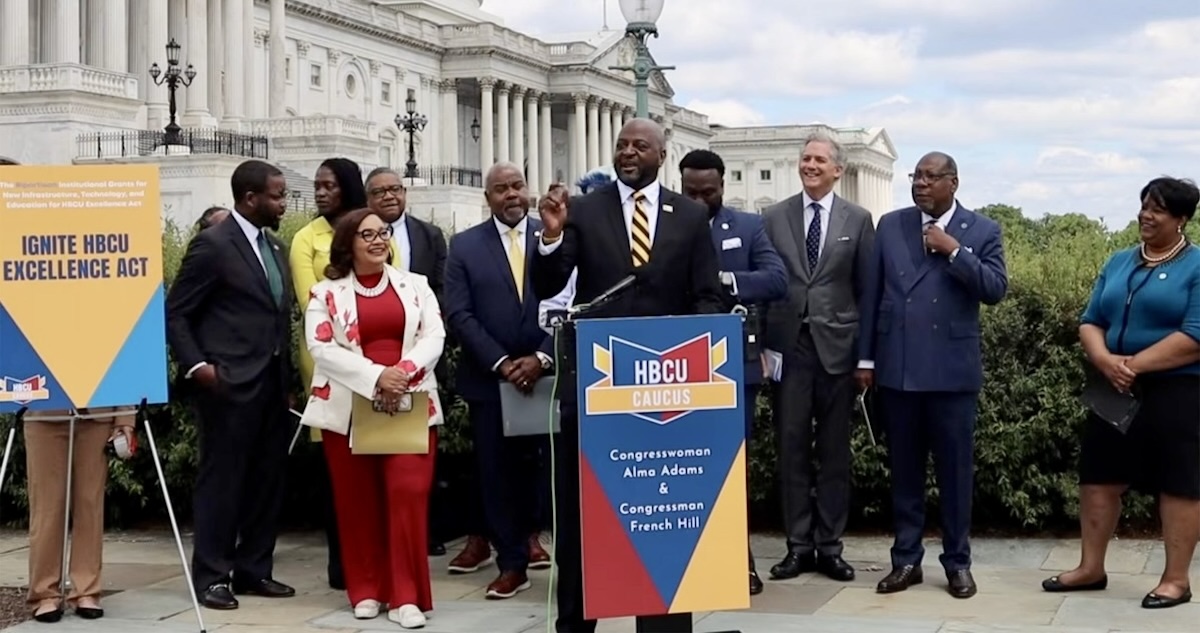
A bill in Congress would direct the U.S. Department of Education to award grants to historically Black colleges and universities (HBCUs) to cover the cost of renovations, repairs and construction of campus facilities.
The University of Arkansas at Pine Bluff, Philander Smith University and Arkansas Baptist College in Little Rock, and Shorter College in North Little Rock are among schools that would benefit if the legislation becomes law.
U.S. Rep. French Hill, R-Little Rock, is the primary sponsor of H.R. 8791, known as the Institutional Grants for New Infrastructure, Technology and Education (IGNITE) HBCU Excellence Act. The lead Democratic co-sponsor is U.S. Rep. Alma Adams, D-N.C. They are co-chairs of the Bipartisan HBCU Caucus.
Hill said the bill aims to address a gap in infrastructure funding for HBCUs and encourage philanthropy by private foundations and corporations. It would include money for classrooms, research labs, student housing and broadband infrastructure, while expanding research capacity, developing workforce skills, building entrepreneurial capacity and advancing AI education.
“I see firsthand in my work in the private sector, having been a community banker, the power, the educating power of the HBCUs in central Arkansas in building workforce, contributing to greater research, particularly in agriculture, filling badly needed professional jobs in the sciences,” Hill said at a press conference outside the U.S. Capitol on Thursday (May 14). Joining him were other members of Congress, along with the leaders of HBCUs from around the country, including three from Arkansas.
UAPB Chancellor Anthony Graham said the bill represents opportunities to strengthen research infrastructure, expand innovation and STEM education, while preparing students for high demand workforce positions.
“We know that historically Black colleges and universities produce a disproportionate number of Black graduates in science, technology, engineering, mathematics and the health sciences despite generations of underfunding,” Graham said. “We see every day the extraordinary talent, promise, and potential of our students. This legislation is ultimately an investment in them and in America’s future workforce, innovation capacity, and global competitiveness.”
Philander Smith President Maurice Gipson spoke of the importance of HBCUs evolving to meet the needs of students and their communities. He noted his school’s new Bachelor of Science in Nursing Program which trains healthcare professionals.
“We are always actively expanding programs designed to meet the workforce shortages and create pathways to economic mobility,” Gipson said. “But sustaining these high quality academic programs requires more than just vision alone. It requires modern facilities, updated technology, and learning environments that allow our students to compete and excel in a rapidly changing world. The IGNITE Excellence Act recognizes that reality, investments in campus infrastructure and technology to strengthen our ability to recruit talented students and faculty and expand workforce opportunities.”
Shorter College President Jeffery Norfleet said modernizing the school’s aging facilities would allow students “to engage with augmented and virtual reality and training for programs such as cybersecurity or nursing to logistics which requires new modified learning classrooms. There could not be a better time or opportunity for … this since we’ve launched our campus master plan which will drive the economic development piece in North Little Rock.”
A 2018 Government Accountability Office report said action was needed to improve participation capital financing. HBCUs that responded to a GAO survey reported that 46 percent of their building space, on average, needed repair or replacement.
“Based on a review of master plans — which assess the condition of HBCU facilities — and visits to nine HBCUs, GAO identified significant capital project needs in the areas of deferred maintenance, facilities modernization, and preservation of historic buildings,” the report said. “The Department of Education’s HBCU Capital Financing Program has provided access to needed funding for some HBCUs and has helped modernize their facilities to improve student recruitment. However, fewer than half of HBCUs have used the program, according to Education data, which was specifically designed to help them address capital project needs.”