
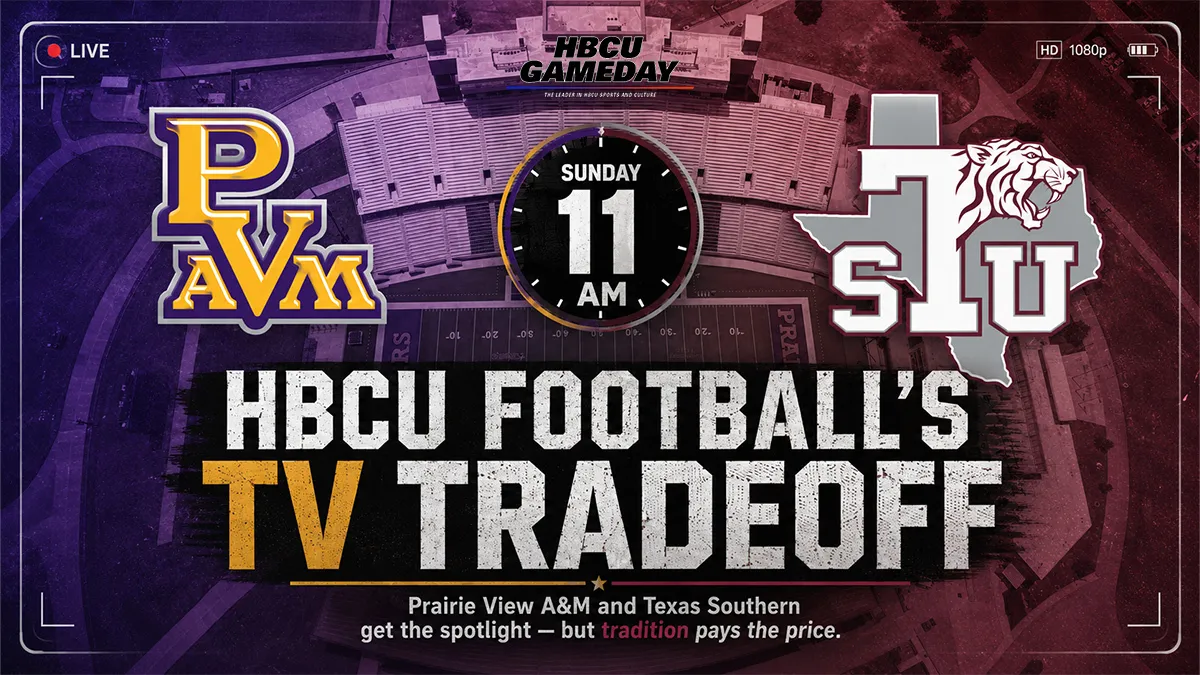
Prairie View A&M AD Anton Goff took ESPN up on the opportunity for his HBCU rivalry matchup as the only football game on TV in its slot.
The Labor Day Classic between Prairie View A&M and Texas Southern has long been one of the SWAC’s signature rivalry games. It usually comes with a familiar rhythm. Fans make plans around Saturday night. Alumni circle the weekend. Tailgates, travel and tradition all build toward kickoff.
This year, that rhythm will change.
According to The Defender, the Labor Day Classic has been moved to Sunday, Sept. 6, at 11 a.m. to accommodate ESPN2. The move has not been received well by many Texas Southern fans, who see the shift as a break from one of the rivalry’s defining traditions.
Prairie View A&M athletic director Anton Goff sees it differently.
“The game has been played at different times, it’s been played on different dates,” Goff told The Defender.
That is technically true. It also does not erase the emotional connection fans have to a rivalry’s usual place on the calendar. HBCU football is not just inventory for a broadcast window. It is also community, habit and identity.
Still, the business case is clear.
Prairie View A&M sees opportunity in the move
Prairie View A&M is coming off a SWAC championship season and a Celebration Bowl appearance under head coach Tremaine Jackson. The Panthers now have a chance to step into a national window with little direct college football competition.
“Not many times do you get to be the only football game on in the country,” Goff told The Defender.
That is the kind of exposure athletic directors chase. It puts the program on screens far beyond Houston and Prairie View. It gives recruits a national look and sponsors more value. It also gives the SWAC another chance to present one of its biggest brands on a major ESPN platform.
But it comes with the obvious tradeoff.
The Labor Day Classic will no longer feel exactly like the Labor Day Classic fans have built their memories around. An 11 a.m. Sunday kickoff is not the same as a Saturday night rivalry game. That is especially true in HBCU culture, where the game day experience is often as important as the game itself. The SWAC is not alone in facing this tension.
Last season, the MEAC had key conference matchups shifted into national television windows in November. Morgan State and Delaware State were originally scheduled for Saturday, Nov. 8 before being moved to Friday, Nov. 7 for a national ESPN platform broadcast. One week later, North Carolina Central and South Carolina State met on Friday, Nov. 14 on ESPN2 in a game with major MEAC title implications.
Those moves gave the MEAC national visibility at a critical point in the season. They also asked fans to adjust to nontraditional kickoff dates and times.
The bigger story is not one kickoff time. It is the new reality.
HBCU conferences want national television. Schools want the recruiting boost, brand lift and revenue possibilities that come with ESPN exposure. Fans want their programs treated like major college football.
The catch is that major college football often moves for television.
Goff’s position is direct.
“I’m trying to be innovative,” he told The Defender.
That may be the right approach. It may also be uncomfortable for fans who believe some traditions should not bend so easily.
The Labor Day Classic shift shows where HBCU football is now. The product is valuable enough for ESPN to want it. That is progress. But progress has a price.
For Prairie View A&M, the price is a Sunday morning kickoff. For Texas Southern fans, it is a disruption to tradition. For HBCU football, it is another sign that the television era is no longer coming.
It is already here.