
Staring down the company suggestion box at LA Gear, 19-year-old D’Wayne Edwards sketched a sneaker on a 3-by-5 notecard, signed his name and dropped it in the box. The next day, a different idea, and a different illustration, went in.
Never mind that the Inglewood, Calif., native had no formal design education or training, or that his high school guidance counselor had dismissed his design dreams, telling him he’d be better off focusing on the military. Who cared that his job, as a file clerk in the accounting department of the trendy lifestyle brand, had nothing to do with design? Edwards, who had been sketching sneakers since he was 12, had ideas — lots of them.
So for six months, he dropped a different design in the suggestion box, waiting to be noticed.
Nearly 40 years later, Edwards’ fingerprints are all over the sneaker industry and, correspondingly, the NBA Finals.
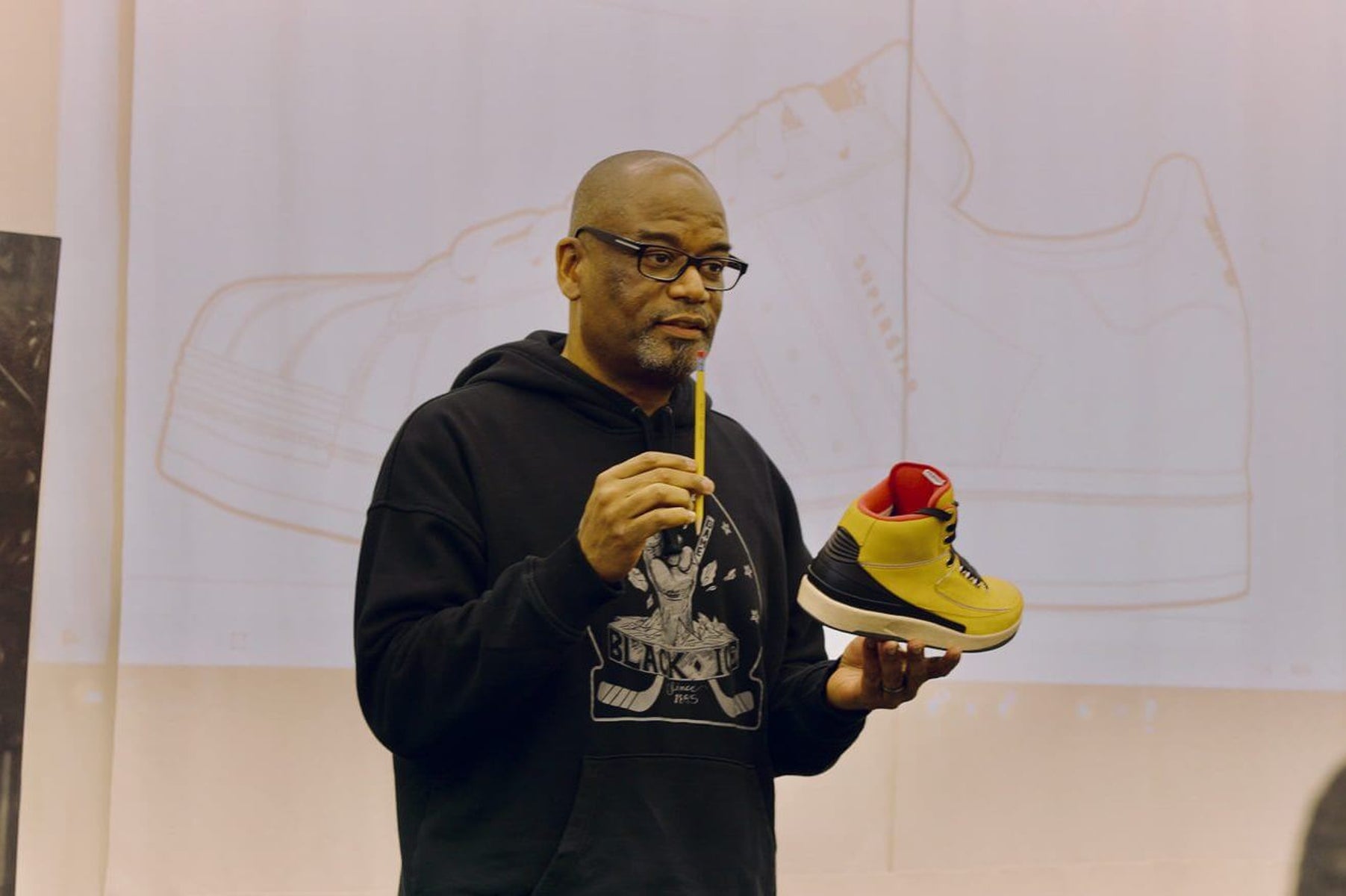
Widely considered the most influential Black designer in the history of footwear, the former Jordan Brand executive who didn’t go to college has dedicated the second half of his career to creating a path for aspiring Black designers that didn’t exist for him. Edwards never set out to work in education, but a young future hoops Hall of Famer sparked his idea to teach, and Edwards first launched Pensole design academy in 2010 in Portland, Ore. Now 56, Edwards is president of Pensole Lewis College in Detroit, where he took over a formerly shuttered historically Black college and built a pipeline to footwear companies across the world.
Consider the work from Edwards’ mentees and former students on display. While trying to lead the New York Knicks to their first title since 1973, Jalen Brunson is wearing Nike Kobe Bryant sneakers; Erin Reyes and Jaime Rojas, two Pensole graduates who studied under Edwards, are among the lead designers of the Kobe division.
“People talk about Bill Parcells’ coaching tree or Gregg Popovich’s coaching tree,” Allen Largin, one of Edwards’ first students, said, “but D’Wayne’s ripple effect is second to none. His impact dwarfs everyone else’s.”
With a market valued at more than $90 billion annually, the sneaker industry has long moved beyond gear worn only by athletes on the court to everyday streetwear that can make — or break — your outfit. NBA games double as a footwear fashion shows. Who is wearing what becomes one of the biggest talking points each night for sneakerheads worldwide.
It’s all part of the reason Cleveland Cavaliers owner Dan Gilbert’s foundation chipped in $10 million to help Edwards launch his vision of teaching sneaker design at an HBCU.
“The culture around sneakers represents creativity, storytelling and self-expression,” Gilbert, who lives in Detroit, wrote in an email to The Athletic.
“As an NBA owner, I see how sneakers are not just apparel. They are an extension of the game and of identity.”
Edwards has lived a screenplay-worthy life since he turned the LA Gear suggestion box into his launching pad, even as he’s remained behind the scenes.
“I don’t dream small,” he said. “And when you dream big, you get kind of addicted to it.”
Edwards worked his way up from LA Gear, where the CEO rewarded his ambition with an entry-level gig as an assistant footwear designer in 1989. He worked at Sketchers, MVP Footwear and eventually Nike, moving in 2001 to Jordan Brand, where he created products related to one of the most iconic logos and athletes in sports. He worked on signature products with celebrities including Jordan, Derek Jeter, Dr. Dre and Snoop Dogg.
Many view design as subjective, but Edwards became known in the industry for rooting his work in facts. He was a storyteller above all else, using tidbits from athletes’ lives and backgrounds to create products layered with unique details.
Michael Jordan, for example, was one of the first Americans to own the Bentley Continental GT Coupe, which Edwards used as inspiration when designing the Air Jordan 21 in 2005. That sneaker was meant to showcase Jordan’s hobbies — which is why it featured premium leather and high-quality suede, just like his luxury car.
Though they share a campus, Nike and Jordan are different, a distinction that mattered deeply to the notoriously competitive namesake. Nike has its Swoosh and Jordan Brand its Jumpman logo. Jordan Brand also signs its own athletes to endorsement deals. Edwards joked that because Nike was Jordan Brand’s biggest competitor, the namesake “did not like Nike, so we didn’t, either.”
The first basketball athlete to sign with Jordan Brand was future Hall of Famer Carmelo Anthony. A 19-year-old superstar drafted No. 3 by the Denver Nuggets in 2003, Anthony signed with Jordan as a rookie. When Edwards, then Jordan’s design director, flew to Denver to meet with Anthony, the player peppered Edwards with questions, insisting that he understand every granular detail. Edwards considers his work with Anthony “the birth of my teaching career.”
“Melo was engaged from Day One, he was a student of the process, a student of creativity, of business,” Edwards said, adding that in his previous experience, it was unusual for an athlete to be interested to that level. “He didn’t just want me to say, ‘Here’s a shoe, go wear it.’ He wanted to know the why.”
Anthony’s participation got Edwards thinking about the future.
An uneasy truth had always nagged at Edwards: Brands make products representing Black athletes and market them to young Black customers, he said, typically without empowering or educating aspiring Black designers.
When it became clear to Edwards no one had a plan to increase industry diversity, he decided he needed to do it himself.
Edwards had been tinkering with ideas for how to get kids, specifically teenagers who posted on sneaker forums, more engaged and educated about the design process. He wanted kids like him, who didn’t have financial resources to go to college, to know a pathway existed for them, too. In 2008, with Nike’s blessing and financial backing, Edwards created Future Sole, a competition where young creatives submitted their best sneaker sketch with the possibility it would get made, and maybe even worn by an NBA player.
To get the event rolling, Edwards got Anthony involved as a familiar face to put on the Future Sole advertisement, “a carrot to click on the link,” Edwards said.
Edwards and Nike received 800 submissions. In the second year, they got around 10,000. By the fourth year, more than 800,000 kids were submitting sketches. It reinforced to Edwards there was a market for sneaker design-based mentorship and education.
“That was really the start of me thinking, ‘Hmm, this could be cool to do full time,’” Edwards said.
“We’re just now reaping the benefits of the work D’Wayne started putting in 20-something years ago,” Anthony said. “The independent sneaker industry, where it’s going and the impact of it — he was at the forefront of that. When it comes to bringing designers and young Black talent together, we hadn’t seen that before. He created that lane and kicked down that door.”

The Future Sole competition confirmed D’Wayne Edwards’ interest in creating more ways to teach design.Courtesy of Nike
The winner of the third Future Sole competition was Largin, then a 15-year-old sneakerhead from the Detroit suburbs. He traveled in November 2010 to Denver to pitch Anthony directly on his design. In the players-only tunnel after a Nuggets game, Edwards casually introduced Largin to Los Angeles Lakers coach Phil Jackson.
“You get access to this type of stuff?” Largin asked in disbelief. “For designing sneakers?”
Four months later, Anthony debuted Largin’s design, the MELO M7.
Largin, now 31, considered Future Sole “my Willy Wonka golden ticket” into the design world. He is the partner and co-founder of Supper, a Detroit-based creative agency, and sits on PLC’s board. He has his dream job, a career he directly credits to Edwards’ influence.
“A lot of people view creativity as a hobby or a side hustle,” Largin said. “He’s shown so many people you can have a career, make a salary, have benefits. You can really surprise and delight people, take them on a journey through your designs. And it goes beyond sneakers, beyond sport. It’s footwear design, but it’s also car design and graphic design.”
At arguably the height of his career, Edwards took a sabbatical from Nike in 2010 to open Pensole, North America’s only footwear-specific design academy. (The name is a double entendre; a pencil is a designer’s most important tool to sketch sneakers, which have a sole.) He set up shop in Portland, which has in its orbit Nike world headquarters, Adidas North America headquarters and design houses from Hoka, Under Armour and Lululemon, among other major brands. A year later, he retired from Nike to focus on Pensole full time.
The school was an instant hit, helping students earn internships and first jobs. In 2014, Edwards hosted the first World Sneaker Championships, inviting aspiring designers from all over the globe. His teaching ethos is simple: He wants students to know that everything they’re interested in is a job. You like — or hate — how sneakers are displayed in a store? That’s merchandising. You drool over smooth suede on your favorite pair of kicks? That’s color, art and materials.
“A lot of people would have stopped at the Jordan design director job,” Nick DePaula, a sneaker industry insider, said. “But for 15 years, the guiding piece in everything he’s done has been, ‘How can my next step help even more people?’”
For years, Largin had been trying to talk Edwards into moving to Detroit. Then, in the summer of 2020, the murder of George Floyd sparked discussions about systemic anti-Black racism and topics such as access to higher education. Largin and Edwards were catching up on the phone when Edwards mentioned he wanted to work with HBCUs to develop a pipeline of designers.
“Man, I wish Detroit still had its HBCU,” Largin said offhand. Edwards asked what he was talking about. Largin sent him the Wikipedia page.
Originally known as the Lewis College of Business, PLC was founded in Indianapolis in 1928 to help Black women learn secretarial skills. A Detroit branch opened 10 years later and quickly grew bigger than the original Indianapolis campus. It became an HBCU in 1987 but lost its accreditation 20 years later amid a dramatic decline in enrollment. It closed in 2015 and sat unoccupied for years.
Twenty-four hours after telling Edwards about Lewis College, Largin stood in a parking lot waiting to get a copy of NBA2K and heard his phone ping.
“I think I’m gonna buy that college,” Edwards texted him.
“It’s like, dude, what?” Largin recalled. “He didn’t even go to college! And now he’s gonna buy an academy?”
Edwards was able to reopen the school in part because of the $10 million investment from the Gilbert Family Foundation via Cavaliers owner Gilbert. (Largin works closely with the Gilbert family on creative endeavors and introduced Gilbert and Edwards years ago.)
Gilbert, who likes to refer to himself as “the original sneakerhead,” called partnering with Edwards “an easy decision” and “major win for our city.”
“D’Wayne’s impact on basketball is felt in every corner of the game,” said Gilbert, who co-founded StockX, an online sneaker resale site where customers can track down some of the most in-demand kicks. “He has created opportunity for aspiring designers and young people who may never have seen a path into the industry.”
PLC by its own admission is “not a traditional education institution.” Many students take four-week master classes, which are industry certified, but in August 2025, the school launched its first degree program with 13 students.
One of those students is Justin Woods, a Detroit native who grew up “buying, selling and trading sneakers — I was the kid going to conventions, with piles of shoes in my closet.”
Woods, 28, attended Michigan State after high school and earned his bachelor’s degree in media and information. But when he learned about PLC, he couldn’t wait to sign up. Recently, he also started a job at PLC, helping design curriculum for first-year students.
“I always had a passion for sneakers,” Woods said, “but I had no idea you could actually make sneakers. Like, that’s a job? That’s insane! I tell my cohort all the time, we’re part of history. But more people need to know about us — what the University of Michigan is to Ann Arbor, I want PLC to be that to Detroit.”

PLC’s Justin Woods conceptualized a signature sneaker for Detroit Pistons point guard Cade Cunningham.Courtesy of Justin Woods
Brands partner directly with the school on projects, and PLC students have done work for Nike, MillerKnoll, Logitech, PepsiCo and Target, among others. The past four years, they’ve also worked with the NBA to design a portion of the HBCU Classic basketball court during NBA All-Star Weekend. Recently, PLC hosted the Pistons and their G League team, the Motor City Cruise, for a two-hour “business of basketball” session in which students took players through elements of the design process.
Tuition and housing are covered by PLC’s brand partners. Online classes are available, too. In 2025, PLC had 200 students. Edwards’ hope is that they can max out at 500 to 550 in-person students, with as many as five times that enrolled online. (They’ve recently launched a partnership with three other HBCUs to give students on those campuses access to design classes.) There are 11 faculty members, a mix of full time and adjunct, and in-person students convene in one large building, divided into three sections, that spans more than 400,000 square feet.
PLC Detroit has also become the host of the Black Footwear Forum, an annual event created by Edwards and Matt Priest, the president and CEO of the Footwear Distributors and Retailers of America. The forum brings together the best minds in the industry with hopes to increase opportunities for Black professionals to “influence, lead and impact the global footwear industry and consumer culture.” The organization hosts its annual “homecoming” event each fall at PLC.
Edwards said sneakers will always be at the heart of PLC. But as usual, he’s thinking bigger. He imagines that someday, PLC will walk the runways at the world’s biggest fashion weeks. In a full-circle moment, Edwards relaunched the Future Sole competition in 2024 at PLC, opening it to HBCU students who don’t have access to a design program.
Dating to 2011, Pensole has placed more than 800 graduates in the professional footwear industry, from Nike to Prada to Timberland and everywhere in between.
Edwards is eyeing retirement but still has a robust to-do list, including seeing PLC through the accreditation process, which should be completed around 2030. It would, he said, be his proudest accomplishment.
And although Edwards’ influence throughout the basketball community and sneaker culture is clear, Largin said what Edwards has done is only skimming the surface, and that his work remains crucial to the next generations of designers.
“I don’t feel like we can afford for him to retire — like ever,” Largin said. “I mean, when is this guy’s life gonna be made into a movie?”