
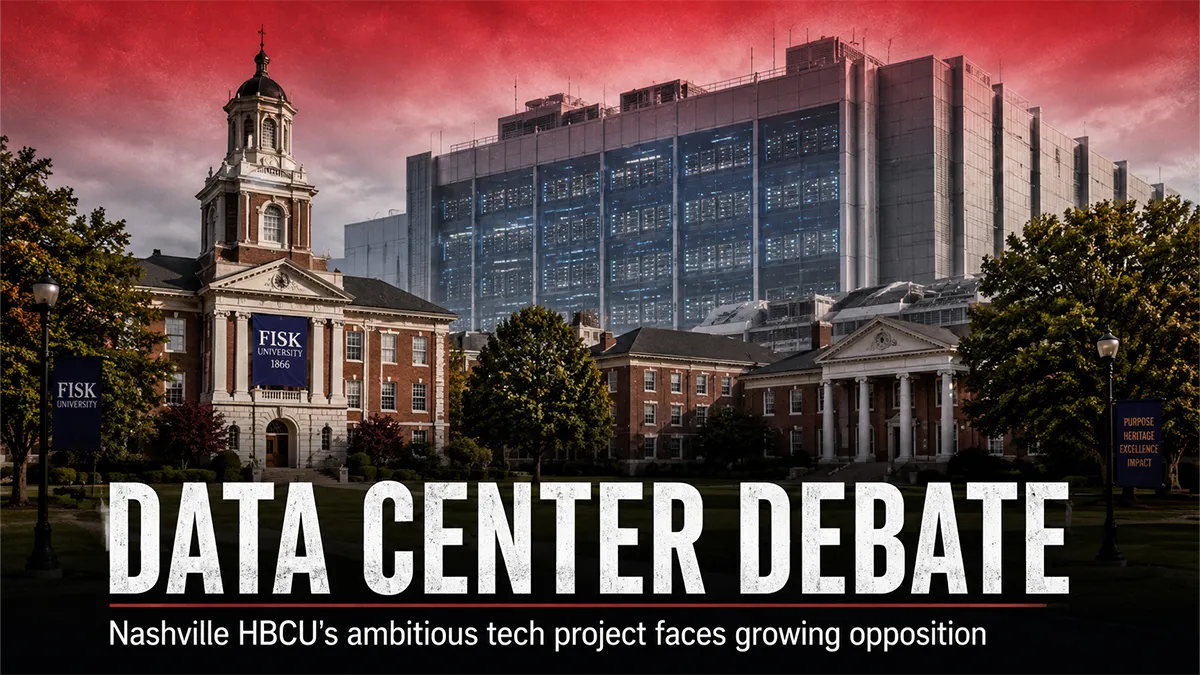
NASHVILLE, Tenn. (WSMV) – The Nashville area is already home to more than two dozen data centers and more have been proposed — including one at Fisk University.
The HBCU announced plans in May for the data center as part of its $1 billion “Quantum Leap” initiative. The plan, described by the university as “the most robust campus master plan in its 150-year history,” includes an innovation and technology center.
While the university does not describe it as a data center, the functions described are the same.
“The Quantum Leap Innovation & Technology Center is a 100,000 square foot facility on the southern end of Fisk’s campus — comprising a 70,000 square foot innovation center and a 30,000 square foot Innovation and Academic Center,” the university says.
The Innovation and Technology Center, the university said, “is the physical infrastructure that houses the servers, storage, and networks behind websites, financial systems, enterprise software, and — increasingly — artificial intelligence.”
“Most Innovation & Technology centers are owned by large technology companies,” the university says. “The Quantum Leap Innovation & Technology Center puts the infrastructure in the hands of an HBCU.”
While these plans are being described by Fisk as “a replicable framework for responsible, community-centered digital infrastructure development across the nation,” it has sparked a large outcry from the local community.
Where will the Fisk University data center be located?
Fisk University says that the Innovation Center will be located on “five undeveloped acres” on the university’s campus. Based on renderings posted online by Fisk, the center would be located along Herman Street in between DB Todd Junior Blvd. and 17th Ave. N.
Data center pushback
Since the announcement of the Fisk data center, at least two petitions have started to circulate against the plans.
One of the petitions, launched on Change.org, has garnered more than 4,200 signatures, with the petitioner arguing the center goes against the history of the university.
“In the 1960s during the construction of Interstate 40, leaders like Dr. Flournoy A. Cole, a Fisk Professor & renowned Black economist, fought against the city and state regarding the construction of Interstate 40 and while ultimately losing, pushed the fight all the way to the Supreme Court,” the petitioner wrote. “Now, in the 2020s… it’s time for us to fight our fight.”
Another petition, which has garnered more than 360 signatures, was launched by Kaylynn Mourning, who lives near the university with her two small children. For Mourning, the problem isn’t technology as a whole — it’s the rapid expansion of data center construction across the U.S. and the unknowns that come with it.
According to Statista researchers, the U.S. ranks as No. 1 globally for the number of data centers, with more than 4,100 across the country. Ranked No. 2 globally is the United Kingdom — with just 515 centers.
“I don’t understand why we need so many,” Mourning told WSMV. “… Why do we have so many, so fast? … Why does every single university or business need their own data center?”
Environmental impacts of Fisk University’s data center
A major concern for Mourning and others is how this data center would impact the surrounding environment, as research has shown these facilities use a significant amount of water and energy and are also known to be a source of pollution, including noise pollution.
“We don’t know the full effects on our environment or our health,” Mourning said. “…How do we know how it affects me … how does it affect my kids?”
Don Hardin, whose construction management firm is a partner on the project, previously said that Nashville Electric Service has assured developers that it can handle the data center’s 30-megawatt electricity needs without increasing local power bills. NES, however, is dealing with its own controversy after thousands of its customers were without power for weeks after January’s ice storm.
“We’re going to do everything we can to make sure we answer questions, make the campus feel comfortable, students feel comfortable, and the community feels really good about what we’re doing in terms of noise mitigation, water consumption and energy usage,” Hardin said. “…we want to make sure we do it right.”
According to South Carolina-based cooling solution company Airsys, “data centers already rank among the ten most water-intensive industrial and commercial sectors in the United States.”
Medium-sized data centers, which the company considers to be between 10 and 20 megawatts — less than what is proposed for Fisk — “can consume up to 110 million gallons of water per year for cooling alone,” the company says.
The company notes that there are approaches that can reduce the amount of water needed, but that many of them require higher electricity demand and other challenges.
On a page of frequently asked questions, Fisk says that its data center will not strain the community’s power or water supply.
“The Quantum Leap Innovation and Technology Center will be LEED certified and built to operate responsibly within the community’s infrastructure — not to burden it,” the university said, adding that LEED certification means that a facility has met “rigorous standards for energy efficiency, water conservation, and environmental responsibility.”
The U.S. Green Building Council, which helps issue LEED certifications, says there are three different LEED rating systems that can be used for data center certification: LEED BD+ C Data Centers, LEED BD+C Core and Shell, and LEED O+M. The USGBC says that certification for these facilities is meant to address the unique “set of challenges and opportunities” known to exist amongst data centers, including their energy use, heating and cooling needs and water use.
Fisk has not publicly provided more details about its plans for LEED certification.
Regarding concerns of noise coming from the data center or its construction, Fisk said: “The facility will be designed to be neither loud nor intrusive.”
“It will sit on the undeveloped southern end of campus, and its architecture will complement Fisk’s historic campus aesthetic and the surrounding neighborhood,” the university says. “Community impact has been a core design consideration from the beginning.”
Several homes would sit directly across the facility on Herman Street, as well as several nearby housing units.
‘It just doesn’t benefit the community.’
Mourning says that while Fisk officials say the facility could be an asset to students and the campus at-large, she doesn’t see how the center will be beneficial for the neighborhood.
“This community of 37208 is already lower income, vulnerable. … Why are we so OK with putting data centers in places that aren’t well-off,” she said. “Same with the one at the [Nashville] Zoo.”
Census data shows that more than half of the residents in the zip code are Black and that about 40% of the residents earn less than $50,000 a year. Meanwhile, Apartments.com reports that single adults with no dependents should earn about $76,000 a year before taxes to live comfortably in Nashville. About 22% of 37208 residents live below the poverty line — a rate higher than that of the surrounding area and the state as a whole.
“We just don’t know the long-term effects and that’s what scares me the most with having kids,” Mourning told WSMV. “…Our city’s future depends on responsible development that prioritizes environmental sustainability, public health and community well-being over short-term industrial expansion.”
“If we don’t have clean air, water, and all that stuff, then our quality of life will go down. And we need to not just be OK with that,” she said. “…Progress is only progress if we’re here to see it.”
What happens next
Fisk University must go through several standard municipal and regulatory review processes before the project can be advanced. It is still awaiting approval by the Metro Planning Commission.
“Fisk University is actively engaged with relevant governing bodies to ensure a smooth and compliant path forward,” the university says. “Updates will be shared as milestones are reached.”