Although New York is home to more than 200 colleges and universities, it does not have a single historically Black college or university.
A Queens public high school is working to address that gap through an exclusive partnership with Delaware State University, giving students a pathway to college credit, an associate degree and a high school diploma.
“This innovative partnership with New York City Public Schools will not only prepare high school students for college education, but give them a head start toward a bachelor’s degree while they’re still in high school,” said Tony Allen, president of Delaware State University, in a statement. “We know this approach can work because we’ve seen it work.”
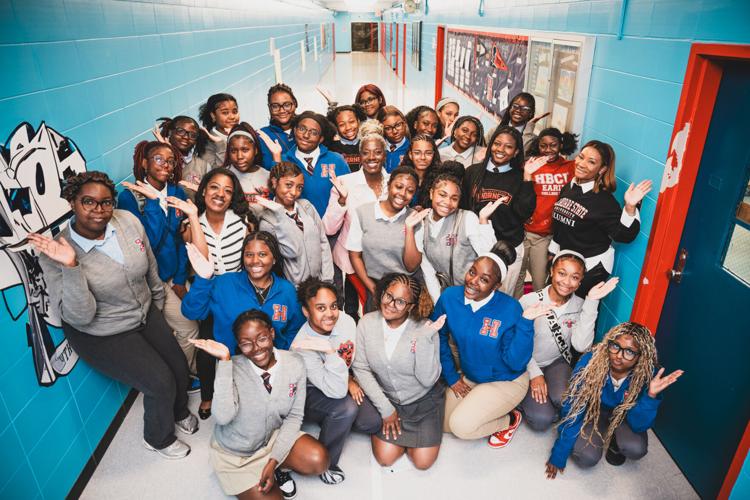
Rooted in the legacy and culture of historically Black colleges and universities, HBCU Early College Prep High School enrolls students in university courses and allows them to earn an associate degree in liberal studies at no cost while still in high school.
Students begin earning college credits in the ninth grade and can complete up to 64 credits by their senior year. The school operates under the African proverb Ubuntu, meaning “I am because we are.”
“We’re a school that seeks to define that brilliance is not rare, but just unrecognized,” said Asya Johnson, founding principal of HBCU Early College Prep High School and a Delaware State University alumna.
“We believe in collective values and that excellence is part of their inheritance,” she said. “We want students to build confidence and leadership, give back to their communities, and know they belong in spaces of excellence, even when they are in rooms where they may be the only ones who look like them.”
Johnson, a North Philadelphia native, said upper-level coursework begins in the second semester of junior year.
The school offers course pathways in business, psychology, computer science with cybersecurity coursework and a liberal studies leadership track — four pathways in total.
Students use the DEEDS (Discover, Examine, Engineer, Do and Share) model to guide project-based learning and civic engagement, including projects focused on housing, protests and voter suppression.
“Most recently, they completed a project with the New York City Public Housing Authority tenant association after reports of unaddressed issues in housing developments, including poor ventilation and air quality,” Johnson said.
Teachers at the school are trained as adjunct professors through Delaware State University and work with supervising faculty to ensure course alignment with accreditation standards.
“Our teachers are trained as adjunct professors from Delaware State University so they have a supervisor professor at the university who meets with them, reviews the syllabus and course materials to ensure it is aligned with the Middle States accreditation for non-college classes that are project based,” Johnson said.
Nearly 1,000 students applied for roughly 100 seats in the inaugural class. The school will expand one grade each year until it serves grades nine through 12. Once admitted, students receive academic and career support from both the school and Delaware State University.
Kareem McLemore, vice president for strategic enrollment management and international affairs at Delaware State University, said the associate degree also provides direct admission access to the university, giving students first right of refusal.
Founded in 1891, Delaware State University is a public historically Black university in Dover, Delaware.
“Through dual enrollment, students gain exposure to academic programming, career readiness and the Career Services Department, including internships, co-ops, job opportunities, graduate school recruitment and pathways from a bachelor’s to a master’s degree,” McLemore said.
“This is a very unique model. I can see this scaling significantly, especially as parents look to reduce the financial burden of higher education and take advantage of dual-enrollment courses,” he added.
The partnership also includes campus experiences. Ninth graders visited Delaware State University during homecoming weekend, touring the campus and participating in a pinning ceremony with the university president.
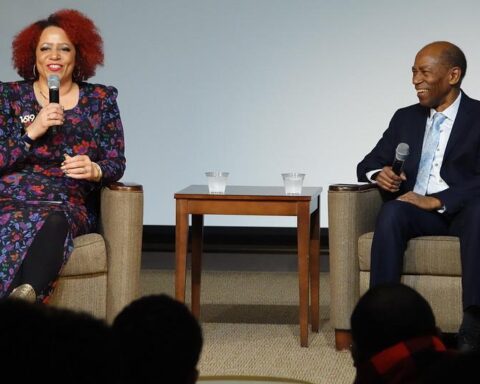
Last month, the school hosted Delaware State President Tony Allen and university officials for a “Chat and Chew” discussion. Students will continue attending campus events and career fairs throughout high school.
While historically Black colleges and universities make up about 3% of U.S. colleges and universities, they produce about 40% of Black engineers, 50% of Black teachers and lawyers, 70% of Black doctors and dentists and 80% of Black judges.
Johnson said the work is deeply personal, rooted in her experience as a first-generation college student and her time at Delaware State University.
“Being a Delaware State University graduate, for me it’s a full circle moment,” she said. “I’ve always thought about ways to give back beyond donations, by helping students experience what I experienced and understand that even when people tell them they don’t belong, they can still pursue academic excellence at an HBCU.”
“As a first-generation college student, I want to give students what I didn’t have and expose them to that experience,” she added.
McLemore said he hopes students leave the partnership believing their futures are within reach.
“Their voices matter and higher education can serve as a powerful vehicle for personal growth, economic mobility and community impact,” he said. “This collaboration is about helping students see not just where they can go, but who they can become.”