
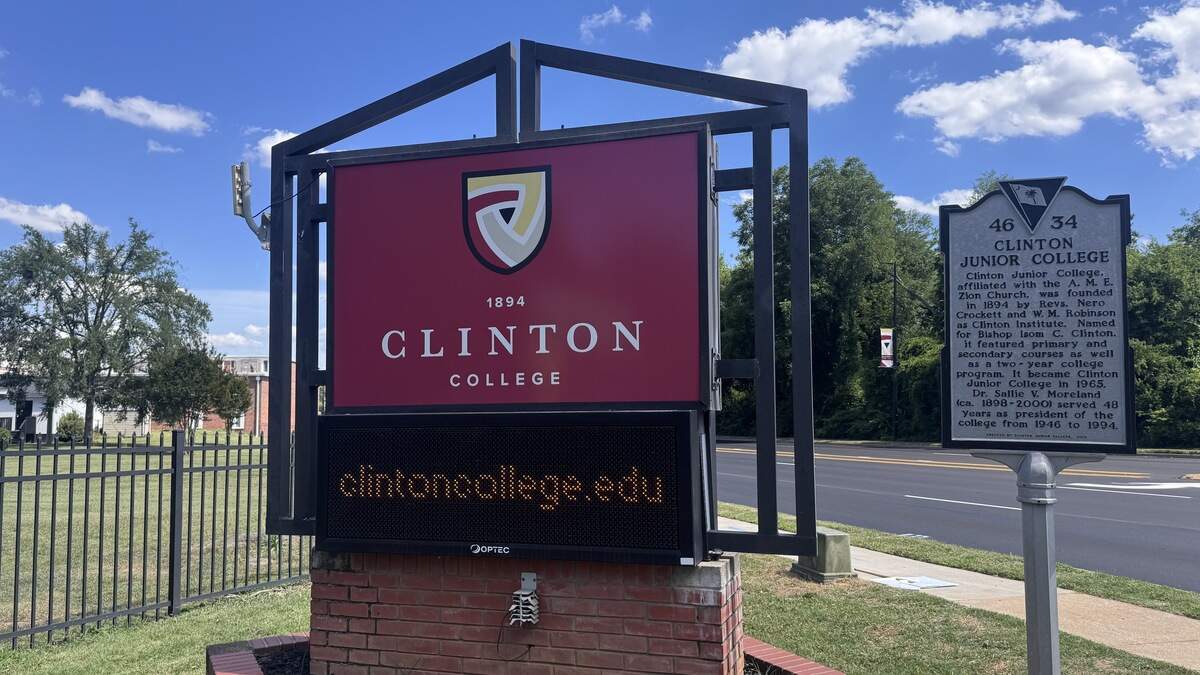
Clinton College is facing an existential crisis.
The small historically Black college in South Carolina has struggled to pay its employees for months and currently owes some workers thousands of dollars in overdue wages. Frustrated employees are looking for the exits while college leaders have yet to articulate a vision for stability. Employees are still required to come into the office even as they go unpaid.
But even as the college is withholding pay, it’s hiring for several positions.
Current and former employees there see the situation as untenable and believe that the administration has spent lavishly on social events such as the president’s inauguration while failing to meet financial obligations and misleading the community about its financial outlook.
“There needs to be accountability, and the college is not being transparent, and they’re continuing to hire, which is a scary thing. They continue to hire as if we have money,” a college employee speaking anonymously due to fear of retaliation from leadership told Inside Higher Ed.
As the college struggles to pay employees, outside agencies have taken notice. The South Carolina Department of Labor, Licensing and Regulation is investigating in response to complaints from employees, local media reported. Clinton’s accreditor, the Transnational Association of Christian Colleges and Schools, said this month it is also looking into the college’s ongoing financial issues.
Meanwhile, college leadership has said little publicly about specific challenges.
“Clinton College continues to make progress in addressing its financial challenges. Our leadership team and Board of Trustees continue to work diligently to secure the resources necessary to support the College, fulfill our commitments and advance our mission of educating and preparing future leaders,” President Pamela Richardson Wilks wrote in a statement to Inside Higher Ed. “While the College does not comment on personnel or internal operational matters, our focus remains on strengthening the institution and continuing to serve our students and fulfill our mission.”
The college did not respond to requests for more detailed information on its finances, and the board chair did not respond to requests for comment.
But one major financial issue that the college has not publicly discussed is a debt to the state. A state review last fall found that the college could not adequately document or reconcile nearly $940,000 charged to the Higher Education Excellence Enhancement Program. The state lottery–funded program supports eligible South Carolina colleges serving large numbers of low-income students. Reviewers directed the college to return the money to the South Carolina Commission on Higher Education. College officials concurred with the findings—which appears to have not been previously reported—and agreed to pay the funds back.
Official Explanations
Emails obtained by Inside Higher Ed show that Clinton College has struggled to meet payroll since at least late March and employees lost health insurance coverage at the beginning of June. But internal explanations are vague; multiple emails reference opaque financial challenges.
“The College is currently experiencing a temporary cash-flow shortage resulting from funding shortfalls and delayed reimbursements,” Wilks wrote in a June 4 email notifying employees of another payroll delay. “While the administration continues to pursue multiple funding opportunities, we recognize the immediate impact these circumstances have on our employees.”
The weekly updates from the president often contain little new information about the specific nature of the funding challenge and how leadership is working to stabilize the college. But many of those emails acknowledge the hardship employees are navigating.
“Behind every paycheck is a household, financial responsibilities, and commitments that cannot simply be postponed. I want you to know that I fully understand the weight of this situation, and resolving these remaining payroll obligations continues to be my highest operational priority,” Wilks wrote in an update to employees sent Friday.
Although Wilks strikes an empathic tone in her emails, an anonymous official told Inside Higher Ed that the college is doing little to relieve the hardship imposed on employees by a lack of pay. They point to in-office work requirements at a time when gas prices are high as one example.
Others have directly blasted the president for the college’s failure to pay employees.
“Please do not expect us to work another day until we are paid according to our contracts. How much longer are we expected to stay silent and not express our outrage at not being paid on time and being notified the day before payday?” one employee wrote in an email to Wilks.
She also questioned the future of the college.
“If Clinton College cannot operate as a legitimate academic institution, I encourage you to close the doors until we can operate as a real institution of higher learning,” she wrote in late May.
(That employee is no longer at Clinton. Her position was posted on the college’s hiring site in July, and she did not respond to an interview request from Inside Higher Ed sent via LinkedIn.)
As employees go unpaid, they are losing faith in a president who promised a bright future at her investiture ceremony in early March, part of three days of inauguration events, which included a gala that cost more than $125 a ticket to attend and featured an open bar. And as pressure mounts on Wilks, one employee told Inside Higher Ed that the president and other top administrators have been spending less time on campus and are actively looking for their critics.
“The administration has gotten to the point where they have started asking around about who was talking to the media; they have started circling our LinkedIn,” they said. “And then [late June] is when marketing and communications said we’re not allowed to speak to the media.”
Fiscal Challenges
Publicly available documents paint a bleak picture of the college’s finances.
While Wilks has borne the brunt of the complaints from unpaid employees, Clinton College’s financial position was precarious before she stepped into the presidency in June 2025.
The college saw a $2.8 million operating loss on a $10.2 million budget in the 2025 fiscal year, according to the latest available numbers. The college also posted a $1.4 million loss for fiscal year 2024. Net assets fell from $8 million at the start of FY25 to $5.2 million by the end of the fiscal year.
The college’s meager endowment has also collapsed. Federal data show endowment assets of $591,359 in fiscal year 2023 but only $22,780 the following year, a decline of $568,579 in just 12 months.
Clinton College’s latest available audit shows that the U.S. Department of Education gave it a 1.3 Financial Responsibility Score. (Composite scores are on a scale that runs from negative 1.0 to 3.0.) The Federal Student Aid website notes that “schools with scores of less than 1.5 but greater than or equal to 1.0 are considered financially responsible, but require additional oversight” including cash monitoring and other requirements to maintain eligibility to participate in federal financial aid programs.
Enrollment has also been shaky in recent years. Clinton College has historically been small; in the last decade, enrollment peaked at 200 students in 2016. The latest federal data shows a head count of 126 students in fall 2024, though a source said enrollment surpassed 180 last fall.
But as payroll and accreditation issues mount, employees worry about the effect on recruiting.
One employee said that only 17 students showed up to a new student orientation event last month and that parents and applicants are reaching out with questions. But like employees, they’re still awaiting answers from the administration, even as the fall semester is set to begin Aug. 3.