
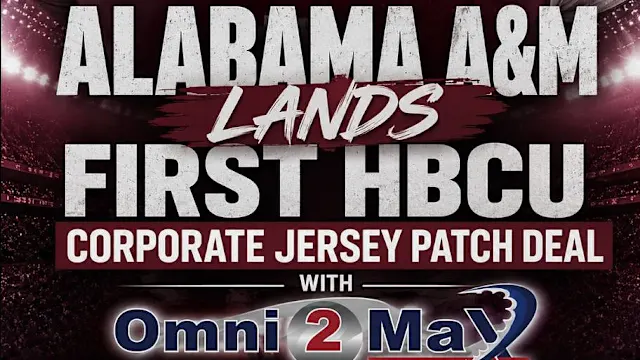
Alabama A&M became the first HBCU football program to secure a corporate jersey patch partnership Friday, announcing a new agreement with San Diego-based Omni2Max Inc. that will place the company’s logo on Bulldogs uniforms beginning with the 2026 football season.
While Power Four conferences have dominated headlines with multimillion-dollar jersey sponsorships, Alabama A&M’s agreement represents a different kind of milestone—one built around workforce development, engineering talent and long-term corporate partnerships rather than television reach alone.
“This is a historic moment for Alabama A&M University, our football program and HBCU athletics,” Alabama A&M Director of Athletics Dr. Paul A. Bryant said. “We are proud to welcome Omni2Max as our inaugural football jersey-patch partner. This agreement reflects the innovative direction of our athletics department and the tremendous value of the Alabama A&M brand. Omni2Max shares our commitment to excellence, leadership and creating opportunities, making the company an ideal partner for Bulldog Athletics.”
For Alabama A&M football, the partnership establishes the Bulldogs as the first HBCU to capitalize on one of college athletics’ newest sponsorship opportunities, the jersey patch. While creating a potential blueprint for programs across the Southwestern Athletic Conference and the broader HBCU landscape.
NCAA Opens the Door to Jersey Patch Sponsorships
The opportunity emerged after NCAA Division I leaders approved commercial uniform patches on Jan. 23, allowing programs to display up to two corporate logos measuring no more than four square inches during regular-season competition.
The legislation applied equally to Football Bowl Subdivision (FBS) and Football Championship Subdivision (FCS) programs, giving schools like Alabama A&M the same ability to monetize uniform space as college football’s biggest brands. Within months, more than 25 Division I institutions had announced jersey patch partnerships.
The first wave of agreements, however, revealed that college football’s newest sponsorship category has evolved into two distinctly different markets.
The Power Four Model vs. the HBCU Model
At the top of the marketplace, college football’s traditional powers are selling national media exposure.
Notre Dame inked a six-year partnership with SoFi reportedly valued between $18 million and $20 million annually. Ohio State followed with a JPMorganChase agreement reportedly worth nearly $17 million per year across all 36 varsity sports.
Illinois secured approximately $6 million annually from Busey Bank, while Michigan State agreed to a 10-year partnership valued at roughly $40 million. The Big 12 also entered the market collectively, selling conference-wide jersey patch rights to Monster Energy in a deal estimated to return approximately $1 million per member institution.
Those agreements demonstrate the premium attached to national television reach and massive fan bases.
Where Alabama A&M Fits
Terms of Alabama A&M’s agreement with Omni2Max were not disclosed, and the Bulldogs were never expected to compete financially with Power Four institutions.
Instead, the closest comparison comes from the FCS level, where North Dakota State recently announced a jersey patch partnership with Gate City Bank without disclosing financial terms.
At this level of college football, the exact dollar amount is often less significant than the strategic value of the partnership.
For Alabama A&M, the inventory being sold is far from insignificant.
The SWAC has led the FCS in average football attendance during 47 of the past 48 seasons while drawing more than 800,000 fans in 2025. Alabama A&M’s annual Magic City Classic matchup against Alabama State regularly attracts crowds exceeding 60,000 at Birmingham’s Legion Field, making it one of the best-attended games in the subdivision.
SWAC Commissioner Dr. Charles McClelland is providing the conference with media exposure via MMC deal, which will expand. The league recently signed a new television agreement with ESPN that runs through the 2030-31 academic year, with more than 360 events annually distributed across ESPN platforms and HBCU GO.
That means an Alabama A&M football jersey is far more than local advertising inventory; it’s national and at times international.
Selling Access, Not Impressions
The most important business element of Alabama A&M’s announcement isn’t the jersey patch itself—it’s the identity of the buyer.
Unlike consumer-facing brands such as SoFi or JPMorganChase, Omni2Max operates in a different marketplace.
The San Diego-based company is a privately held professional technical services firm specializing in cybersecurity, information technology, engineering, logistics and program management. It is certified as both a minority-owned business and a service-disabled veteran-owned small business under the U.S. Small Business Administration’s 8(a) program.
President and CEO Dr. Allen F. Maxwell, a retired U.S. Navy officer with 36 years of combined federal service, oversees a company whose client base includes federal agencies and defense-related organizations.
Companies like Omni2Max are not purchasing jersey space to build consumer brand awareness. They are investing in access—to engineering talent, workforce development and long-term relationships with one of the nation’s premier HBCUs.
That distinction changes the entire conversation for HBCU and FCS programs.
In October 2025, Omni2Max representatives visited Alabama A&M’s College of Engineering, Technology and Physical Sciences to discuss research collaboration, STEM education and workforce development initiatives.
Viewed through that lens, the jersey patch becomes the public face of a much broader strategic investment.
Located in Huntsville—home to Redstone Arsenal, NASA’s Marshall Space Flight Center and Cummings Research Park—Alabama A&M occupies one of the nation’s most important engineering and defense technology corridors. The university’s graduates represent a valuable talent pipeline for federal contractors facing increasing demand for highly skilled engineers and cybersecurity professionals.
“Omni2Max is honored to make history alongside Alabama A&M University,” Maxwell said. “This partnership extends beyond the placement of our logo on a football jersey. It represents our investment in a distinguished institution, its student-athletes and the next generation of leaders. We are excited to support Bulldog Athletics and build a relationship that creates a lasting impact on the university and its community.”
A Blueprint for HBCU Athletics
The immediate reaction across HBCU athletics may be to compare Alabama A&M’s agreement with the multimillion-dollar deals signed by college football’s biggest brands.
That comparison misses the point.
Power Four programs are selling television impressions.
Alabama A&M is selling access to a highly specialized talent pipeline.
Federal contractors, healthcare systems, utility companies, aerospace firms and engineering organizations all compete for the same highly skilled workforce. Recruiting budgets increasingly overlap with marketing investments, creating sponsorship opportunities that extend well beyond traditional advertising.
That reframes the sales strategy for athletic departments across the SWAC, MEAC, CIAA and SIAC.
An HBCU may never match the television inventory offered by a Big Ten or SEC powerhouse. But institutions with nationally recognized engineering, healthcare, agriculture or business programs possess assets that many Fortune 500 companies and federal contractors value just as highly.
By becoming the first HBCU to enter the jersey patch marketplace, Alabama A&M established an important benchmark for every HBCU athletic department exploring new commercial revenue opportunities.
What Comes Next
The next evolution may not come from individual campuses.
The Big 12 demonstrated the value of packaging conference-wide jersey patch inventory into a single sponsorship property. A similar model within the SWAC or MEAC could create substantially greater value than schools negotiating independently while leveraging existing conference media agreements with ESPN and HBCU GO.
Whether HBCU conferences pursue that strategy remains to be seen.
One thing is already clear.
Alabama A&M may never command the sponsorship dollars of Ohio State or Notre Dame, but that was never the objective for AD Bryant.
The Bulldogs became the first HBCU football program to demonstrate that jersey patch partnerships can be sold on something more valuable than television ratings alone.
They sold access to talent, innovation and long-term relationships.
If other HBCUs follow that blueprint, Friday’s announcement won’t simply be remembered as Alabama A&M’s first jersey patch deal.
It may be remembered as the moment a new commercial model for HBCU athletics truly began.