
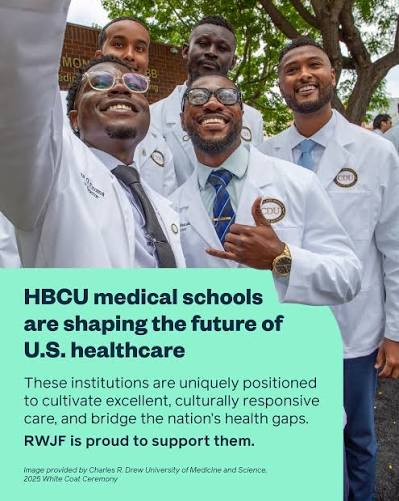
Historically Black Colleges and Universities (HBCUs) have served as critical pillars of America’s health care workforce for more than a century. Despite representing only a small fraction of U.S. colleges and universities, HBCUs have produced a disproportionate number of Black physicians, nurses, pharmacists, public health professionals, and biomedical scientists. At a time when the United States faces physician shortages, widening health disparities, and declining access to care in underserved communities, policies that weaken these institutions may have consequences that extend far beyond higher education.
Supporters of recent federal funding reductions and policy changes argue that such measures promote fiscal responsibility and reduce government spending. Critics, however, warn that these policies disproportionately affect institutions that have historically educated students from economically disadvantaged backgrounds and communities that remain underrepresented in medicine. To understand why this debate matters, it is necessary to understand why HBCUs exist in the first place.
HBCUs did not emerge by accident. They were born out of necessity. Following the Civil War, millions of formerly enslaved Americans entered freedom with little access to formal education because literacy itself had often been criminalized under slavery. In many Southern states, laws prohibited teaching enslaved people to read and write because education was recognized as a pathway to empowerment, economic mobility, and citizenship. After emancipation, Black Americans sought educational opportunities in a nation that had spent centuries denying them.
Institutions such as Howard University, founded in 1867, and Meharry Medical College, established in 1876, were created to fill a void that mainstream American institutions refused to address. They opened doors that had long been closed and provided educational opportunities to populations excluded from much of higher education. Their mission was not simply academic. It was transformational.
The importance of these institutions became even more pronounced during the era of Jim Crow. The Supreme Court’s 1896 decision in Plessy v. Ferguson established the doctrine of “separate but equal,” providing legal justification for racially segregated educational systems across much of the United States. In practice, separate was rarely equal. Black schools and colleges routinely received fewer resources, less funding, inferior facilities, and fewer opportunities than their white counterparts. Yet despite these barriers, HBCUs produced generations of teachers, scientists, physicians, lawyers, military officers, and civic leaders who helped shape modern America.
For many HBCUs, federal support through Pell Grants, research funding, workforce development programs, and student assistance initiatives is not merely supplemental. It is essential to institutional survival. Unlike universities with multibillion-dollar endowments, many HBCUs operate with limited financial reserves while serving large numbers of first-generation college students and aspiring health care professionals. Reductions in federal investment can directly affect laboratory infrastructure, faculty recruitment, research opportunities, scholarship availability, and student retention.
The implications for health care are profound. Health care itself was deeply segregated throughout much of American history. Prior to the Civil Rights Movement, many hospitals either excluded Black physicians from medical staffs or restricted their privileges. Black patients frequently received care in separate and underfunded facilities. As a result, HBCU medical schools became indispensable pipelines for training physicians who could serve communities neglected by the broader health care system. Howard University College of Medicine and Meharry Medical College trained thousands of physicians during periods when many predominantly white medical schools either excluded Black applicants outright or admitted them in extremely limited numbers.
Today, the United States continues to struggle with significant racial and geographic disparities in health outcomes. Black Americans experience disproportionately higher rates of hypertension, heart failure, maternal mortality, chronic kidney disease, and diabetes-related complications. Numerous studies have demonstrated that physician diversity improves patient trust, communication, preventive care utilization, and health outcomes, particularly among historically marginalized populations.
HBCUs play an indispensable role in addressing these challenges. Institutions such as Howard University, Meharry Medical College, and Morehouse School of Medicine have produced generations of physicians who serve communities with the greatest health care needs. Collectively, HBCU medical and health professional programs have helped diversify a workforce that remains disproportionately unrepresentative of the nation’s population.
Financial instability at HBCUs threatens this pipeline. Reduced funding can lead to fewer training opportunities, diminished research productivity, and decreased enrollment of future health care professionals. Over time, this may worsen physician shortages, particularly in primary care, rural medicine, and underserved urban communities. The consequences would be measured not only in educational statistics but also in patient outcomes, access to care, and public health indicators.
History demonstrates that educational exclusion rarely remains confined to the classroom. It influences employment, income, housing, health care access, and ultimately health outcomes. The consequences of educational inequity extend across generations. By the middle of the twentieth century, disparities in life expectancy, infant mortality, infectious disease burden, and access to medical care reflected decades of unequal educational and economic opportunity.
Progress required deliberate intervention. The landmark Supreme Court decision Brown v. Board of Education in 1954 challenged the legal foundation of educational segregation. The Civil Rights Act of 1964 and the Voting Rights Act of 1965 dismantled many of the formal barriers that had excluded millions of Americans from full participation in public life. These reforms did not weaken America. They strengthened it. They expanded the nation’s talent pool, workforce, scientific capacity, and democratic legitimacy.
The phrase “Make America Great Again” therefore raises an uncomfortable but necessary question:
Which version of America are we trying to restore?
The America where millions of Black Americans were enslaved and denied literacy by law?
The America where women could not vote, own property on equal terms, attend many universities, or participate fully in civic life?
The America before Brown v. Board of Education, when educational segregation was legal?
The America before the Civil Rights Act, when discrimination in public accommodations, employment, and education was commonplace?
The America before the Voting Rights Act, when millions of Americans faced barriers to political participation?
If that was greatness, it was greatness enjoyed by some and denied to many.
History teaches a different lesson. America’s most celebrated achievements have not come from preserving exclusion. They have come from expanding opportunity. The abolition of slavery, the expansion of voting rights, the creation of public education systems, the Civil Rights Movement, the opening of medical schools and universities to previously excluded groups, Medicare, Medicaid, and sustained investments in scientific research all moved the nation forward.
America became stronger when more people were allowed to contribute, not fewer.
The history of HBCUs illustrates this principle with remarkable clarity. These institutions transformed individuals who were once excluded from higher education into physicians, scientists, public health leaders, researchers, entrepreneurs, judges, legislators, and policymakers. Their graduates have contributed to medical discoveries, strengthened communities, expanded access to care, and advanced the nation’s scientific and health care infrastructure.
History also offers a sobering warning. During much of the nineteenth and early twentieth centuries, educational opportunities for Black Americans were intentionally restricted through law, policy, and custom. The resulting exclusion contributed to economic, social, and health inequities that persisted for generations. Progress in health equity has required sustained investments in education, workforce development, and research. Weakening institutions that have historically expanded access to these opportunities risks reversing gains that have taken decades to achieve.
America’s health care future depends on developing a workforce capable of serving an increasingly diverse population. Policies that undermine HBCUs may unintentionally weaken one of the nation’s most effective mechanisms for producing culturally competent physicians, scientists, and health care leaders.
The question facing policymakers is not whether HBCUs deserve symbolic praise for their historical contributions. The question is whether the nation is willing to invest in institutions that continue to address some of its most pressing health care challenges.
Praising HBCUs while reducing the programs that sustain them creates a contradiction that students, educators, health care professionals, and communities cannot ignore.
If America truly seeks greatness, it should remember a simple principle: greatness is not achieved by narrowing opportunity. It is achieved by expanding it.
A nation that weakens institutions responsible for educating large numbers of future physicians, scientists, nurses, and public health leaders risks compromising its own future. The future of HBCUs is therefore not simply a higher education issue. It is a health care issue. It is a workforce issue. It is a public health issue. Most importantly, it is a test of whether America remains committed to the belief that talent, regardless of race, gender, background, or zip code, deserves the opportunity to flourish.
The real question is not whether America should be great again. The real question is whether America is willing to continue becoming greater than it once was.