
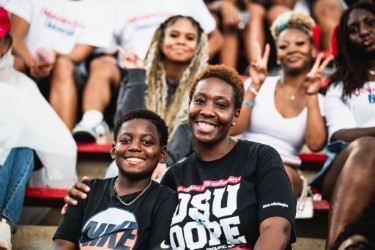
As homecoming season begins, Delaware State University is approaching a record enrollment of nearly 7,000 students. Enrollment across all campuses and programs is running ahead of where it stood at this point last year, putting the University on pace to surpass last fall’s record census of 6,623 when it certifies Fall 2026 enrollment on October 31. Since 2020, when the University enrolled 5,027 students, enrollment has grown nearly 40 percent.
As of this week, 6,990 students are registered across the University’s Dover and Wilmington campuses, its online programs, and its international partnerships, including 6,370 on the University’s U.S. campuses, roughly 10% more than at the same point a year ago. Final counts come at census on October 31, after the University’s second term start, additional online sessions — including the first cohorts of eHBCU, the national online consortium of HBCUs the University leads — and semester starts in its international locations.
The growth is coming from students who are already here. While new out-of-state freshman enrollment is down roughly a third from the same point last year, continuing undergraduates from Delaware and from out of state are up 7 percent, the clearest measure that students who enroll at Delaware State are persisting toward degrees. Graduate enrollment is up 5.6 percent, driven by online programs, and continuing online graduate students are up nearly 40 percent, a historic high.
“The number I care most about is not how many students arrive — it’s how many stay, and how many finish,” said Tony Allen, President of Delaware State University. “Every one of these students came to change the trajectory of their lives — for themselves, their families and their communities. They deserve quality, commitment and community from the University they call home. The growth we are seeing this fall is where we meet them. How we see them through is the proof of our belief in them and their belief in us — a mutual investment with significant return for generations to come.”
Delaware first. More than half of the University’s students are Delawareans, and the backbone of that share is the INSPIRE Scholarship: a four-year, full-tuition award for Delaware high school graduates who enroll the fall after graduation, maintain a 2.75 grade point average, complete ten hours of community service each semester, and file the FAFSA each year. This fall, the University anticipates that more than 80 percent of new in-state, full-time freshmen will be INSPIRE Scholars, and this year’s in-state freshman class is the largest in the University’s history.
INSPIRE was created in 2010 in legislation sponsored by Representative Darryl Scott and Senator Brian Bushweller and signed by Governor Jack Markell, originally as a partial award. In 2018, Senator Bushweller and Representatives Stephanie T. Bolden and Sean Lynn extended it to a full four years, though still as a partial scholarship. In 2021, Senator Trey Paradee and Representative Bolden, a 1969 graduate of the University, made it a full-tuition scholarship with the unanimous support of the General Assembly, signed by Governor John Carney. Last October, Governor Matt Meyer signed legislation sponsored by Senator Paradee allowing INSPIRE Scholars who finish their degrees early to apply the remaining funds toward a master’s degree at the University. Since 2010, more than 2,500 Delawareans have attended the University as INSPIRE Scholars.
“We built the enrollment strategy around Delaware first — Delaware students, Delaware families, Delaware’s workforce,” said Kareem McLemore, Vice President for Strategic Enrollment Management and International Affairs. “This fall shows that strategy taking hold at every level: more first-year students from across the state, more high schoolers getting a head start, and more of our own students coming back to finish what they started.”
Jordan Perkins, a 2026 Sanford School graduate and INSPIRE Scholar in the Class of 2030, put it plainly. “I had offers from some of the most prestigious schools in the country. I chose Delaware State because it is an exceptional community of people who believe in me and are investing in me,” Perkins said. “And I know exactly what I owe them: my very best in the classroom, ten hours of service every semester, a debt-free degree, and a commitment to lifelong service. That is the Delaware State University difference.”
The pipeline behind them. The number of Delaware high school students taking University courses for college credit has nearly doubled over last year, to 582. The Williams School, the University’s early college school dedicated last month in honor of former President Harry L.
Williams and Dr. Robin S. Williams, enrolls roughly 700 students in grades 7 through 12 and sends 63 percent of its graduates to Delaware State. In Queens, HBCU Early College Preparatory School, a partnership between the New York City Public Schools and Delaware State University, drew more than a thousand applications for its first hundred seats and is now in its second cohort. Its 200 students will earn a high school diploma from the preparatory school, an associate degree from Delaware State University, and automatic admission to the University.
Daveon Wisher, who attended the Early College School before earning his degree at Delaware State University and now teaches seventh- and eighth-grade English at The Williams School, said the program’s impact has come full circle. “It really shaped me into the person I became, because the same tools and the same education that they gave me in early college carried over at Delaware State University,” Wisher said. “I just flourished and grew from the seeds that they had already planted.”
What the national data say. New research from the Dr. N. Joyce Payne Research Center at the Thurgood Marshall College Fund, conducted with Gallup, puts the University’s momentum in national context. The Center’s Proof of Promise report, the largest study of recent HBCU alumni to date, found that 70 percent of recent HBCU graduates are thriving in their everyday lives, compared with 48 percent of all U.S. adults; that 83 percent felt they belonged at their institution, against 65 percent of college graduates nationally; and that 79 percent say their education was worth the cost, above the 72 percent of U.S. college graduates who say the same. The Center’s Black Thriving in America: 2026 report found that 80 percent of Black adults now believe children in their community have the opportunity to get a good education, up from 74 percent in 2023. Dr. Allen serves as a Senior Fellow of the Center.
Delaware State University’s own outcomes track with that national picture. Its graduates earn a median of $57,700 early in their careers and $96,700 by mid-career, at a median undergraduate tuition of about $9,050 — roughly $15,000 below the national average for institutions of its kind. In August, Forbes’ first ranking of America’s Top HBCUs, built on outcomes alone, placed the University tenth among public HBCUs and second for online programs. Last month, US News and Word Report issued similar findings.
A stronger institution. The enrollment momentum follows a summer in which the University won significant federal awards, including BRIDGE, a nearly $10 million Department of Defense award to build defense research capacity, the program maximum and the only award of its kind in Delaware, and a named partnership in the National Science Foundation’s $21.5 million AI Institute for Human-AI Cooperation. Counted conservatively over five years, new awards on which Delaware State is the grantee total $54.7 million.
Delaware State University will certify its Fall 2026 enrollment on October 31 and will welcome prospective students and families to Open House on Saturday, November 7.
About Delaware State University
Delaware State University is a public historically Black university in Dover, Delaware. Founded in 1891, the University is a Carnegie-classified research institution committed to academic excellence, community engagement, and expanding access to higher education. Its students come from 39 states and 34 countries.