By Andy Barbour
A Black male college student in class. Many HBCUs are working to address the Black male college crisis.
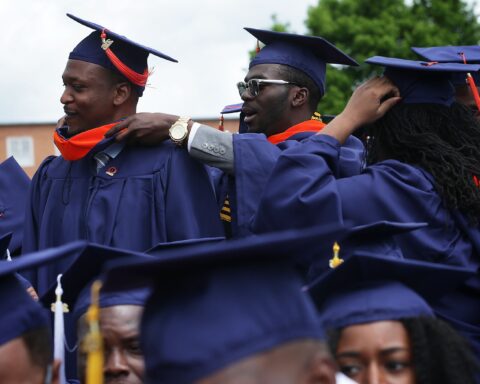
A crisis is happening on HBCU campuses. Black men account for only 26% of HBCU students, the lowest level in nearly 50 years. The South, where 89% of HBCUs are located, has the lowest Black male college enrollment rate at just 33%. At Howard University, only 19% of students are Black men. Nationwide, Black male enrollment has plummeted from 38% in 1976 to just 26% today.
These aren’t just numbers. They represent a generation of Black men being locked out of economic mobility. For Democrats, economic mobility, or the lack thereof that is felt by many working-class voters, has cost us votes and pushed winnable elections out of reach. A case in point would be the 2024 presidential campaign, which saw Donald Trump secure 24% of the Black male vote.
Black male college crisis
This number is even more concerning because it says nothing about our inability to reach the millions of Black men who didn’t bother to cast a ballot at all. Democrats cannot win elections if these trends continue.
Many HBCUs are working aggressively to address the Black male college crisis. Alabama A&M just welcomed its largest freshman class in years, with 42% of that class being male. Morgan State University has launched a Presidential Task Force to address Black male enrollment. Others are similarly focused on the crisis, but HBCUs shouldn’t shoulder this responsibility alone.
If smart policy truly is smart politics, then Democrats would be wise to make this issue a central plank of our agenda to regain power. Black men need to hear from us directly. Addressing the Black male college pipeline crisis and the broader barriers against Black male economic mobility should be a central agenda item as Democrats plot strategy for the 2026 and 2028 national elections.
This crisis is about more than college degrees. This crisis underscores the overall lack of economic mobility for many Black men, whether they choose to attend college or would rather explore careers in the trades or entrepreneurship. No matter the path they’d like to choose, Black men don’t see Democrats as fighting for them — and that must change.
Expanding the HBCU mission
As HBCU alumni and Democratic strategists, we see this as more than an education issue: it’s a political emergency Democrats are dangerously ignoring.
First, Democrats must acknowledge the pipeline crisis starts early. We’ve experienced this firsthand. One of us attended Howard and struggled to adjust after matriculating in an underfunded southern public school system. The other got into Morehouse on academic probation after considering trade school. We each had to contend with how to pay tuition with no college trust fund to rely on, despite the best efforts of our hardworking single-parent mothers. We were able to get by, but similar economic barriers systematically filter out Black males who can’t afford tuition or need jobs right away.
Democrats should continue to carry the mantle of debt-free college and remember that HBCUs have proven themselves at producing the highest return on investment for economic mobility for Black people. As we call for debt-free college, Democrats should also fight to ensure HBCUs are fully funded. These are things we stand for as a party, but Democrats need to be more direct in communicating that support to Black men.
Set up for success
We should become the champions of helping HBCUs expand their missions to increase economic opportunity for Black men. With funding, HBCUs can offer multiple pathways to economic mobility, not just traditional degrees. Why can’t Black men get HVAC certifications at Morehouse as well as entrepreneurship training?
Democrats should also promote policies supporting HBCUs expanding their reach outside the South. Recent reports indicate officials in Boston and San Francisco are actively working to bring HBCU satellite campuses north to strengthen the pipelines for Black college enrollment. These efforts, along with affordable online degree programs, can help center HBCUs as key strategic pillars to win back lost ground with working class Black men.
Democrats should also advocate for robust federal funding and engagement to assist local governments in ensuring that every high school graduate has a diploma, trade certification and college tuition assistance at graduation. We should champion every child being prepared for college or the workforce at age 18. More grants should be made available to localities like Birmingham, Alabama, where Mayor Randall Woodfin, himself an HBCU alum, has developed the Birmingham Promise Program.
Birmingham Promise provides up to four years of tuition assistance for Birmingham City Schools graduates to attend any public two-year or four-year college or university in Alabama. The program also provides coaching to ensure that students can succeed in college and connects them with workforce experience to help promote economic mobility. To date, the program has provided over $11 million in tuition assistance to over 1,600 graduates. HBCUs can be strong partners in this work, and federal policy should support local governments in developing and expanding such initiatives with added emphasis on Black men.