
Written By Lexx Thornton
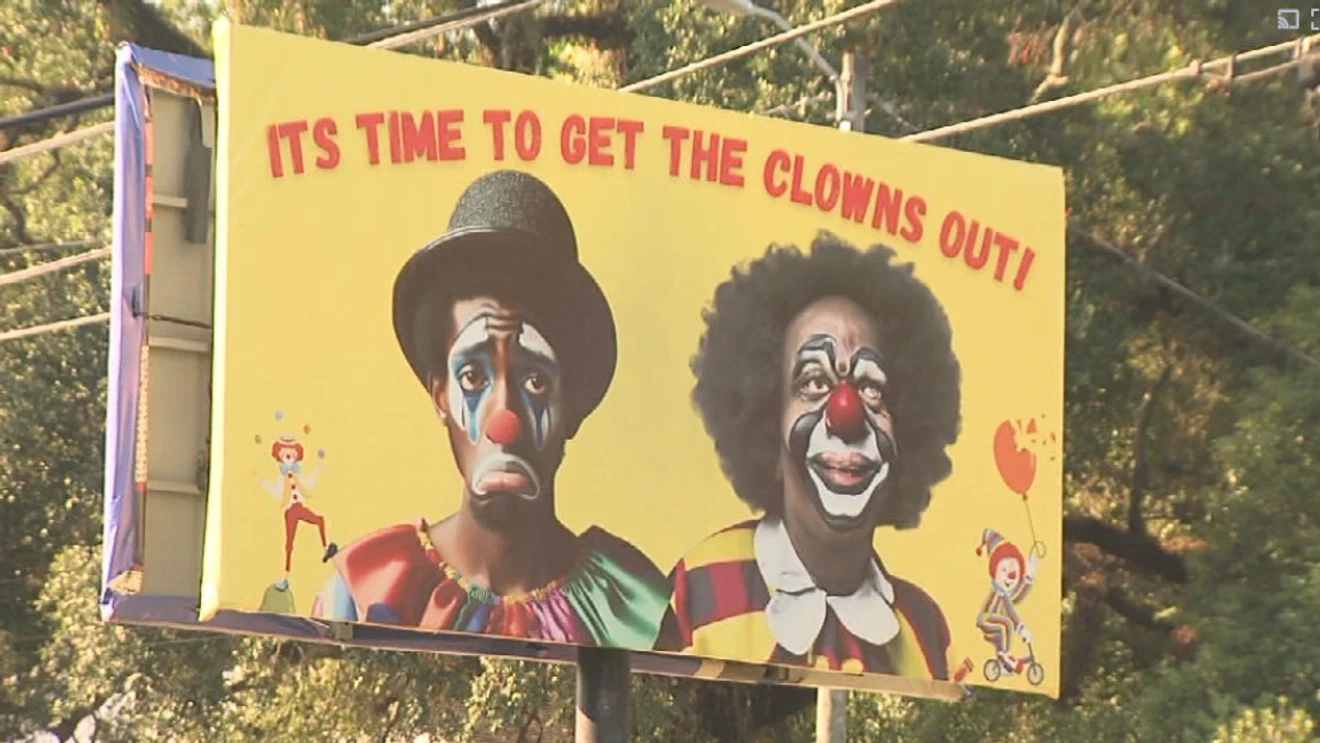
For days, a billboard lacking context and showing two Black clowns alongside the message “It’s time to get the clowns out” ignited outrage and stirred suspicions of political undertones. The message also came just weeks before key runoff elections in majority Black cities of Mobile and Prichard. On Wednesday, after prolonged silence, the billboard’s owner, Michael Lewis, broke his silence on WBLX-FM, an urban and hip-hop radio station in Mobile. The billboard, he said, “doesn’t have anything to do with y’all politics.”
Lewis, who is Black, owns Bumblebee Billboards and is collaborating with comedian Joe Paige to promote the 10th anniversary show of “Laugh, Love, Live.” The comedy event is set for October 12 at the Black Wolf Event Hall on Wilson Avenue in Prichard.
“It’s about bringing the clowns in,” said Lewis, also known as “Square Tite Mike.” “All the comedians you want on one stage. Get your tickets, tables, cause it will be out of control. All the games and all the fun stuff.”
The announcement put an end to speculation that had swirled across social media, generated TV coverage, and drew sharp criticism from some public officials. State Rep. Barbara Drummond, a candidate in Mobile’s September 23 mayoral runoff, had called the billboard’s imagery demeaning and said it “has long been meant to belittle Black people.”
“Mobile deserves better — and as Mayor, I’ll always keep working for a city where everyone is respected,” said Drummond in a Facebook post. She is running against former Mobile County District Judge Spiro Cheriogotis in the runoff.
Lewis has not returned calls for comment. He has also not responded to inquiries from TV media outlets that had reported the billboard’s appearance leading up to the announcement on Wednesday.
On a Facebook post, Lewis said that people are now mad that they can’t be “mad anymore.”
Bumblebee Billboards, in the past, has posted messaging with a social statement. They mostly include messaging against gun violence, such as “So Many Places to Go … Prison Ain’t One! #STAYFREE.”
He criticized political candidates in a May Facebook post for not supporting community businesses. In recent weeks, he posted public support for Prichard mayoral candidate Carletta Davis. She is facing incumbent Prichard Mayor Jimmie Gardner during the runoff.
“I was not aware until someone called me about it,” Davis said about the billboard hours before Lewis announced it was related to a comedy show. “I don’t have anything to do with it. It’s in Mobile. I have no comment about it.”
Jason Johnson, a spokesperson for Stimpson, said the city requires permits for the erection of new billboards to ensure they do not create traffic obstructions and that they are correctly installed. He said the Bumblebee Billboard was erected around 1992 and is properly permitted.
The city has no oversight over messaging, he said, unless they depict “actual threats of violence, obscenity, or incite violence.”
“We did receive a few complaints about it,” Johnson said about the clown messaging. “Members of the Council and staff from the Mayor’s Office attempted to contact the owner to obtain more information about the nature of the billboard. As far as our reaction, it was mainly bewilderment. Without context, it’s understandable that some people had concerns about the depiction. We are glad the owner has publicly clarified the intent of the billboard.”
Lee Rowland, executive director of the National Coalition Against Censorship, said there is nothing city or state leaders could have done about the billboard without running afoul of the First Amendment.
“The owner of the billboards generally has the right to decide what kind of content to put up,” Rowland said. “Generally, the billboard owners are looking for publicity to sell that ad space to someone who wants to reach the people’s eyes.”
Rowland said that, absent a wholesale ban on billboards, there is nothing Mobile can do about controversial messaging that might appear along a city street. Only four states – Alaska, Vermont, Hawaii, and Maine – outlaw billboards.
Alaska was the last state to enact a ban on billboards in 1998, with 72.3% of voters backing a referendum to ban them.
In Minnesota, state legislation was introduced this year to ban new billboards and to consider existing billboards as non-conforming.
The push to remove billboards is aimed at preserving the scenic beauty and natural landscapes of states and cities. Houston, for example, has removed thousands of billboards for years to reduce clutter along highways.
Rowland said Mobile could adopt its own billboard ban. However, she said the city would be on “constitutional thin ice” since a ban would occur after controversy regarding the content of a billboard.
There is no indication that Mobile is considering regulations on billboards or any other public messaging.
The city has, for years, dealt with criticism from the messaging that appears on small billboard-style displays during the Comic Cowboys Mardi Gras parade.
The anonymous group that focuses on political and cultural satire has been criticized for parading insensitive messaging. The group, established in 1884, goes by a mantra of “Without Malice” while parading its version of comedy and social commentary.