
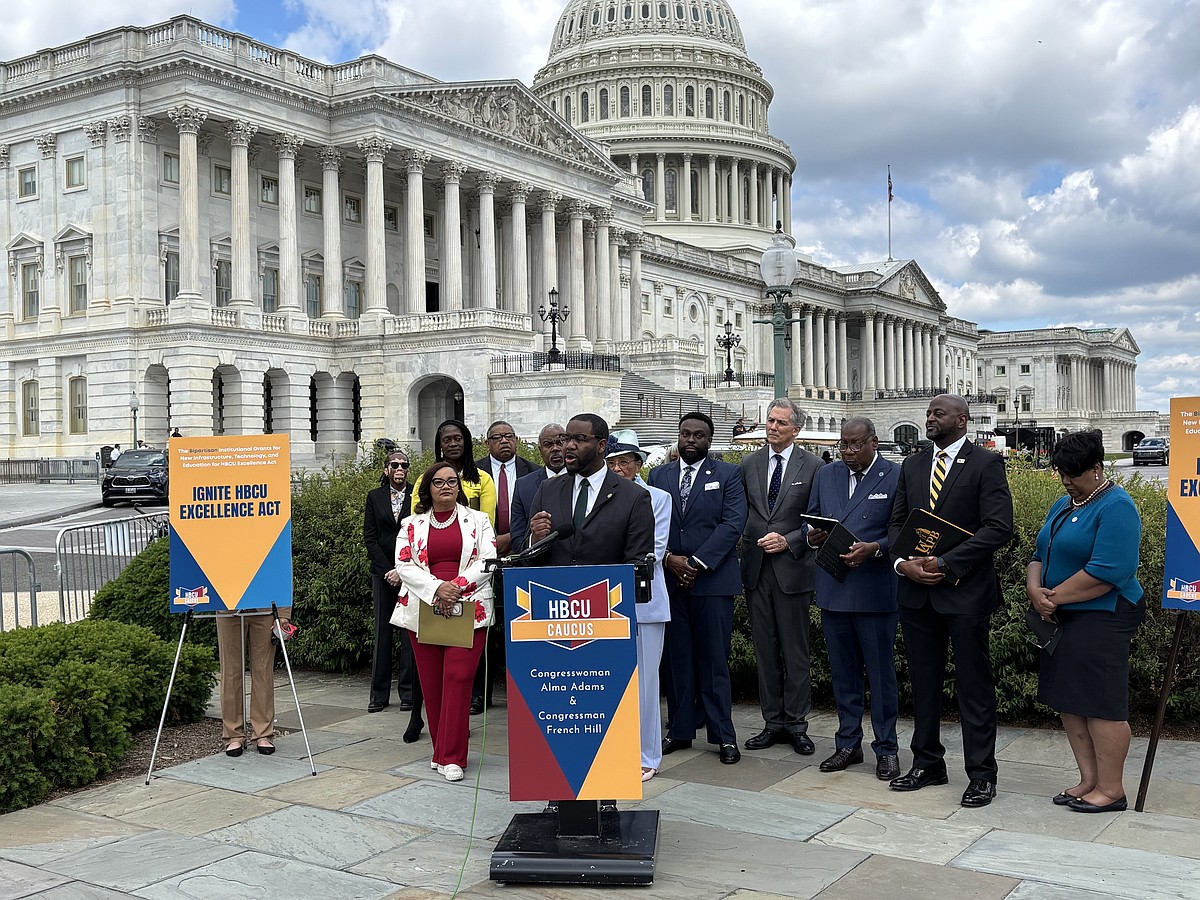
WASHINGTON — Leaders of three historically Black colleges and universities in Arkansas joined education leaders and lawmakers on Thursday in championing federal legislation to help institutions receive grants for campus improvements
College and university officials from across the country joined Reps. French Hill, R-Ark., and Alma Adams, D-N.C., to announce the IGNITE HBCU Excellence Act. The news conference on Capitol Hill occurred two months after Hill and Adams — co-chairs of the Congressional Bipartisan HBCU Caucus — held an HBCU summit in Little Rock.
Arkansas has four HBCUs: Philander Smith University in Little Rock, the University of Arkansas at Pine Bluff, Shorter College in North Little Rock and Arkansas Baptist College in Little Rock. Arkansas Baptist College hosted Hill and Adams’ March forum.
“HBCUs, since their inception, are economic and cultural anchors within our communities,” said Maurice Gipson, Philander Smith’s president and CEO, as he stood outside the U.S. Capitol.
“We educate first-generation students, develop leaders, create pipelines into those critical professions — including healthcare, education, business and STEM fields,” he added. “When Congress invests in HBCUs, it is investing in communities and workforce development, and in the future of this country.”
UAPB Chancellor Anthony Graham and Shorter President Jeffery Norfleet also traveled to Capitol Hill for Thursday’s conference.
The IGNITE HBCU Excellence Act would establish a competitive grant program to help HBCUs secure funding for facility improvements, such as enhancements to research spaces and upgrades to student housing.
Sens. Tim Scott, R-S.C., and Chris Coons, D-Del., are pushing the Senate version of the bill. The senators also serve as co-chairs of the Congressional Bipartisan HBCU Caucus.
“This legislation represents far more than funding,” Graham said.
“It represents opportunity,” he continued. “Opportunity to strengthen research infrastructure, opportunity to expand innovation and STEM education, opportunity to prepare more students for high-demand workforce fields.”
Republicans and Democrats have advocated for legislation to help HBCUs receive more money, as these institutions have been historically underfunded by state legislatures and the federal government compared to other colleges and universities. Philanthropic efforts have not done enough to fill the funding gap at both public and private institutions.
“We need this funding,” said Adams, an alumna of North Carolina Agricultural and Technical State University and a retired professor at Bennett College, both in Greensboro, N.C. “It is difficult to get it because a lot of our students are first-generation and don’t come with a lot of dollars.”
Shaw University President Paulette Dillard noted most buildings on her institution’s campus in Raleigh, N.C., were built “before the 1960s.”
“But yet, we continue to turn out amazing teachers, doctors, lawyers, leaders throughout this nation,” she said. “Imagine — if we can do that kind of work in facilities that are not up to par — what an investment in infrastructure will do for our campuses.”
Hill’s understanding of infrastructure problems on HBCU campuses goes back to his time in the banking industry. The Little Rock congressman worked with Fitz Hill, then president of Arkansas Baptist College, on developing a campus improvement plan for renovating the Old Main building and constructing new learning and residential spaces.
The private institution would secure funding through the federal New Markets Tax Credit program, which aims to incentivize private investment in projects located in low-income communities by offering tax credits.
“You have a unique economic driver in our HBCUs,” the congressman said Thursday. “It’s a blessing to see them thrive and succeed under many, many years of successive struggles sometimes to have the right kind of infrastructure.”
Gipson framed the IGNITE HBCU Excellence Act as a chance to help institutions boost curriculum and better meet community needs. He cited Philander Smith University’s new nursing program, stressing modern facilities are a necessity for developing competitive courses.
“Investments in campus infrastructure and technology strengthen our ability to recruit talented students and faculty, and expand workforce opportunities,” he said.
In Norfleet’s endorsement of the bill, he mentioned the possible infrastructure grants would pair well with Shorter’s campus improvement plan and $40 million capital campaign.
“This year at Shorter, we are celebrating 140 years of existence,” he said. “Shorter College is ready, our students are ready, our HBCUs are ready.”
Hill and Adams were part of a bipartisan coalition that introduced legislation in April addressing research programs at HBCUs. The HBCU Research Capacity Act would create a federal clearinghouse on grant opportunities supporting institutional research capacity.
Alex Thomas has served as the Washington Correspondent for the Arkansas Democrat-Gazette since November 2022. He also produces “Arkies in the Beltway,” a weekly podcast covering national politics and the Arkansans involved in public policy debates.