Opening Remarks Frame HBCUs as Essential, Not Peripheral
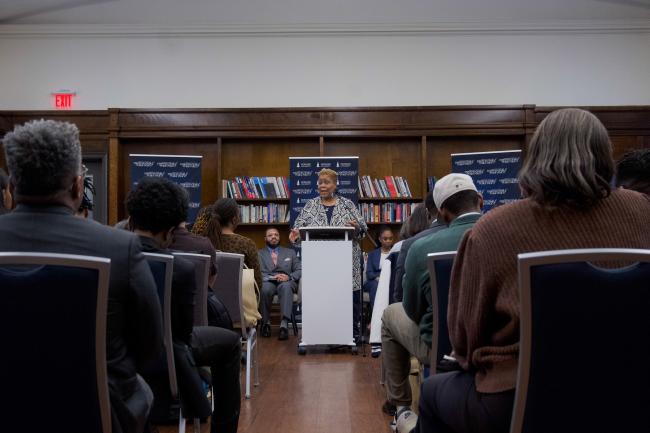
The formal program began with remarks from Tonjia Hope Navas (Ph.D. ’24), assistant provost for international programs, and Trustee Emerita Marie C. Johns (DHL ’13), the 2025-26 King Endowed Chair holder. They both framed the conversation as timely and necessary, an invitation to think expansively about where higher education is headed and what it will take for institutions rooted in a mission to shape that future rather than simply respond to it.
Tonjia Hope Navas, Ph.D., spoke to the historical essence of HBCUs. (Photo: Simone Boyd/Howard University)
Hope, on behalf of Interim Provost and Chief Academic Officer Dawn Williams, Ph.D., spoke to the historical essence of HBCUs and how that history informs their standing today.
“When we speak of the future of HBCUs, we are speaking of institutions that have always existed at the center of these tensions,” Hope said. “HBCUs are not peripheral to the future of education; they are essential to it. They have long modeled what it means to educate the whole student. They have demonstrated how policy can be leveraged to advance equity rather than entrench disparity. And we know that they continue to produce leaders, educators, policymakers, entrepreneurs, and public servants who understand that education is both a private good and a public trust.”
In her opening, Johns underscored the purpose of the endowed chair lecture: to create space for rigorous, solutions-oriented dialogue that does not sidestep complexity, particularly when the stakes include access, public policy, and systemic progress.
“My approach to this series this year was that we could go 10 miles deep on issues of public finance or international diplomacy, but I thought it was important to approach policy from an every man, every woman perspective, and that is really trying to drive home the point that policy is imbued in nearly every aspect of our lives,” Johns said. “That’s what this series is attempting to do, talk about those key issues for our community and the policy implications that are embedded there.”