
As President Donald Trump’s administration moves to smother diversity, equity and inclusion initiatives at U.S. universities, Louisiana’s higher education board is eliminating an incentive that encouraged universities to graduate more minority students.
The change means the state’s historically Black colleges and universities stand to lose millions of dollars.
“I’m not going to lie, because the numbers are out there,” interim Southern University System President Orlando McMeans said. “It will put us in the red as it relates to funding for 2026-2027.”
The Louisiana Board of Regents doles out money from the Legislature to the state’s public colleges and universities based on a complex formula. For the new fiscal year that starts July 1, that formula will no longer include an “underrepresented minority completer” metric, which rewarded institutions for graduating students of races with lower graduation rates than the rest of the population.
Kim Hunter Reed, Louisiana’s commissioner of higher education, said the board dissolved the metric to comply with Trump’s executive orders prohibiting the federal government and federal contractors from maintaining DEI programs.
In an executive order on March 26, Trump said individuals are separated on the basis of race and ethnicity in DEI initiatives “rather than treated equally and objectively based on their merit and without regard to their immutable characteristics.”
La. Commissioner of Higher Education Kim Hunter Reed speaks at the kickoff of the Louisiana Meauxmentum Summit, a two-day conference to discuss plans to improve higher education in Louisiana, Wednesday, Feb. 1, 2023 at LSU’s South Stadium Club.
“There’s been significant conversation about race-based metrics, so we removed it in the formula,” Reed said.
Among Louisiana’s four public university systems, the historically Black Southern University System will lose the most: roughly $1.5 million, the Board of Regents estimates based on numbers from the previous fiscal year.
The Southern University System’s total appropriated funds for that year were $191.9 million, according to its budget report.
The individual schools most affected by the change are the Southern University campus in Baton Rouge and Louisiana’s other public HBCU, Grambling State University, of the University of Louisiana System.
“It may not seem like a lot for three universities, but for us, that’s a significant cut,” McMeans said, referring to Southern’s campuses in Baton Rouge, New Orleans and Shreveport. “It’s one that we don’t want to think about trying to make decisions on how we’re going to overcome.”
Southern recently requested an additional $19 million in one-time funding to address campus safety and infrastructure, including the ailing power grid that forced classes to be delayed or canceled three times since February.
“We’re trying to go in the other direction and increase our revenues and increase our funding and our fiscal stability,” McMeans said. “Having a decrease in funding in our base — it’s not a one-time cut; this is our base — it will definitely negatively impact us as a system.”
Some non-HBCUs will benefit from the redistribution of dollars through other metrics used to determine funding, such as the benchmark that rewards universities for graduating Pell Grant recipients. The LSU System could receive approximately $1.2 million in additional funding once the race-based metric disappears from the formula, according to Board of Regents estimates for fiscal year 2025.
“I think it was President McMeans, the interim president of Southern, who said something to the effect of, ‘Where you stand depends on where you sit,’” University of Louisiana System President Rick Gallot said. “This change does impact some of our institutions, but it also helps other institutions.”
Change comes amid federal investigation
The Board of Regents divides money from the Legislature between public universities using a funding formula. The equation has been run with a “standstill,” or frozen, budget for three years.
“It doesn’t create funding, but it allocates funding based on priorities,” Reed said.
In the past decade, the formula has increasingly focused on educational outcomes, funneling dollars according to benchmarks like Pell Grant graduates, adult learner graduates and the time to a degree for first-time freshmen.
The board decided to remove its underrepresented minority benchmark last year as an anti-DEI wave, led by the White House, began to sweep through higher education, Reed said. The change will take effect when the formula is run for the upcoming fiscal year.
The move occurs as the U.S. Department of Education announced an investigation into the Louisiana Board of Regents in February over its DEI policies and what the department said were potential violations of the Civil Rights Act of 1964.
At issue were the higher education board’s executive budget documents in recent years, in which the board included performance targets for the state’s public colleges and universities to increase the number of “underrepresented minorities (all races other than white, Asian)” receiving postsecondary credentials.
“The Louisiana Board of Regents’ objective to prioritize recruitment and graduation efforts for ‘all races other than white (and) Asian’ appears to blatantly violate not only America’s antidiscrimination laws, but our nation’s core principles,” Assistant Secretary for Civil Rights Kimberly Richey said in a press release in February.
What happens next for HBCUs
While the formula shakeup will result in some dollars being regained through other metrics, Louisiana’s HBCUs still come out with the biggest losses.
Southern University in Baton Rouge and Grambling State University in Grambling would have missed out on $1.1 million and $899,000, respectively, in fiscal year 2025 had the race-based incentive not been included in the formula, according to Board of Regents estimates.
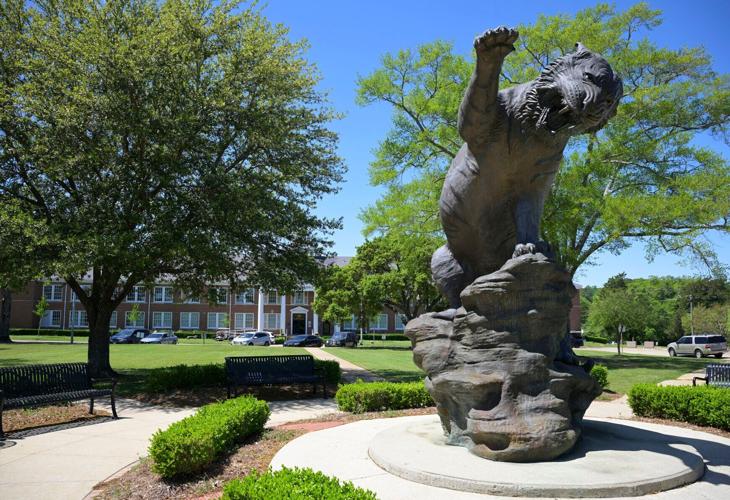
Grambling State University in Grambling, La., Wednesday, April 3, 2024.
“Certainly, they have the ability to weather the storm,” Gallot said about Grambling State. “But as we think about the goal of attainment of a degree or a credential of value, and when you have approximately a third of your state’s population being minority, not only does it have an impact on individual institutions, but it has an impact on overall support for students all across the state.”
Tramelle Howard, Southern University alumnus and Louisiana director of the Washington, D.C.-based education policy group EdTrust, said the absence of the underrepresented minority metric this year is disappointing.
He said higher education leaders have different strategies for how to handle anti-DEI pushback. Some continue to follow the practices by a different name, while others “overcomply” and root out all measures that benefit students from diverse backgrounds.
“They have been overcomplying and responding to a narrative,” Howard said of Louisiana leaders. “I do think it’s about the pendulum swinging, but I think the damages are going to be so longstanding that even when the pendulum swings in a different direction, it’s going to take some real, intentional, innovative work to ensure that we can actually live out the promises of what education should be.”
He said Louisiana’s HBCUs will need to seek more philanthropic dollars, but the change only adds more barriers to universities that struggle to access state funding at the same rate as their flagship counterparts.
“I feel like right now HBCUs are being served in a policy space that we did not create,” Howard said. “We literally created institutions because people didn’t want us to go to other institutions, and now we create our institutions, we’re doing more with less, and you’re still trying to put us under attack.”