
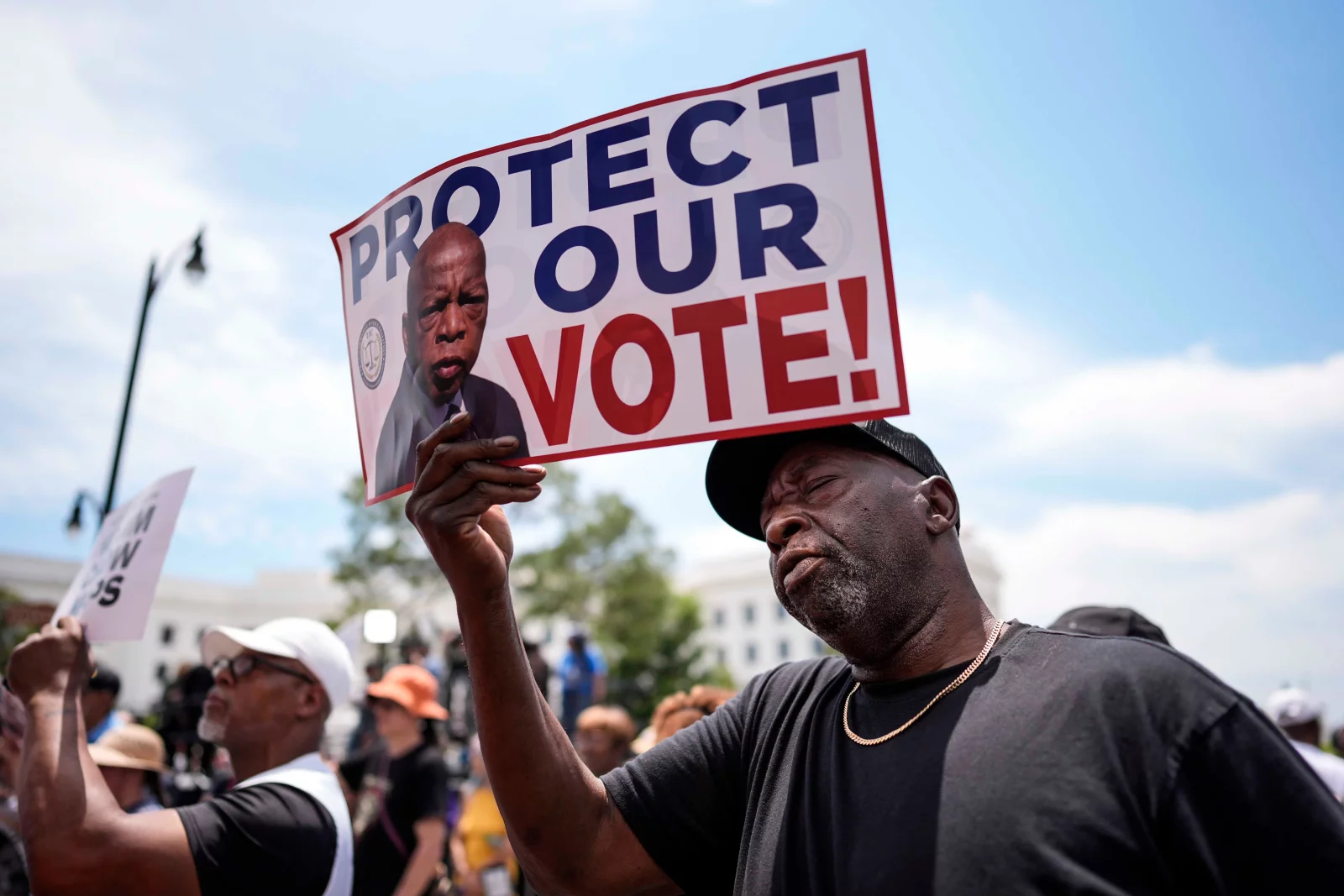
Minority voters are left with limited alternatives for combatting racial discrimination in redistricting, after the U.S. Supreme Court’s latest undermining of the federal Voting Rights Act.
Remaining options for protecting the collective power of racial-minority voters include state-level voting rights acts and map-drawing strategies, likely in Democratic-controlled states, yet they cannot fully replace the nationwide provisions under Section 2 of the Voting Rights Act that many legal experts say are now practically impossible to enforce.
This week, the high court decided to allow Alabama to use a congressional map that a lower court found intentionally discriminates against Black voters. That ruling has also heightened concerns about the future of racial-minority representation in government — particularly in Southern states where voting is polarized between a white, Republican-leaning majority and a Black, Democratic-leaning minority.
“Today the bulk of Black people live in the states of the old Confederacy. And that is exactly where you’re seeing the worst types of retrenchment,” says Wilfred Codrington III, professor of constitutional law at Yeshiva University’s Cardozo School of Law.
Still, some voting rights advocates are pushing forward with what they see as short-term solutions ahead of a longer-term project of rebuilding the federal Voting Rights Act or even the overall system for electing members of Congress.
State-level voting rights acts provide some of the protection offered by the federal law
State-level voting rights acts offer various anti-discrimination protections for racial-minority voters that go beyond the federal law, and in the month since the Supreme Court’s ruling in Louisiana v. Callais, supporters of these legal protections have reignited calls for more states to enact them.
Democratic lawmakers have recently advanced bills in states including Michigan and New Jersey. The Delaware John Lewis Voting Rights Act is set to be formally introduced Friday.
But unlike the federal Voting Rights Act, its state-level counterparts generally cover only state and local elections. And while around a dozen states have passed these kinds of laws, no state with a unified Republican or divided government has done so, making it unlikely that bills introduced in the Deep South will become law.
Some court watchers are now concerned that enacted state voting rights acts may ultimately be weakened or struck down.
“I’m nervous that the Supreme Court may sort of have those in its crosshairs as well,” says Codrington, the Cardozo law professor.