
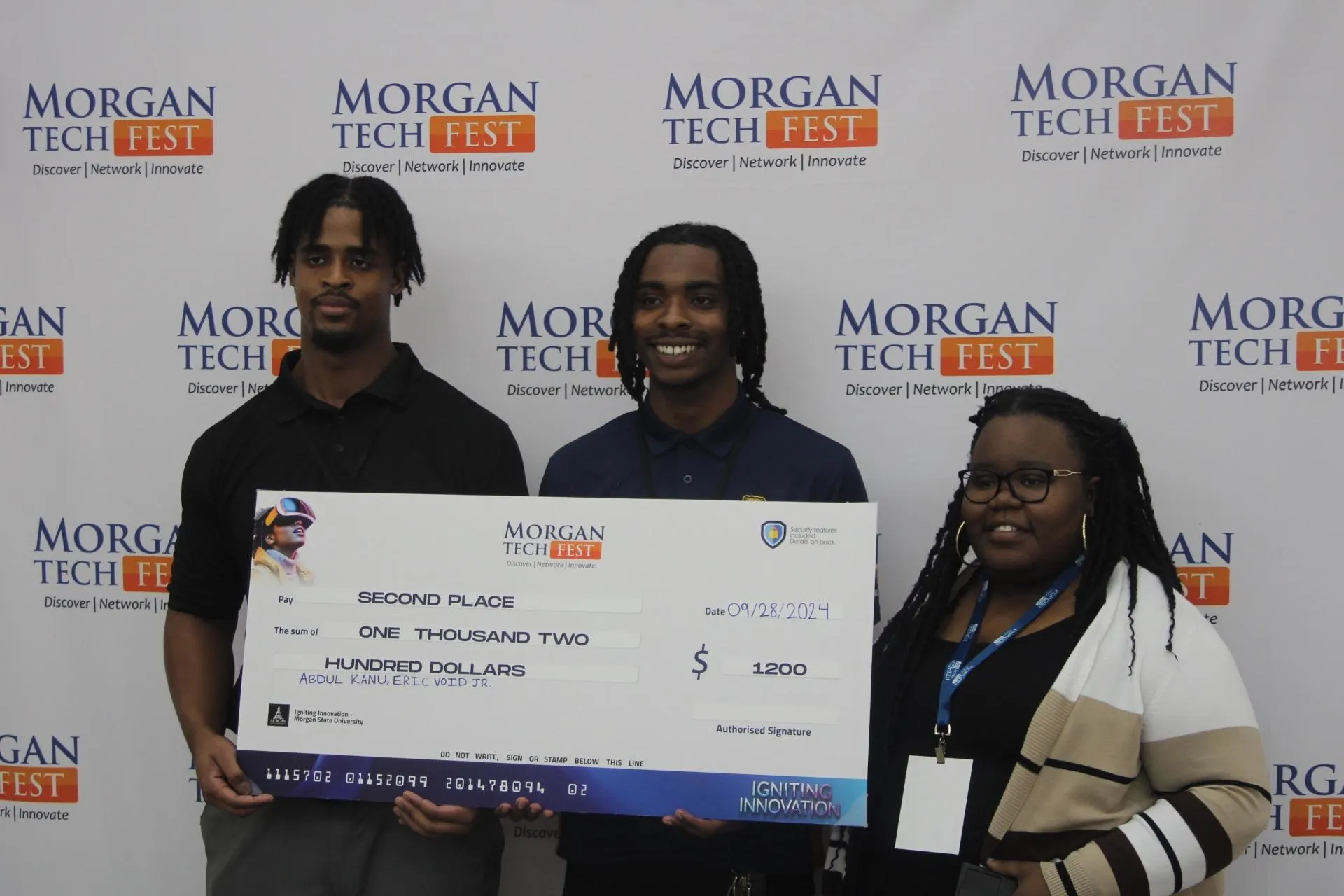
We often hear companies describe their relationships with Historically Black Colleges and Universities (HBCUs) in terms of pipelines or pathways. In this model, HBCUs educate talented students who eventually enter internships and industry jobs. However, the pipeline/pathway metaphor captures only a tiny part of what HBCUs contribute.
Opeyemi T. Adeniran, a doctoral student in Computer and Electrical Systems Engineering at Morgan State University and founder of Morgan TechFest, offers a broader perspective on the role HBCUs play in technology and innovation. She sees this role as an ecosystem. She explained to me, “A pipeline sends talent somewhere else to create. An ecosystem is a loop of curriculum, community, research, and industry, intentionally integrated so each feeds the next.”
Morgan TechFest demonstrates how this ecosystem works. Founded in 2022, the student-led technology initiative brings together students, faculty members, researchers, and professionals from companies including Amazon, Google, Microsoft, Bloomberg, Capital One, Kyndryl, M&T Bank, and Oracle. Students have the opportunity to present research, participate in technology case competitions, receive mentoring, attend workshops, and share their creations with industry professionals.
Adeniran established the program after recognizing a growing gap between what students learned in their degree programs and what they encountered upon entering the workforce. As she shared with me, “Technology is reshaping careers faster than students are being prepared for them. Graduates were finishing degrees only to find that industry had moved on.”
Morgan State already offered career fairs, lectures, and academic symposia. Adeniran wanted students to have a sustained opportunity to examine how technology was transforming their chosen professions. She built Morgan TechFest around three words: “Discover. Network. Innovate.” Students discover how technology is changing their fields, develop relationships with the people and companies driving those changes, and strengthen their ability to create new ideas and solutions.
At first, Adeniran believed the disconnect between what students learn and what the industry needs was more regional in scope. Then, while attending a quantum computing conference in Maryland, she heard a parent describe his son’s difficulty finding employment. The young man had earned a science degree and then pursued a master’s degree, yet he remained unable to find a job. For Adeniran, the exchange confirmed that students needed experiences that connected their academic preparation to rapidly changing industries. They needed opportunities to apply their knowledge, present their work, build relationships, and envision themselves as contributors to technological innovation.
This philosophy is at the foundation of Morgan TechFest. For example, a nursing student, a business student, and an engineer might present side by side. Every project involves technology, while the ideas emerge from a wide range of disciplines. This kind of interdisciplinary approach has become especially important as artificial intelligence (AI) is transforming most professions.
Student projects at Morgan TechFest have applied AI to brain tumor diagnosis, autonomous wheelchair navigation in airports, urban air-quality monitoring through satellites, career guidance, and drone delivery. Other projects have examined stereotypes in STEM and Black representation in media. Together, these projects demonstrate students’ interest in technical careers and their commitment to addressing questions related to healthcare, accessibility, the environment, education, and racial equity. According to Adeniran, “The tumor-diagnosis model and the study of representation share the same room, the same audience, the same afternoon.”
Morgan State prepares students for careers while also creating knowledge and producing inventions. The university houses the National Center for Equitable Artificial Intelligence and Machine Learning Systems, which focuses on the development and use of socially responsible and equitable AI. Adeniran is a named co-inventor on two university inventions: an explainable AI method for the early detection of Alzheimer’s disease and a machine-learning system for identifying vulnerabilities in blockchain smart contracts.
Morgan students are already contributing to the future of technology while on campus. Morgan TechFest gives them an audience for that work and helps them establish relationships that can support their continued development. The program also offers a useful model for building stronger corporate partnerships with HBCUs. Many companies concentrate their HBCU engagement during recruitment season. However, Morgan TechFest invites companies into a more substantive relationship with the university. Corporate representatives lead workshops, deliver talks, serve on panels, judge student research, and evaluate technology case competitions.
According to Adeniran, these interactions could even change the nature of recruitment. When an engineer evaluates a student’s research poster, for example, the conversation might begin with the student’s knowledge, questions, and ideas rather than basic get-to-know-you questions. Companies can also gain a clearer understanding of what students are studying and creating across the university. Adeniran believes that meaningful partnerships require companies to engage with HBCU students, faculty, and researchers year-round.
Morgan TechFest’s early outcomes are encouraging. Adeniran told me that one student secured a full-time position at Amazon after speaking with a company recruiter during the event. Other students reported obtaining internships with Goldman Sachs, Bloomberg, and Kyndryl. Some faculty members connected and shared their research interests, and those relationships have continued after the event.
By 2024, students from Towson University and the University of Maryland began traveling to Morgan State to participate in TechFest. Adeniran noted, “The opportunity flow reversed direction.” In effect, Morgan State has become a destination where students from multiple universities encounter new research, technological ideas, companies, and professional opportunities. This “reversed direction” also challenges a persistent assumption that knowledge and resources must flow from institutions with greater wealth and visibility to HBCUs. Morgan TechFest demonstrates the knowledge, creativity, and opportunities already present on an HBCU campus.
The program could eventually strengthen its case by systematically tracking participants over time, including their internships, employment, graduate education, entrepreneurial activity, and continued engagement with mentors. According to Adeniran, this kind of information would help her and her colleagues to identify the experiences that most strongly influence students’ academic and professional trajectories.
Morgan TechFest shows what becomes possible when an HBCU is recognized as a center of innovation. Colleges, universities, and companies across the country could learn a great deal from what Adeniran and her classmates have built at Morgan State.