
Before podcasts, playlists and social media timelines, radio stations at our historically Black colleges and universities (HBCUs) were already giving Black voices somewhere to land. But much of that history was dangerously close to disappearing—left behind on aging reels, cassettes and forgotten station archives.
Real Photos of Slaves Released After 15-Year Legal Battle with Harvard
Now, enter Jocelyn Robinson and a Mellon-funded preservation effort with a mission: save the sound before the silence becomes permanent.
Call it an archival rescue mission. Call it a Black media reclamation project. Either way, Robinson and the HBCU Radio Preservation Project are making sure these stories don’t become casualties of time. With support from the Andrew W. Mellon Foundation, this ambitious preservation effort is bringing endangered HBCU radio collections back from the brink. Here are five treasures that deserve more than a spot in somebody’s storage closet.
Fisk University’s First-ever Broadcast
At Fisk University, a reel-to-reel recording of the station’s first day on air survived in the personal collection of Dr. Lucius T. Outlaw Jr., a professor connected to the station’s founding, according to the HBCU Radio Preservation Project. The recording was eventually entrusted to preservation specialists for digitization. Imagine losing the original sound of a historic Black institution introducing itself to the world.
A Black Music Time Capsule
HBCU stations documented musical cultures spanning gospel, blues, jazz, soul, R&B, funk, reggae and hip-hop. Their archives offer researchers a chance to explore how Black communities discovered, celebrated and circulated music outside conventional commercial broadcasting channels.
Over 65 Hours of Black Campus Life
At Elizabeth City State University’s WRVS, preservation specialists digitized more than 65 hours of recordings. Among the discoveries were recordings of sporting events that captured the excitement and personality of campus life.
“I saw committed folks from both the archives in the library as well as the general manager at the radio station who said, ‘Yeah, our material is important. Let’s join together and preserve it,’”Robinson told WUNC of the findings. “Elizabeth City is really unique in that they had a lot of legacy equipment, old cart machines and playback equipment that is vital when you’re looking at some of these old formats.”
Community Reacts to Toni Morrison’s Death
At Central State University’s WCSU– the country’s first federally licensed HBCU radio station— a recovered episode of “WCSU Community Conversations” documented community discussion surrounding the passing of the renowned Toni Morrison. The restored collection also includes coverage of the 2019 Dayton mass shootings.
Unrest Captured on ‘Cross Talk’
On May 8, 1991, host Ernest White used “Cross Talk” to discuss unrest in Washington, D.C.’s Mount Pleasant neighborhood following the shooting of a Salvadoran man by an African American police officer, NPR reported. The program addressed protests, a curfew imposed by Mayor Sharon Pratt Dixon, and 66 arrests.
That recording is a remarkable example of local Black radio documenting complicated community realities as they unfolded.
Black History on a Mission…
Robinson’s work began with surveying HBCU radio collections in 2019. A Mellon-funded pilot helped establish the foundation for a much greater effort. In 2024, WYSO announced a four-year, $5 million Mellon Foundation grant to expand preservation work across 29 HBCU radio stations, American University’s “Current” reported.
A station may leave the airwaves, but its cultural significance doesn’t expire. Preserving its recordings means preserving the people, programming and community relationships that made it matter. Silence on the dial should never mean silence in the archives.
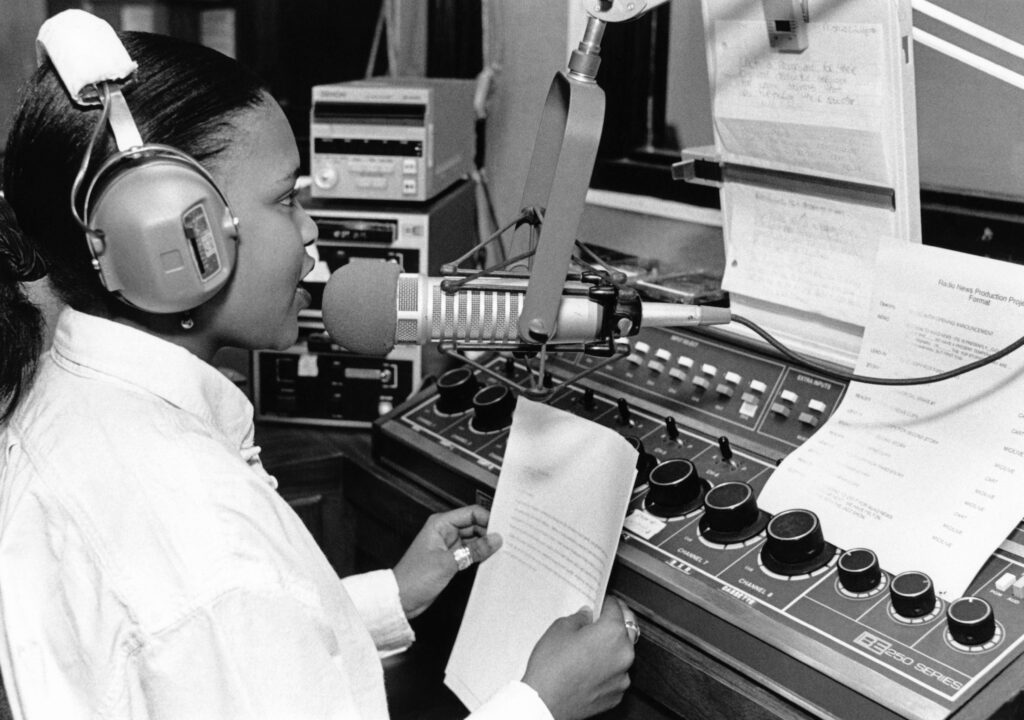
**A Southern University and A&M College student participates in a radio broadcast session in the Mass Communication Department on campus. (Photo by the Archives Department/Southern University and A&M College via Getty Images)