
North Carolina is home to more than 100 higher education institutions. They include large research universities, small private liberal arts colleges, HBCUs, single-gender colleges, community colleges, and others.
Some focus on workforce pipeline training, others are attached to enormous healthcare systems, and several promote being a place where students can discover themselves alongside a close-knit academic community.
All the schools face an unprecedented higher education landscape: declines in the number of available traditional college students; shifts in federal support; and rapidly changing advances in technology.
WUNC higher education reporter Brianna Atkinson asked chancellors and presidents across the state five big questions about how they are navigating this environment.
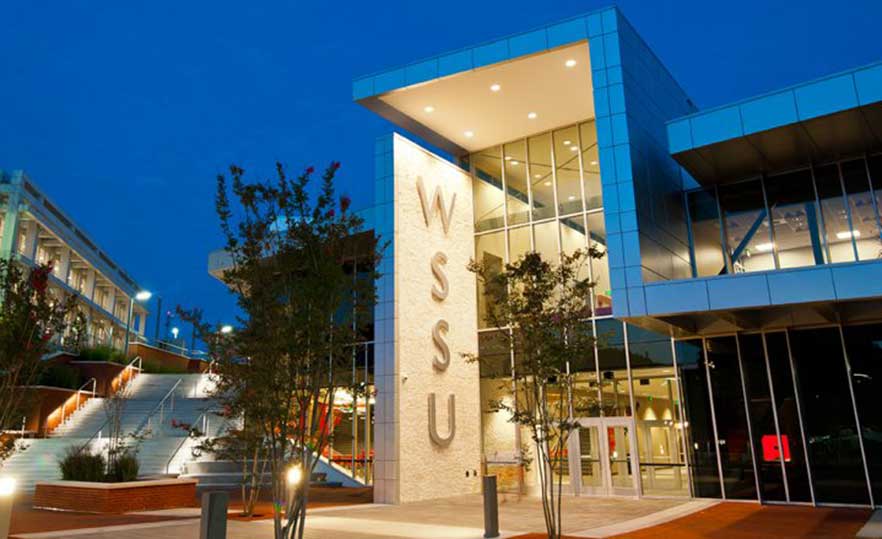
Winston-Salem State University is the next-to-smallest of five public historically Black colleges and universities in North Carolina. The university is focused on social mobility and has lately been investing more in health sciences like nursing. It serves almost 5,000 students, with most coming from Forsyth, Mecklenburg, and Guilford counties. Enrollment has been slowly increasing the past couple of years, after a 200-student drop around the pandemic. Almost 75% of its student body is female, following a national trend of fewer men attending HBCUs. WSSU also has a large portion of first-generation learners and more than 70% of its students are pell-eligible.
Bonita Brown has been the university’s chancellor for more than two years. She came in on the heels of the HBCU facing a $3.3 million deficit and cuts to several dozen staff positions (most of which were vacant). The university is still continuing to evaluate other positions for “realignment” as they become vacant. Like other public universities in the state, WSSU is also trying to address a deferred maintenance backlog and several outdated campus buildings.
Brown started in July 2024, becoming Winston-Salem State’s first permanent female chancellor.
What is one important thing happening in higher education and affecting your institution that no one is talking about?
One issue that deserves more attention is the growing gap between those who have access to higher education and those who may be pushed further away from it by financial barriers. At Winston-Salem State University, approximately 71 percent of our students are Pell Grant eligible, which means federal financial aid is often the difference between attending college and not attending at all.
As conversations continue around higher education funding and financial aid policies, we cannot lose sight of the fact that access remains a very real challenge for many students and families.
That’s why investments in student success matter. Winston-Salem State University has seen firsthand the impact of transformational philanthropy. Through MacKenzie Scott’s combined $80 million investment in our university, we have been able to expand scholarships, strengthen academic programs and create new opportunities for student success. Those resources help remove barriers that might otherwise prevent talented students from reaching their full potential.
One of the things we must never forget is that talent has no zip code. Exceptional potential exists in every community and neighborhood. The responsibility of higher education is to help students realize, develop and maximize that potential regardless of their socioeconomic circumstances.
A second trend that deserves greater attention is the changing demographics of college enrollment, particularly among men. Across the country, fewer men are enrolling in and completing college than in previous generations. At Winston-Salem State University, approximately 74 percent of our student population is female, a reflection of a broader national trend.
The success of women in higher education is something to celebrate. At the same time, we should be asking important questions about why fewer men are pursuing college, what barriers may exist and how institutions can create pathways that encourage more young men to see higher education as a viable and valuable option for their futures.
If you could make one change to how higher education is viewed in this country what would it be?
If I could change one thing, it would be the perception that higher education is primarily about status, prestige or exclusivity rather than opportunity, transformation and service.
Increasingly, people are questioning whether college is worth the investment, and that’s a fair question. Families want to know they are getting value and that a degree will open doors to meaningful careers and economic mobility.
At Winston-Salem State University, we believe higher education should be measured not by the name on a diploma, but by the opportunities it creates and the lives it transforms. We are proud to provide a high-quality education at an exceptional value, preparing students to succeed in the workforce, graduate school and their communities.
That impact is best illustrated through student success. This year, among our largest spring graduating class in more than a decade – 905 graduates – we highlighted students such as Ja’Moya Blue and Devin Cunningham. Ja’Moya became a student researcher studying diabetes, presented at national conferences and is headed to Brown University this fall to pursue her graduate degree at an Ivy League institution. Devin arrived at WSSU on a football scholarship and is headed to law school at Elon University.
Their stories are not exceptions. WSSU alumni can be found at some of the world’s most influential organizations, including Apple, Google, Microsoft, Cisco, JPMorgan Chase and even the NBA. You’ll find Rams in courtrooms shaping justice, in boardrooms driving innovation, in classrooms inspiring the next generation, in hospitals delivering healing, in laboratories advancing discovery and in public office influencing policy.
What makes me most proud is that our alumni embody our motto, “Enter to Learn. Depart to Serve.”
What is college for?
College is certainly about preparing students for careers, but it is also about preparing them for life and developing well-rounded citizens. At its best, higher education helps students discover their purpose, develop their talents and gain the knowledge, skills and confidence to contribute meaningfully to society.
For many students, college is the opportunity to earn more than previous generations, to build wealth, to achieve greater financial stability and to create new opportunities for themselves and their families – in essence, it is a pathway to social mobility. Winston-Salem State University is proud to be recognized as the nation’s No. 1 HBCU for social mobility because we see every day how education can change the trajectory of a family’s future.
Many of our graduates are the first in their families to earn a college degree, and that degree often leads to careers, earnings and opportunities that were not previously within reach.
College should also cultivate problem-solvers, innovators, entrepreneurs and engaged citizens. Our communities need graduates who can launch businesses, create jobs, strengthen local economies, improve health outcomes, address complex challenges and lead with integrity and compassion. Higher education provides students with the tools, experiences and resources to do exactly that.
Ultimately, college is about expanding possibilities.
What’s something on your campus that’s giving you hope and how do you envision your institution will look in the next 5-10 years?
Through our strategic plan, “We Are Rising,” we are building on a strong foundation while positioning ourselves for an even greater future, particularly in the health sciences, where we have long been a leader and where we see tremendous opportunity for growth.
Today, WSSU is the nation’s leading producer of Black nurses, and we are expanding our impact through new academic offerings such as our Master of Public Health program and initiatives like the Nursing Fellows Program recently approved in the state budget. These investments reflect the critical role WSSU plays in preparing the next generation of health professionals to meet the needs of North Carolina and beyond.
Looking ahead, I envision Winston-Salem State University becoming the premier destination for health sciences education, research and workforce development among HBCUs. We are already seeing increased opportunities for students and faculty to engage in meaningful research, from regenerative medicine and liver cell development to diabetes research and astrobotany. I believe we will continue to strengthen our research enterprise and position ourselves for Carnegie R2 research status.
I am equally excited about the transformation of our campus. Significant investments in infrastructure, including planned improvements to K.R. Williams Auditorium and Eller and Pegram Halls, will help create learning environments that match the excellence of our students and faculty.
Five years from now, I see a university that is larger, stronger and even more influential – a university that has risen, and not only for academic excellence and social mobility, but also for groundbreaking research, exceptional health sciences programs and its ability to transform lives.
You made history two years ago by becoming Winston-Salem State’s first permanent female chancellor. Before that, you worked in assistant roles at several public and private HBCUs in the state. How does that experience inform how you lead WSSU?
Long before I became a chancellor, I was a student of leadership. Throughout my career, I had the opportunity to serve at several outstanding public and private HBCUs across North Carolina, and some of my most important leadership lessons came from observing the leaders around me. I paid attention to how they made decisions, how they treated people, how they navigated challenges and how they built trust.
Those experiences shaped my leadership philosophy. They taught me that leadership is not about position or title. It is about relationships, listening, learning and creating opportunities for others to succeed.
Perhaps most importantly, what I’ve learned is that people are an institution’s greatest asset. At Winston-Salem State University, our students are the heartbeat of the university, our employees are the foundation of our success, and our alumni carry forward our legacy. When students visit our campus, they often describe feeling a sense of belonging and connection. Whether you are a student, employee, parent, alumnus or supporter, once you become part of WSSU, you become part of what we proudly call the “Ramily.”
That belief in people also reflects what I have always loved about HBCUs: Our greatest strength is our ability to see potential in people and help them become the best version of themselves.
As Winston-Salem State University’s first permanent female chancellor, I am mindful that leadership carries both responsibility and opportunity. I strive to lead with authenticity, transparency and purpose, while ensuring that others have the same opportunities for mentorship, growth and encouragement that were afforded to me.
John Maxwell famously said, “Leadership is caught, not taught.” I have found that to be true. Some of the most valuable lessons I learned did not come from a textbook. They came from watching leaders in action and carrying those lessons forward in service to our students, our university and our community.