
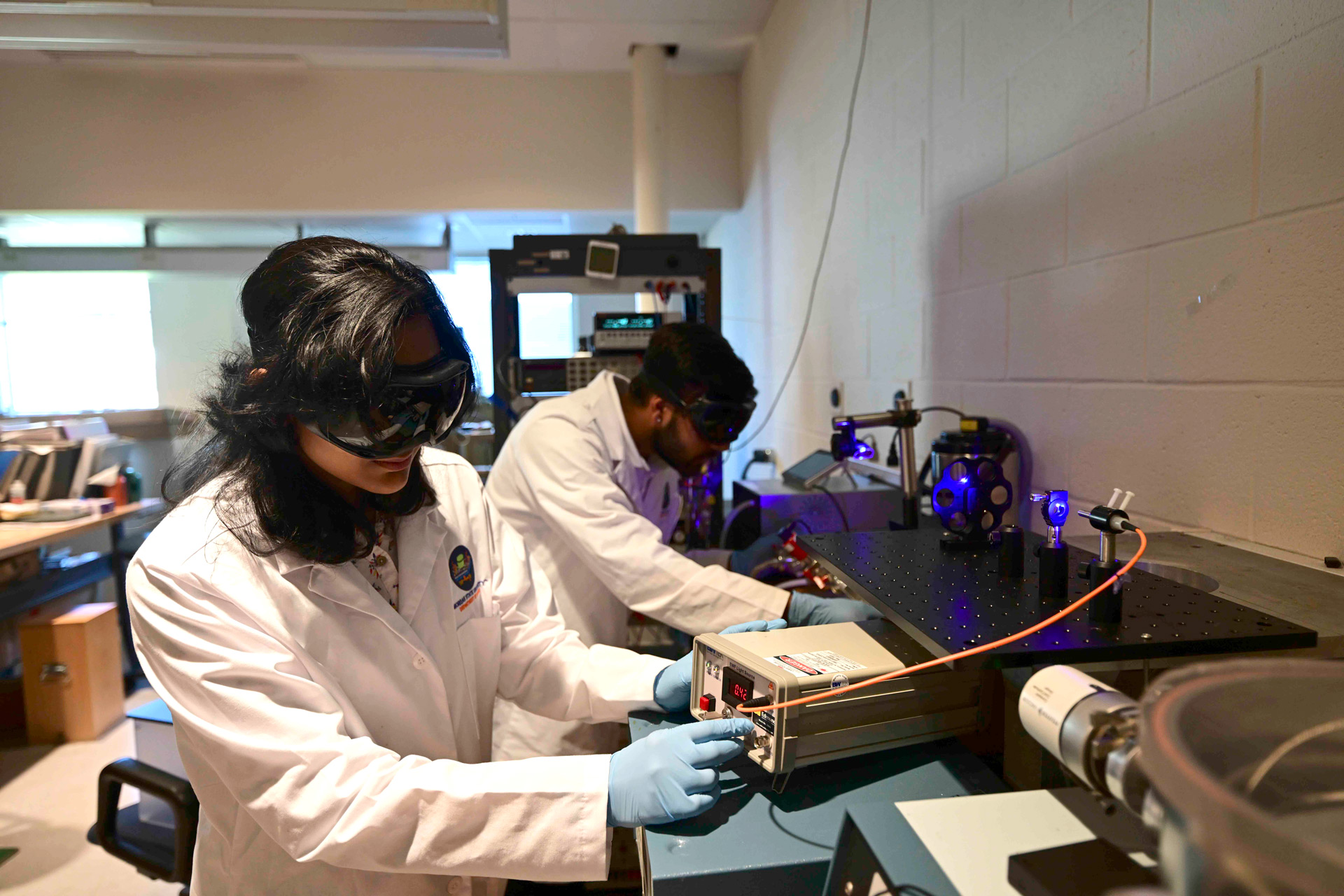
by Morgan State U
As autonomous technologies assume greater responsibility in transportation, infrastructure, communications and other high-stakes environments, ensuring that these systems can operate safely, explain their decisions and withstand disruption has become a defining research challenge. Morgan State University has been selected to help meet that challenge, securing a crucial five-year, $10-million federal grant to establish The Institute for Trusted Autonomous Networks (TITAN), expand research and doctoral training, and strengthen the institutional capacity supporting the University’s advancement toward a Carnegie R1 “very high research activity” classification.
Morgan received the maximum award available through the U.S. Department of War (DoW) Pilot Program to Increase Research Capacity at Historically Black Colleges and Universities and Other Minority-Serving Institutions, which is funded by the DoW Research and Education Program for Black Colleges and Universities/Minority-Serving Institutions (HBCU/MI). Only ten awards have been made nationwide under the highly selective program. The program is administered by the U.S. Army Combat Capabilities Development Command Army Research Laboratory (DEVCOM ARL) through the Army Contracting Command – Aberdeen Proving Ground, Research Triangle Park Division.
Created to help eligible HBCUs and minority-serving institutions attain and sustain the Carnegie Classification’s designation of very high research activity, or R1, the program will invest approximately $100 million in the ten selected institutions. Morgan’s proposal, “Research and Education in Trusted AI Autonomous Systems for National Defense,” earned the full $2 million per year available over the five-year performance period.
The award is an institutional research-capacity investment that will support a coordinated portfolio of interdisciplinary research, faculty development, doctoral and postdoctoral training, student research experiences, workforce preparation and the creation of TITAN as a lasting engine for research growth. The Institute will serve as a central hub for faculty team formation, doctoral research placement, proposal development, innovation tracking and partnership engagement.
“This award affirms the strength of Morgan’s research trajectory and provides catalytic support at a pivotal point in our evolution as a public research university,” said David K. Wilson, president of Morgan State University. “Our pursuit of R1 is not about attaining a label; it is about building the lasting capacity to generate knowledge, prepare more doctoral scholars, attract consequential investment and produce research that impacts national security. We remain steadfast in reaching R1 by 2030, and this federal investment will help us accelerate that work while creating meaningful opportunities for Morgan students to learn, discover and lead.”
Building Networks Worthy of Trust
TITAN will be a University-wide research and education initiative focused on developing reliable, explainable and resilient autonomous systems capable of operating in complex and uncertain environments. The Institute will unite expertise from across Morgan to examine how artificial intelligence, cybersecurity and quantum-enhanced security, resilient communications, wireless networks, robotics, sensing and human-machine collaboration can be integrated so autonomous technologies perform predictably, resist cyberattacks and system failures, and support sound decision-making.
Willie E. May, Ph.D., vice president for Research and Economic Development and professor of chemistry at Morgan, will serve as principal investigator. Kofi Nyarko, D.Eng., professor of electrical and computer engineering and director of Morgan’s Center for Equitable Artificial Intelligence and Machine Learning Systems (CEAMLS), will serve as co-principal investigator and technical lead.
“Autonomous systems will only be as useful as they are trustworthy. Through TITAN, Morgan will integrate trusted AI, secure communications, resilient networks and human-machine systems within one research and education enterprise,” said Dr. May. “Our students will be embedded in that work—conducting research, testing solutions, presenting findings and developing the advanced skills that position them for consequential careers across government, industry and academia. At the same time, the Institute will strengthen the doctoral and postdoctoral pipeline essential to Morgan’s long-term research growth.”
Research will be organized across four integrated science and technology thrusts: trusted AI and autonomous decision-making; cybersecurity and quantum-enhanced security; resilient communications and networked systems; and human-machine teaming, mechatronics and autonomous robotics. Each thrust will pair faculty-led investigation with doctoral research, graduate and undergraduate participation, publishable scholarship and the development of externally competitive projects. Annual cross-thrust reviews and integrated demonstrations will help turn individual investigations into a cohesive research ecosystem. The DoW will provide technical oversight of the program and will work collaboratively with Morgan researchers.
TITAN will leverage the established capabilities of CEAMLS, the Cybersecurity Assurance and Policy (CAP) Center, Center for Education and Research in Microelectronics, National Transportation Center and SMARTER Center, along with expertise and resources across the Clarence M. Mitchell Jr. School of Engineering, the School of Computer, Mathematical and Natural Sciences, the Graduate School and other University units. Morgan will support the Institute through access to existing laboratories, GPU-enabled and institutionally controlled computing resources, graduate collaboration spaces, technology-transfer infrastructure, established research administration and previously acquired equipment.
Students Embedded in the Research
Morgan students will be integral to TITAN, not peripheral to it. Undergraduate and graduate research assistants and postdoctoral fellows will work alongside faculty on interdisciplinary teams, gaining hands-on experience with advanced AI, cybersecurity, quantum technologies, resilient communications, robotics, sensing and human-machine systems. Over five years, the Institute is projected to support approximately 20 research projects, 48 unique STEM research trainees and 24 unique postdoctoral researchers. Twenty-four doctoral students are expected to receive project support as TITAN aligns dissertation research, faculty mentoring and research assistantships with its four technical thrusts.
The initiative will also strengthen the pathway from education to employment. Students will receive mentorship and innovation-management instruction, present their work at annual research symposia, participate in poster sessions and integrated demonstrations, and connect with prospective employers through internships and job-placement events. Across the award period, TITAN projects are expected to engage 68 students and postdoctoral researchers in specialized instruction and symposia, connect 48 trainees with internship and job sessions, and place 20 participating trainees into technical internships or jobs. A dedicated government and industry liaison will be established to coordinate these opportunities with Morgan’s Graduate School, postdoctoral affairs coordinator, faculty and external partners. Morgan students will have access to DoW internship and employment opportunities.

TITAN will further connect research growth with emerging academic pathways. The approved proposal incorporates new and developing programs in advanced computing, Cyber-AI, quantum computing, digital intelligence engineering and autonomous systems to strengthen student recruitment and sustain the pipeline from undergraduate preparation through doctoral study. The Institute’s target is to contribute to a 15% increase in enrollment in Morgan’s STEM doctoral programs—approximately 50 additional students—over the five-year period.
Accelerating — and Sustaining — the Journey to R1
The DoW program closely aligns with Morgan’s institutional goal of attaining Carnegie R1 classification by 2030. Morgan earned R2 status in 2018 and has since expanded its research enterprise through new research centers, additional research-active faculty and postdoctoral researchers, increased faculty support, new doctoral programs and greater institutional investment in research.
Morgan’s annual new research awards increased from approximately $34 million in fiscal year 2021 to more than $104 million in fiscal year 2025. Research and development expenditures have quadrupled since 2019, and the University surpassed $50 million in research expenditures for the second consecutive year in fiscal year 2025. Morgan currently enrolls approximately 2,000 graduate students, including 973 doctoral students and 333 STEM doctoral students. Its current three-year average of approximately 84 doctoral conferrals exceeds the present Carnegie R1 threshold; TITAN is designed to help Morgan sustain that momentum and reach a target of 80 doctoral conferrals annually.
The TITAN award represents the latest milestone in Morgan’s expanding national leadership in artificial intelligence and defense research. Building on the University’s earlier DoW investments in research and equipment, the initiative establishes a comprehensive research ecosystem spanning trusted artificial intelligence, resilient autonomous systems, advanced communications, robotics, and human-machine collaboration. Together, these efforts position Morgan as a leading HBCU contributing to the future of national defense while preparing the next generation of scientists and engineers.
About Morgan
Morgan State University, founded in 1867, is a Carnegie-classified high research (R2) institution offering more than 150 baccalaureate, master’s degree, doctorate and certificate programs. As Maryland’s Preeminent Public Urban Research University, and the only university to have its entire campus designated as a National Treasure by the National Trust for Historic Preservation, Morgan serves a multiethnic and multiracial student body and seeks to ensure that the doors of higher education are opened as wide as possible to as many as possible.