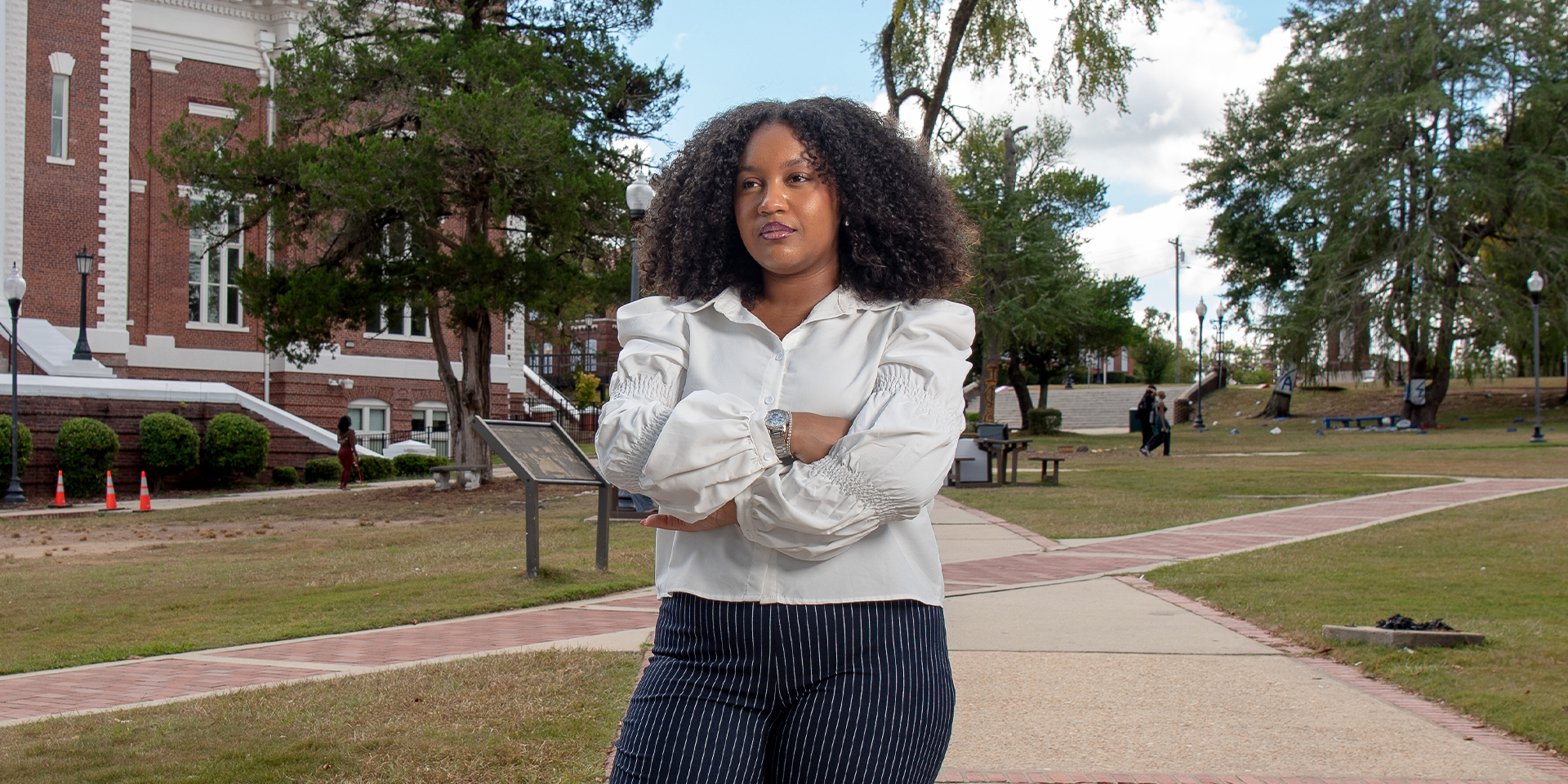



When the leaky roof of her crumbling New Orleans high school left rain-drenched students huddled in moldy classrooms, Alaina Zelaya helped rally her community to demand improvements to school facilities. Now a junior at Tuskegee University in Alabama, Zelaya is channeling that same determination to get out the vote on her campus.
“In class, I’d look up at the ceiling and see cracks and think to myself, ‘What is going on? We should not be going through this,’” Zelaya said. “I was tired of being outraged but not doing anything with the outrage. I’ve always been told by my mother that just talking is not enough. You have to be willing to do something to make a difference.”
Zelaya and other students at historically Black colleges and universities (HBCUs) across the South are working to register, educate and mobilize voters ahead of this year’s midterm elections. Student organizers are responding to the needs of their campuses and communities while partnering with local and national organizations to turn out voters.
Robin Brulé, Vote Your Voice senior program officer at the Southern Poverty Law Center, said student-led organizing has been central to historical and modern movements that strengthened democracy. Launched in 2020, Vote Your Voice — in partnership with the Tides Foundation — supports increased voter registration, participation and civic engagement among communities of color in the SPLC’s focus states of Alabama, Florida, Georgia, Louisiana and Mississippi.
Vote Your Voice is aligned with the SPLC’s We Decide / Decidimos campaign, which is designed to mobilize and unite voters of color across the South and help them create the change they wish to see in their communities and the world.
“Student-led organizing obviously isn’t new,” Brulé said. “It’s the foundational DNA of the Civil Rights Movement. But I think it’s really important that we are not asking students to lead and then treating them as an afterthought. We have to listen to what they say they need and to their lived experiences. Students are necessary to building permanent civic infrastructure that is really critical right now.”
HBCU student perspectives are vital to understanding how to effectively reach young people through voter registration and education efforts, Brulé said.
“If we want to really transform the South, we have to listen to the HBCU students who are already doing the work on the ground every single day and what they identify as their needs versus the assumptions we may make,” she said. “The South is always the battleground for voting access, gerrymandering and structural inequality, and HBCUs sit directly at the intersection of that resistance.”
Students connecting through voter education
On HBCU campuses across the Deep South, students are taking their voter registration and education work beyond traditional campus events, partnering with fraternities, sororities and other student organizations, to help ensure students receive political education and increase their civic participation. They are canvassing door to door, talking with voters in their communities and creating opportunities for students to get information in person and online.
Jakari Holland, a senior at Jackson State University in Jackson, Mississippi, said the goal is to meet students where they are, answering questions face to face or making voting information easier to find and understand online. Holland said posting voting-related videos to social media and engaging with young voters online has given him valuable insight he can use in voter education efforts.
“The feedback I receive from students in my generation has shown me that the problem is not our willingness to vote,” said Holland, a fellow with Vote HBCU at Xceleader, a partner organization of the SPLC’s Vote Your Voice grantee Students Learn Students Vote (SLSV) Coalition. “It is often whether we have the information and access to participate confidently.”
Senior Camrynn Wimberly, first vice president of Jackson State’s National Pan-Hellenic Council, said she believes politicians intentionally make politics difficult to understand. She said one of her biggest priorities is making political processes and information more accessible in Mississippi.
“When talking to politicians, or even speaking in academic spaces, people use all sorts of jargon and it completely diminishes the access of information for [the general public],” Wimberly said.
Meanwhile, in the Florida Panhandle, Florida A&M University (FAMU) junior Jalen Fields said she and other students have been working to develop creative on-campus opportunities for students to learn more about the history of voting rights. Fields is a Campus Vote Project (CVP) democracy fellow. CVP is a project of the Fair Elections Center and also an SLSV partner organization.
Fields said a John Lewis speaker series that several organizations hosted in February — honoring Lewis, the late member of Congress who had chaired the Student Nonviolent Coordinating Committee and was a leader in the “Bloody Sunday” march for voting rights — successfully supported voting advocacy, networking and coalition building on the Tallahassee, Florida, campus.
“The event was a celebratory one that functioned as an educational look into the history of John Lewis and his impact on voting advocacy and an opportunity for student leaders to speak on what still needs to be done in the advocacy space while centering John Lewis’ history,” Fields said.
Students are also looking to local elections as another way to capture people’s interest. FAMU junior Mya Mims, also a CVP democracy fellow, emphasizes the importance of both voting in local elections and centering downballot candidates for the upcoming midterm elections to young voters.
“We hear so much about presidential elections and not enough about the local elections,” Mims said. “Those affect the quality of life that you have … your school district, the parks and everything in your community.”
Responding to voter apathy
Several students said one of the challenges they have encountered is convincing other young people that voting has a direct connection to their lives. They are prioritizing voter education that goes beyond simply reminding people to register and includes helping voters understand how political decisions show up in their everyday lives.
While canvassing with Black Voters Matter, a voter outreach organization that is a Vote Your Voice grant recipient, Mims said she was surprised at how many people expressed disinterest in — or felt disconnected from — the voting process.
“I didn’t realize how many people didn’t want to exercise their rights or just didn’t know that they could register to vote,” she said.
Through conversations with students, Fields said she found the best way to energize students about voting is to highlight issues that impact them directly.
“I think the best way to get students to [take] action in elections is to focus on the things they are pushing back on,” she said.
At Dillard University in New Orleans, senior Roderick Morning-Trice said students are working to help their peers understand that civic participation should be ingrained into everyday life. As vice chair of The Union, Vote HBCU’s student leadership council, he said he is also hoping to help students understand that voting is a personal responsibility and right to exercise in support of democracy — not an act in service of partisanship.
“[Some people] view participating in elections and voting through a very polarized lens versus the act of participating in the democracy that they live in,” he said.
Spelman College junior Tajé George is director of operations for Little Legals, a student-led legal aid organization that helps educate and register young voters. George said she would like to inspire hope in fellow young people by reminding them that those who came before them in this work endured difficult and turbulent times.
“We’re here to help youth get civically engaged, especially youth of color,” George said. “We’re not just encouraging the youth to vote but to know why they’re voting — the consequences and the benefits. We’re the youth, the ones that steer the future. We can’t steer the future if we’re already giving up. It’s going to be hard, but try not to give up and keep pushing forward.”
Challenging barriers to voting
HBCU students across the South are also confronting structural barriers to voting head-on as they help students navigate challenges specific to their campuses and communities.
In the city of Tuskegee where the university is located, Zelaya said students are working to incorporate voter registration into popular local events, including rodeos and trail rides.
“Since rodeo events are always a hit at Tuskegee, we can build off that momentum,” she said.
But the challenges do not go away after students are registered. Tuskegee University senior Chasity Player is among many students who cannot vote on their campus or in local elections where they attend college and spend much of their time.
Despite wanting to live near campus, a housing shortage forces Player and other students to live 30 minutes away in Auburn. As Auburn residents, the students cannot use the polling place on Tuskegee’s campus to vote nor vote in Tuskegee’s municipal elections.
“It drives [students] away from voting, and it makes them feel helpless,” said Player, who is a campus and community liaison for the SPLC’s Alabama state office.
Legislative roadblocks
Students are also working to keep up with changes to voting laws and ensure their peers understand what those changes mean for them. Florida and Louisiana recently changed voter identification laws, and student organizers are already preparing for the impact on young people when critical changes go into effect in 2027.
At Xavier University of Louisiana, sophomore Jordyn Nesbitt said several student organizations are partnering to host workshops to inform students of the changes to voter ID laws and help them navigate voting.
“There’s a lot of things going on, not even just in Louisiana, making it harder for people to vote,” Nesbitt said.
Mims emphasized that utilizing voter education beyond traditional election cycles would be the biggest priority for organizers on her campus going forward because many students aren’t aware of voting laws that govern processes like voter registration.
“A lot of students won’t be registered, or they’ll miss the deadline,” Mims said. “So, we’re constantly trying to make sure that it’s a topic of conversation.”
Some student organizers said they have found the voting process confusing themselves, particularly when trying to determine what information is accurate and when different requirements apply. The students say K-12 schools should do more to prioritize education about voting in their curricula and help eligible students register.

Oakwood University senior Amani Williams, a California native, preregistered to vote as part of a high school history class. When she relocated to Huntsville, Alabama, to attend Oakwood, she was shocked to learn that many of her peers had not received the same opportunity.
“It was just something that was already a part of our curriculum,” said Williams, who is currently serving as Oakwood’s student government parliamentarian and a Vote HBCU fellow. “I knew that I was going to be voting before I could vote.”
Williams said voter education should be prioritized in high school so young people who do not attend college can learn about their voting rights.
“Not everybody makes it to college, but most people go through high school, so [voter awareness] definitely has to begin earlier,” she said. “It definitely has to be ingrained in our thought patterns to change culture.”
Building on the HBCU legacy
The students’ voter advocacy sits within a longer history of HBCUs as pillars of political and cultural organizing. From the Harlem Renaissance to the Civil Rights Movement, CVP HBCU Lead Justin Calhoun said HBCU students participated in campaigns and mobilization efforts that have helped build Black political power.
“HBCUs are where Black political leadership is developed from generation to generation and passed down,” Calhoun said. “It’s a continued legacy of work that HBCU students have a passion for doing.”
That legacy is a point of pride for the students. Vote HBCU ambassador Benjamin McDonald, a junior at Bethune-Cookman University in Daytona Beach, Florida, is leading voting advocacy work on campus. He said the work of civil rights leaders, including Mary McLeod Bethune, who founded Bethune-Cookman with just $1.50 and five young girls as students, inspires and empowers him.
“I’m walking in the legacy of the people who have come before me, those who were also out there just trying to do the right thing,” McDonald said.
Fields said she considers educating young people about Black leaders who paved the way for student activists today a critical part of voting rights work.
“That legacy teaches us that you have your own voice, and you can do something your way, and it can be celebrated,” she said. “Continuing that shows the students that come after me that they can also do that as well.”
For Alaina Zelaya, the work of building student power is rooted in the same belief that first pushed her to speak up for better conditions at her New Orleans high school.
“When I look back at what little Alaina went through, it’s very disheartening,” Zelaya said. “But now, I turn that sadness into advocacy. I choose to focus on preventing the next generation from going through what I went through.”