
The University of Arkansas at Pine Bluff will receive $1.6 million in additional federal funding through the U.S. Department of Education’s Title III Strengthening Historically Black Colleges and Universities Program to support institutional capacity and advance student success.
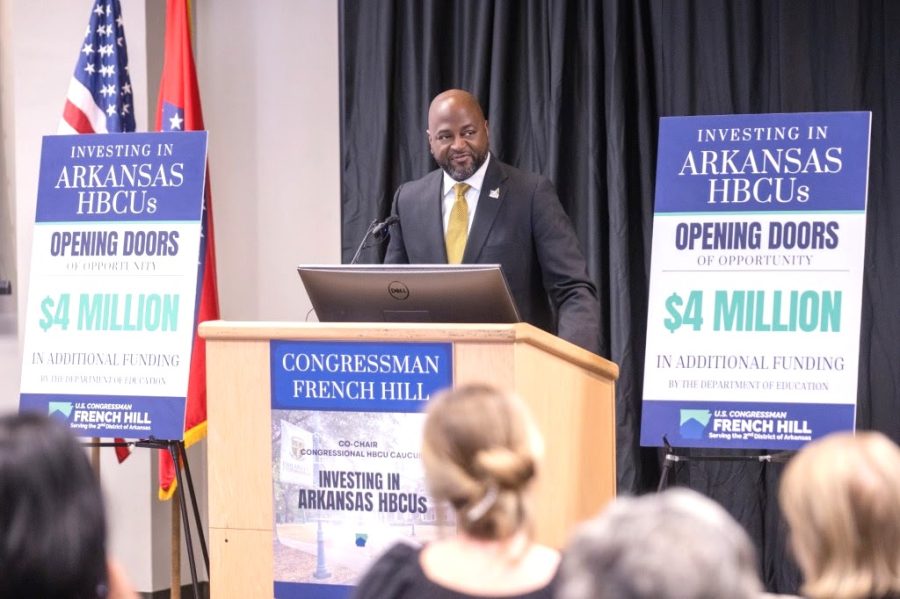
UAPB Chancellor Anthony Graham joined U.S. Rep. French Hill and leaders from Arkansas Baptist College, Philander Smith University and Shorter College on Sept. 28 at Philander Smith in Little Rock to announce more than $4.2 million in additional federal funding for Arkansas’ four Historically Black Colleges and Universities.
“These awards recognize something that I’ve long believed — that investing in our HBCUs is an investment in our young people, an investment in our workforce, and an investment in the success of our communities,” Hill said.
The supplemental funding builds on federal Title III investments in HBCUs and can support academic programs, student services, facilities, technology, and financial management.
Graham said the additional funding comes as UAPB sharpens its focus on four-year degree completion, career readiness, and strengthening its regional economic impact as Arkansas’ only 1890 HBCU land-grant institution.
Support Local Journalism
Independent reporting for Pine Bluff & Jefferson County since 1881.
“Like HBCUs throughout this country, our historic mission has been rooted in access,” Graham said. “But access alone is not enough. Access without success is an incomplete promise. Our responsibility does not end when a student enrolls. We must ensure our students engage, learn, persist, progress toward their degrees, graduate and leave our university prepared for the opportunities that await them.”
“The measure of this investment will not simply be how much money UAPB receives,” the chancellor said. “The measure will be what changes because we received it. Are more students persisting and graduating in four years? Are our graduates prepared for meaningful careers and lives of impact and transformation? And is UAPB becoming stronger and better positioned to fulfill its mission? Those are the outcomes that turn investment into impact.”
Also Sept. 28, Hill, who serves as co-chair of the bipartisan Congressional HBCU Caucus alongside U.S. Rep. Alma Adams of North Carolina, highlighted their work on the IGNITE HBCU Excellence Act, which seeks to strengthen HBCU infrastructure and encourage greater public and private investment in the institutions. He also discussed efforts to expand HBCUs’ participation in federally funded research.