
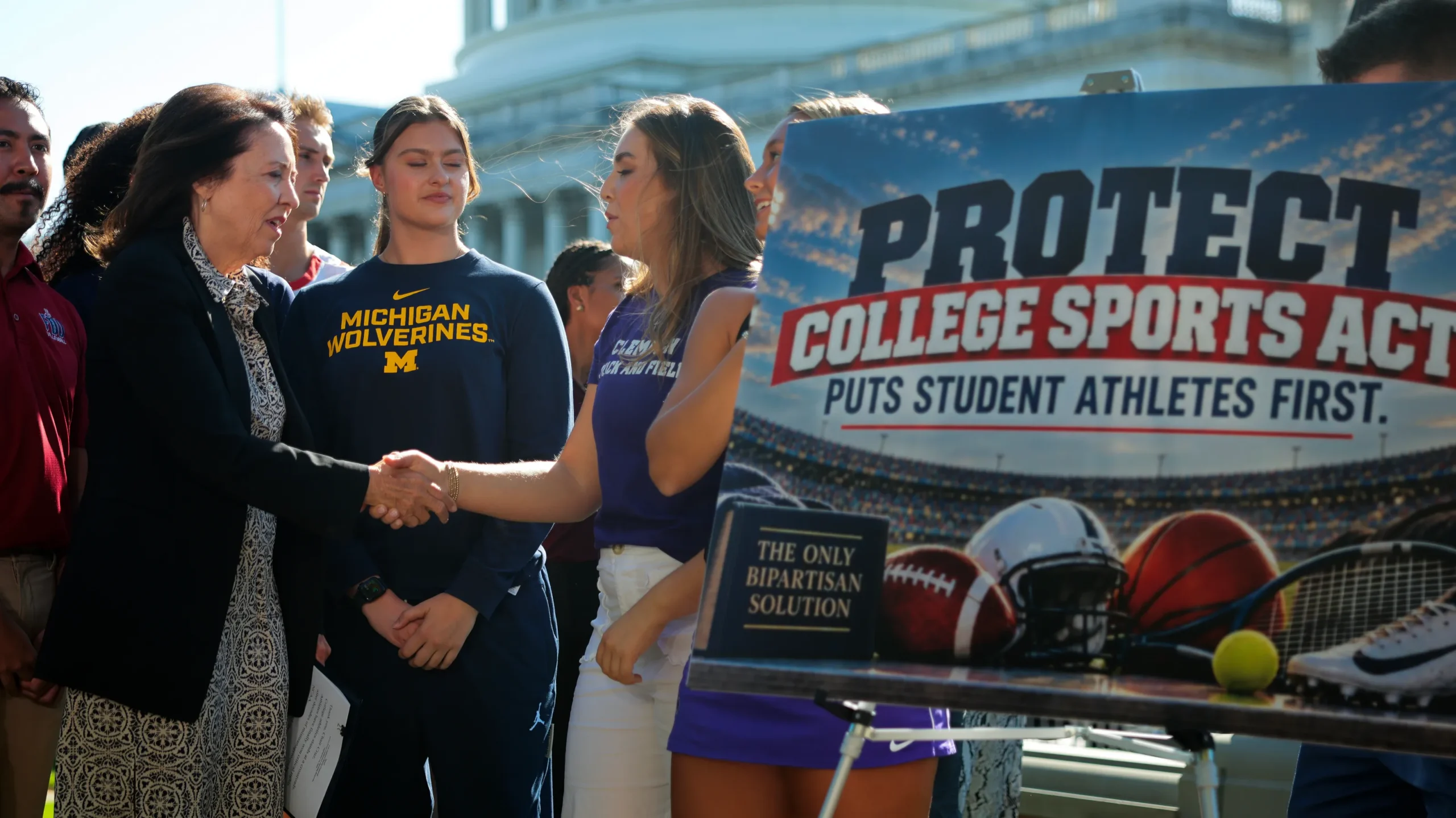
College athletes could gain new guarantees for compensation, scholarships and medical care under a sweeping federal proposal — but restrictions on their earnings, transfers and ability to challenge NCAA rules have divided South Florida athletic leaders and civil-rights advocates.
The Senate passed the Protect College Sports Act of 2026 by a 77–22 vote Sept. 28, sending the bipartisan proposal to the House, which is not expected to return until after the November midterm elections.
The legislation would establish national rules for direct payments from universities, athletes’ name, image and likeness (NIL) earnings, transfers and eligibility. It would also provide scholarship and medical protections while giving the NCAA, athletic conferences and schools limited protection from antitrust lawsuits challenging covered rules.
Sen. Ted Cruz, sponsor of the PCSA, speaks about the bipartisan legislation on Sept. 14.
(Sen. Ted Cruz via Facebook)
More money, unequal resources
The proposal builds on the 2025 House v. NCAA settlement, which allowed participating Division I schools to share athletics revenue directly with players, separately from scholarships.
The bill would allow an additional retention pool for athletes who have completed at least one competitive season at their school. Of the $27.5 million allowance, schools could spend $22.5 million on player retention and qualify for another $5 million through spending on women’s and Olympic sports. Schools could but would not be required to spend the full amount.
A member of the FIU Football team celebrates a victory.
(FIU Athletics via Facebook)
South Florida-based sports attorney Darren Heitner said equal rules would not eliminate resource disparities.
“[University of] Miami can absorb the revenue-sharing cap and the retention pool. FIU is a different story,” Heitner told The Miami Times. “The rules apply the same way on paper, but FIU may not have the resources to fund a retention pool at anywhere near the level a Power Four program can, which means the practical compensation gap widens even as the regulatory framework becomes uniform.”
FIU Panthers walk to their training.
(FIU Athletics via Facebook)
FIU Athletics Director Scott Carr said the university supports the proposal but acknowledged that his program is below the existing ceiling.
“The cap is $21.5 million. We’re not there,” Carr said.
Scott Carr, FIU Athletics Director.
(FIU Athletics)
Carr said an enforceable ceiling would improve a system in which programs allegedly exceed limits through NIL arrangements.
“For a school like FIU, we would welcome a new cap, even though the new cap is projected to be twice as big,” Carr said. “We would still welcome that because that will allow everybody to know where they are and to make competitive decisions based on it.”
Reaching the higher ceiling, Carr said, would require more ticket sales, sponsorships, donations and facility rentals.
HBCU investment is not guaranteed
A Florida Memorial Lion during a football game.
(Florida Memorial Lions via Facebook)
The bill would also establish an HBCU Sports Media and Connectivity Program authorizing up to $180 million annually from 2027 through 2032.
Competitive grants could support broadband production studios and streaming equipment, helping schools broadcast games and attract sponsors. Institutions with smaller endowments, limited fundraising capacity and significant infrastructure needs could receive priority.
The Florida Memorial Lions baseball team.
(Florida Memorial Lions via Facebook)
Florida Memorial University, an HBCU competing in the National Association of Intercollegiate Athletics (NAIA), could potentially benefit. But the bill authorizes funding without providing it. Congress must appropriate the money, federal agencies must implement the program, and universities must apply for grants.
“The bill offers vague promises of funding for HBCUs as a political trade-off for the harm this legislation will do to Black student-athletes,” NAACP President and CEO Derrick Johnson said in a statement. “We cannot continue to ask Black student-athletes to generate billions in revenue on the field and the court while they shoulder all the risk and receive none of the guaranteed security they deserve.”
Locally, Miami-Dade NAACP Branch President Daniella Pierre said the bill is missing an important piece: student-athletes’ perspectives.
“Right now as we see it, we don’t see any students at the table,” Pierre said. “They have a right to be a part of the process. They have a right to guide the conversation, to be a part of the policy-making decisions.”
The Congressional Black Caucus also opposed the proposal, saying the bill limits “opportunities for Black athletes, Black coaches, Black agents, Black entrepreneurs, and HBCUs.”
The bill includes two separate representation requirements. It would reserve two seats for HBCU representatives on the proposed Commission on the Future of College Athletics. It would also require covered athletic associations, including the NCAA and NAIA, to give current or former college athletes at least one-third of the voting seats on their principal governing bodies and rulemaking committees.
“Right now as we see it, we don’t see any students at the table. They have a right to be a part of the process. They have a right to guide the conversation, to be a part of the policy-making decisions.” -Daniella Pierre, NAACP Miami-Dade
(Catalyst Miami)
Different protections for different schools
HBCUs would not benefit equally under the bill. Division I institutions would be held to higher compensation and medical standards than schools outside the NCAA.
FMU does not participate in the NCAA Division I revenue-sharing system. Of the 365 NCAA Division I institutions, only 21 are HBCUs. The bill’s Division I medical guarantees, including five years of post-eligibility coverage for qualifying sports injuries, would not extend to NAIA athletes.
A national medical trust fund would help lower-resource Division I institutions meet those obligations. Covered athletes could receive scholarship support to finish a degree for up to 10 years after eligibility ends.
Broader provisions would prohibit reducing athletic aid because of injury, illness, performance or roster decisions, as well as prevent schools from steering athletes into particular majors. Athletes would also be protected from losing eligibility or aid solely for entering lawful NIL agreements.
FMU Athletic Director Chandra Dorsey-Felton declined an interview with The Miami Times but said she is monitoring the legislation.
“While much of the discussion surrounding this legislation has centered on NCAA Division I, there are provisions that could have implications for smaller institutions like Florida Memorial and other HBCUs competing at the NAIA level,” she said.
Other provisions that could reach NAIA institutions include federal NIL protections and a requirement that athletic associations establish an independent Student-Athlete Ombudsman Office, which would provide athletes with free, confidential assistance involving contracts, disputes and reports of possible violations, along with protections against retaliation.
What would change for NIL?
NIL allows athletes to earn money through activities such as advertisements, social media promotions and autograph signings. Those external business deals differ from payments made directly by universities.
Florida law protects athletes’ NIL rights and requires covered colleges to conduct workshops on financial literacy, life skills and entrepreneurship before an athlete graduates. Unlike the federal proposal, Florida’s NIL statute does not limit how much schools collectively may pay their athletes or regulate athlete transfers.
The federal proposal would replace conflicting state NIL, transfer and eligibility laws with national standards.
The legislation would strengthen oversight of third-party agreements to distinguish genuine endorsements from booster or collective payments intended to recruit or retain athletes while circumventing the compensation limit.
Division I athletes would have to disclose NIL agreements worth more than $600, generally within five days. Agents would need state registration, and endorsement-contract fees could not exceed 5% — $500 on a $10,000 deal. Florida’s current NIL statute does not contain an equivalent percentage cap.
“I think it’s good to have the agent registry where agents need to be registered and to help protect some of our student-athletes that there’s going to be a cap on the agent fees that they can receive,” Carr said. “That’s going to really help our student-athletes, who have been paying some pretty large percentages of what they’re bringing in to agents.”
South Florida-based sports attorney Darren Heitner.
(Heitner Legal)
Heitner questioned how the new compensation rules would affect athletes’ earning potential.
“The retention pool gives schools a new, direct way to pay players, which helps players who might otherwise get nothing, but the bill’s prohibited-compensation language is aimed squarely at the collective-driven, market-rate deals that have produced the largest paydays over the past few years,” he said.
Who holds the power?
The bill generally would allow athletes one transfer without sitting out within a five-year eligibility window, with exceptions including coaching changes, graduate study, discontinued sports, or sexual assault or harassment.
“It does limit them a little bit more,” Carr said. “But I do think that’s good for the overall health of college athletics and ultimately for the young people as well.”
Heitner argued the restrictions would reduce athletes’ ability to seek better compensation elsewhere.
“Limiting athletes to one penalty-free transfer meaningfully reduces their leverage,” he said. “The free-agency dynamic of the last several years, where a player could shop a program every offseason, has been the single biggest driver of the compensation increases we have seen at the top of the market.”
The legislation would also give the NCAA, conferences and schools limited antitrust protection when enforcing covered rules.
“This bill trades away the primary tool athletes have used to force compensation reform, antitrust litigation, without giving them anything comparable in return,” Heitner said.
The bill is neutral on whether athletes are considered employees. Critics say schools and conferences would receive protections resembling those secured by professional leagues, without bargaining with college players.
“The legislation passed by the Senate fails to provide student-athletes with employment rights, includes antitrust provisions that restrict student-athletes’ ability to bring private legal action when disputes arise, and fails to guarantee funding for HBCUs, among other significant shortcomings,” the Congressional Black Caucus said.