
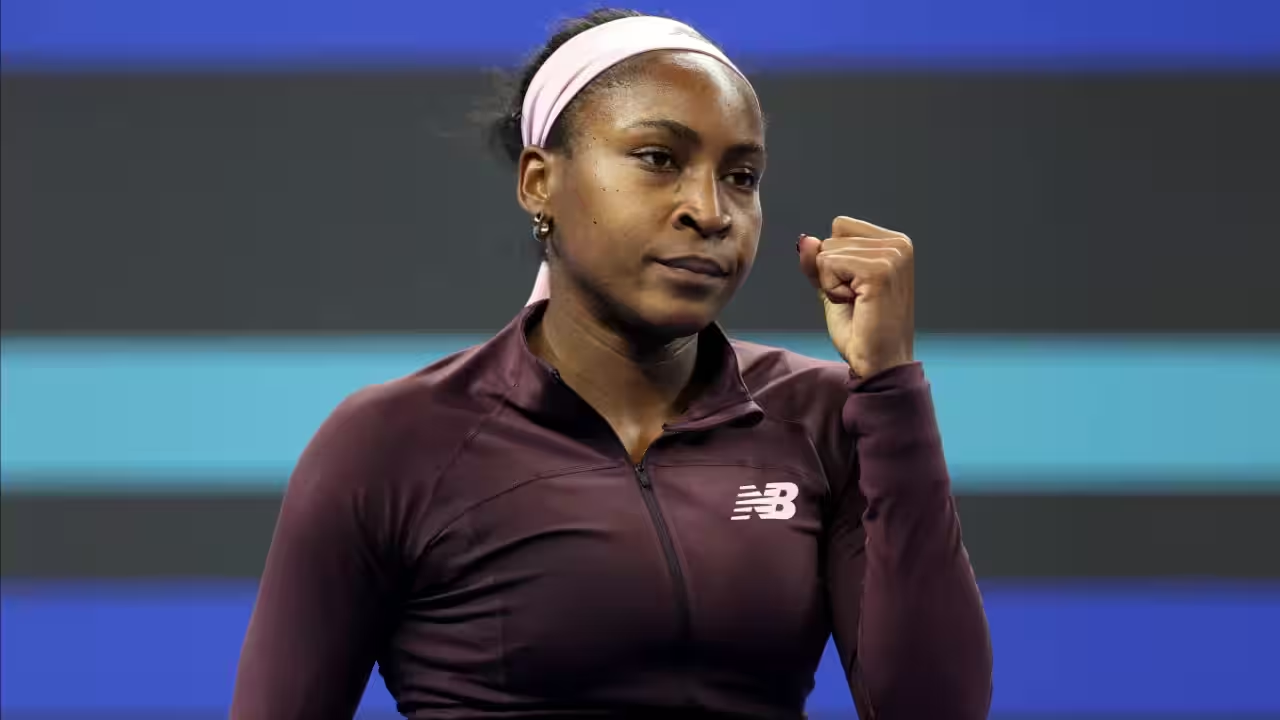
Coco Gauff’s success on the tennis court has helped create opportunities for young players and college students across the United States. Following her 2023 US Open victory, the United States Tennis Association (USTA) committed $3 million to improve public tennis facilities nationwide. She has also donated $250,000 to the United Negro College Fund (UNCF) over two years to support tennis players attending historically Black colleges and universities (HBCUs). These efforts connect Gauff’s own journey, which began on public courts, with her goal of helping more young people access tennis and higher education.
How did Coco Gauff’s US Open victory lead to a $3 million public tennis court initiative?
Coco Gauff won her first Grand Slam singles title at the 2023 US Open, defeating Aryna Sabalenka in the women’s final. At 19, she became the youngest American woman to win the tournament since Serena Williams in 1999. Her victory earned her $3 million in prize money, and the USTA announced an initiative matching that amount to improve public tennis facilities across the country.The programme, called the US Open Legacy Initiative, was designed to give more people access to safe, well-maintained courts. Its funding supports projects at parks, schools and other public facilities, including resurfacing work, lighting improvements and larger construction projects.
For Gauff, the idea has a direct connection to her childhood. She learned to play tennis on public courts in Delray Beach, Florida, where her family helped her develop the skills that would eventually take her to the biggest tournaments in the sport.Public facilities can give children a place to practise without requiring access to expensive private clubs. However, the condition of those facilities matters, too. Worn surfaces, damaged courts and poor lighting can make regular play difficult for young athletes.The USTA announced the $3 million commitment on September 9, 2023, following Gauff’s victory. The organisation said the programme would use its Tennis Venue Services programme to support court repairs and improvements across America.The initiative therefore went beyond celebrating a Grand Slam champion. It linked one of the biggest moments in Gauff’s career to investment in the facilities that help young players get started.
What changed at Pompey Park after Coco Gauff returned to Delray Beach?
In March 2024, Gauff returned to Pompey Park, the public facility where she learned to play tennis, for the unveiling of its renovated courts. The project was one of three locations she personally selected for the initiative.According to the USTA, nearly $60,000 in grant funding went towards resurfacing the park’s two hard courts. The work also included new fence fabric, windscreens, shade structures and benches. The improvements gave local players a better place to practise while honouring the park’s connection to Gauff’s career.The tennis courts also hold family significance. Gauff’s grandfather, Eddie “Red” Odom, and her maternal grandmother, Yvonne Lee Odom, helped establish the Delray Beach American Little League, which encouraged children, particularly those from Black communities, to participate in baseball.Speaking at the court dedication, Gauff said: “I strongly believe that tennis can continue to become a more accessible sport, and I would like to thank the USTA for continuing to commit to do so,”She added: “Investing in public parks and our youth is very important. I had a huge dream and this city, my family, my community supported that, and now I’m in the position to help maybe spark that dream in another kid.”The project was not limited to her hometown. In 2025, the initiative reached Joe Brown Park in New Orleans East, where 10 tennis courts were refurbished. The Gauff family selected the location because of its strong ties to New Orleans.The USTA reported in November 2025 that the initiative had reached more than 100 facilities, with improvements made to over 700 tennis courts nationwide. The organisation also confirmed that the programme had met its $3 million funding goal.For children who cannot afford private tennis facilities, these public courts offer another way to learn the sport. They also give communities spaces where young players can practise and take part in local tennis programmes.
Why has Coco Gauff donated $250,000 to HBCU tennis scholarships?
Gauff’s work also reaches students who want to continue playing tennis while attending college. In January 2026, she made a second major donation to UNCF, giving the organisation $150,000 after contributing $100,000 in 2025. Her total donations to the organisation over the two years reached $250,000.The money supports scholarships for student-athletes who compete in tennis at historically Black colleges and universities. These institutions, commonly known as HBCUs, have played an important role in providing higher education opportunities to Black Americans.For student-athletes, college tennis can bring extra expenses alongside tuition and other education costs. Scholarship support can help students manage those costs while continuing to compete.UNCF said the Coco Gauff Scholarship Program had awarded scholarships to 10 eligible student-athletes attending Alabama Agricultural and Mechanical University, Albany State University, Clark Atlanta University, Howard University, Livingstone College and Tuskegee University.The programme connects Gauff’s support for tennis with her interest in education. Instead of focusing only on younger players entering the sport, her donations also support those trying to balance university studies with competitive tennis.Announcing her second gift in January, Gauff said: “I am honored once again to give back and support the incredible work that UNCF does to help HBCU students get to and through college,”She continued: “Education has the power to change lives, and I hope this gift will help students achieve their dreams.”UNCF also described Gauff as its youngest major gifts donor. The scholarship programme gives student-athletes financial support as they work towards their academic goals and continue representing their colleges in tennis.The distinction matters because access to the sport does not end when a young player leaves a local court. Students also need opportunities to continue competing as they move into higher education. Gauff’s contributions help address that need by supporting players at institutions that are often overlooked in discussions about college tennis.
What does Coco Gauff’s community work mean for young tennis players?
Gauff’s projects connect three stages of a young athlete’s journey: learning the sport, developing competitive skills and continuing education. The renovated courts give children public places to practise, while the UNCF scholarships help college players continue competing as they study.Her own experience at Pompey Park is central to that approach. She began on public courts before reaching the top level of professional tennis. By supporting similar facilities, she is helping preserve access to the kind of spaces that played a part in her development.
The US Open Legacy Initiative also shows how a major sporting achievement can lead to investment beyond the tournament itself. Its work has reached communities far from New York, including Delray Beach and New Orleans, with improvements to hundreds of courts.Her donations to UNCF add an educational side to those efforts. The $250,000 contributed across 2025 and 2026 supports HBCU tennis scholarships, giving student-athletes financial help as they pursue degrees and continue playing the sport.Together, the court renovations and scholarship funding show how Gauff has directed part of her success towards opportunities for other players. The work covers both the public spaces where children first pick up a racquet and the college programmes that allow some of them to keep playing.