
Courtesy of Delaware State University
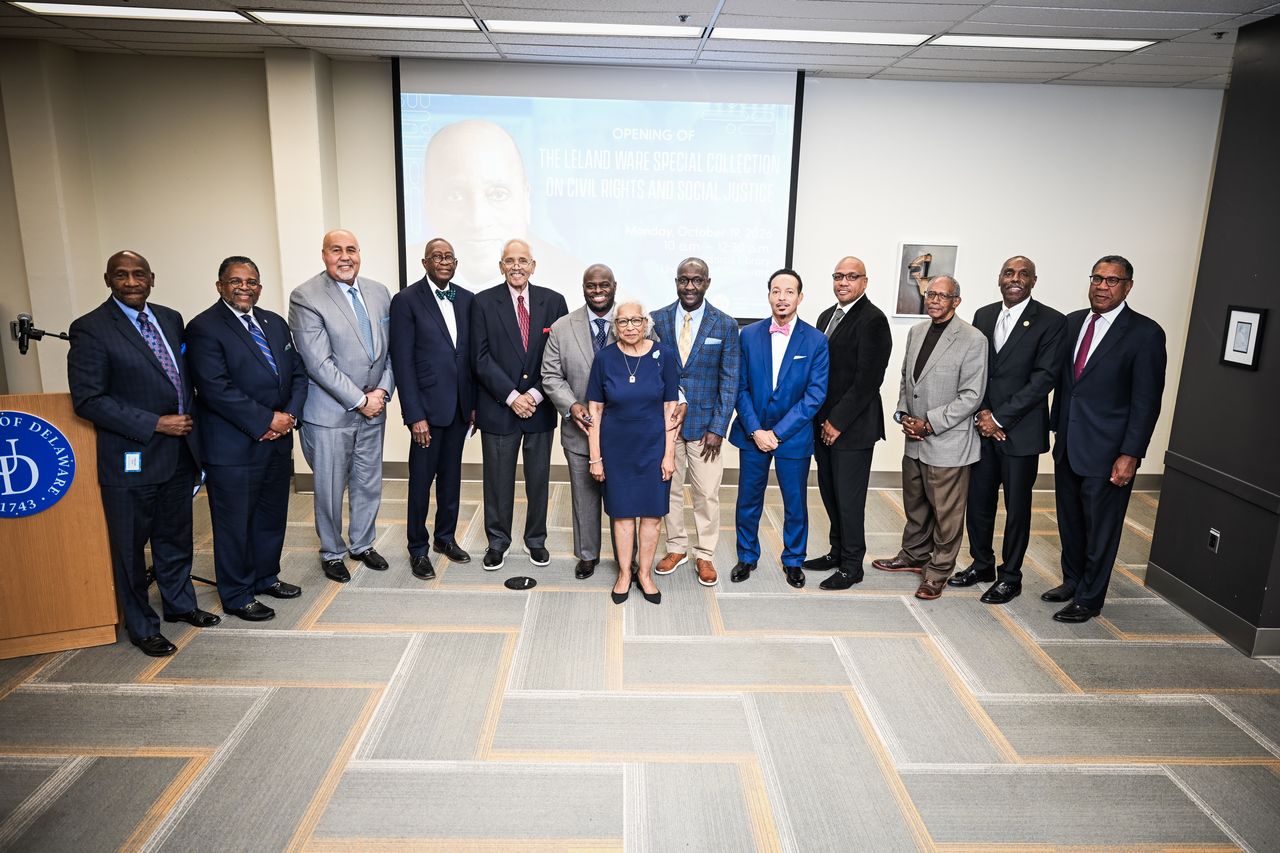
Delaware State University joined the University of Delaware on Monday, Oct. 19, for the opening of the Leland Ware Special Collection on Civil Rights and Social Justice in UD’s Morris Library — a celebration of a scholar whose life’s work is permanently woven into the histories of both universities.
Ware, a nationally recognized civil rights scholar, educator and public servant, was the inaugural holder of the Louis L. Redding Chair for the Study of Law and Public Policy at UD, a position he held from 2000 until his retirement in 2023. He died April 26, 2026, at age 77.
For Delaware State University, the legacy honored Monday begins with its own students. In 1950, Louis L. Redding — the first African American admitted to the Delaware bar — and Jack Greenberg of the NAACP Legal Defense Fund represented ten Black students, all then enrolled at Delaware State College, now Delaware State University, who had been denied admission to the University of Delaware.
In Parker v. University of Delaware, the Delaware Court of Chancery found the education offered those students was not equal to what UD provided and ordered their admission — making UD the first state-funded university in America desegregated by court order, four years before Brown v. Board of Education. Fifty years later, Ware arrived to hold the chair bearing Redding’s name — chosen, fittingly, on the recommendation of that same Jack Greenberg.
Delaware State University President Tony Allen, who studied under Ware as a doctoral student at UD and later became his co-author, delivered reflections at the family’s invitation alongside Charles S. McDowell, retired partner at Potter Anderson & Corroon. In 2002, Ware and Allen co-wrote “The Geography of Discrimination” in the National Urban League’s State of Black America; that same year, Ware and his doctoral student David Rudder produced The Pace of Progress for the Metropolitan Wilmington Urban League — the first full accounting of the state of Black Delaware ever produced.
“We called our tribute to him ‘A Full Quiver,’ after E. O. Wilson’s standard: the ideal scholar thinks like a poet, works like a bookkeeper and writes like a journalist. Most serious people get one of the three. Leland Ware had the whole quiver,” Allen said in his remarks.
“Leland was guided by a simple truth: if you cannot prove it, it is not a fact,” Allen said. “His whole life was kept in receipts — and a special collection is receipts made permanent. Some student is going to sit in this library — a library Louis Redding and Jack Greenberg went to court to guarantee her library card — and check the record for herself.”
Ware’s national contribution came through legal scholarship, teaching and public history. His work explains why the end of legally mandated segregation did not erase racial disparity. His most notable publications include A Century of Segregation: Race, Class, and Disadvantage (2018), Brown v. Board of Education: Caste, Culture and the Constitution (2003) and Policies that Perpetuate Inequality: Colorblind Bias (2026), completed in the final months of his life.
The opening comes weeks after Allen delivered the University of Delaware’s 2026 James R. Soles Lecture, where he argued that Parker is “a remedy still being written” and urged the two universities to finish writing it together.
Minion K.C. Morrison, professor in UD’s Biden School of Public Policy and Administration, served as master of ceremonies. Guests were welcomed by Dr. Melva Ware, Leland Ware’s wife and an adjunct faculty member in the Biden School, and Trevor A. Dawes, vice provost for libraries and museums and May Morris University Librarian. Reflections were also shared by Nina David, associate professor at UD; Dr. Yasser Payne, professor at UD; Dr. Lamont Browne, chief operations officer for The Colorado Sun; David Rudder, former dean at Regis College; Dr. Edward Smith, president of Boost Analytics; and Dr. Lemir Termon, associate professor at Howard University. The program closed with a dance performance by Pieces of a Dream, Inc., “Excerpts from Twelve Plus One: The Education Legacy of Belton, Bulah and Brown,” directed by Ashley Sullivan Kirksey.
A collection of Ware’s most significant works, tracing the arc of civil rights and social justice history, is now on display on the second floor of Morris Library.