
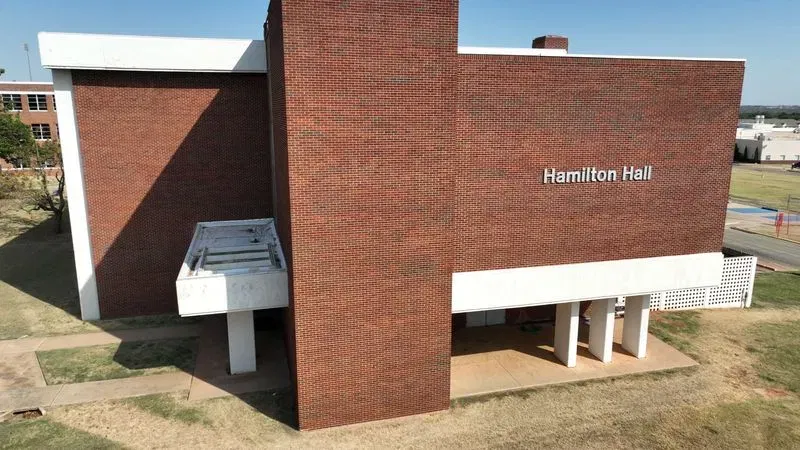
Langston University School of Arts and Sciences announced it received a five-year, $2.25 million grant from the National Science Foundation to improve student success in science, technology, engineering and mathematics (STEM).
The $2,249,925, comes from the NSF’s Historically Black College and Universities Undergraduate Program (HBCU-UP) and will fund a new initiative called Advancing STEM Competencies and Enhancing New Discoveries with AI-Assisted Learning Analytics, or ASCEND.
The program aims to improve student achievement, persistence and success in STEM fields by expanding undergraduate academic support and interdisciplinary learning opportunities.
Dr. Franklin Fondjo Fotou, the Acting Dean of the School of Arts and Science, says the project will use artificial intelligence-assisted learning analytics to strengthen students’ problem-solving and scientific reasoning skills.
“This NSF-funded project at Langston University advances STEM student success through an innovative AI-assisted learning model that strengthens problem-solving, scientific reasoning and retention,” said Dr. Fondjo Fotou. “It expands STEM undergraduate academic support programs and interdisciplinary learning opportunities while building new resources for innovation and data visualization. The project will generate evidence-based practices to improve STEM outcomes and broaden participation in STEM careers and graduate education.”
The project is led by Dr. John Colman, a retired Langston University faculty member and former Interim Dean of the Schools of Arts and Science.
ASCEND will focus on foundational STEM courses, including calculus, general chemistry and physics, where gaps in mathematics preparation and conceptual understanding can hinder students’ progress toward a degree.
The program will use Competency Performance Recording for Learning, an instructional strategy that asks students to explain how they solve problems and why their methods work. Students record brief videos describing their reasoning, allowing faculty to identify misconceptions and provide targeted feedback.
Colman’s team estimates approximately 480 students will participate in ASCEND over the next five years. The grant will fund the program through Aug. 31, 2031.