
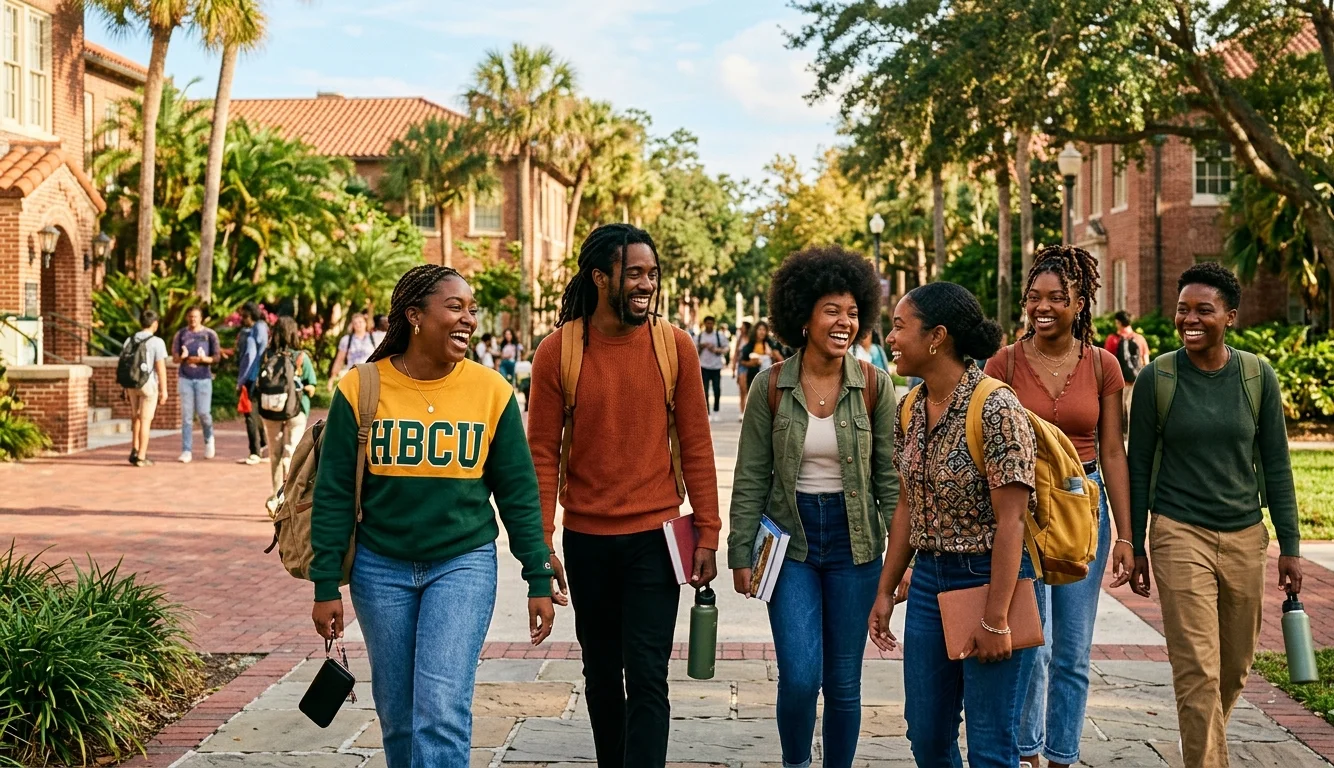
Historically Black colleges and universities have seen growing interest from students and increased investment in their missions in recent years. But for many HBCUs, longstanding resource challenges and the barriers students face outside the classroom continue to create obstacles to college completion.
A new report from InsideTrack found that a five-year coaching initiative across 39 HBCUs boosted attainment among both current and stopped-out students. Stopped-out students who received coaching re-enrolled at a rate of 6.9 percent—2.5 times the national average—with more than 1,300 returning to their institutions during the five-year period.
Among actively enrolled students, those who met with a coach retained at a rate of 90.4 percent from fall to spring, compared with 82.4 percent for students who did not complete a coaching meeting.
The report from the national student success coaching nonprofit tracked outcomes from fall 2021 through spring 2026, during which coaches supported nearly 44,000 students across the 39 campuses. They included more than 23,000 students who had stopped out before completing a degree and nearly 12,000 enrolled students navigating barriers to persistence, including balancing work and family responsibilities, financial challenges, and adjusting to college.
Coaches used personalized outreach and one-on-one sessions to help students clarify their goals, identify barriers, and navigate financial, academic and administrative challenges that could interrupt their paths to completion.
Henri LaSane, associate vice president of HBCU programs at InsideTrack, said the initiative was built around the understanding that students’ paths to completion are rarely linear and that institutions must provide support when challenges arise.
“When we look at the journey and the life cycle of a student, it’s not a straight line,” LaSane said. “Unexpected curves happen, and those things can oftentimes derail and unintentionally impact our belief and ability to re-enroll and persist.”
Rebuilding student momentum: LaSane said many HBCU students cited two common areas of struggle: finances and a sense of belonging. While HBCUs often provide students with a strong sense of community, belonging can still be complicated as students adjust to college life, he said.
“One of those underrated things that happens with belonging is being homesick,” LaSane said. “I don’t think we speak enough about how much of a role being homesick plays into a young person’s sense of belonging on any kind of campus.”
“There’s an assumption that because we are attracting Black students to a Black campus that they’re going to automatically experience this sense of belonging,” he added. “But there’s also still cultural dynamics.”
In addition, many students found financial pressures challenging, LaSane said, as they sought to balance their education with family responsibilities and other obligations outside the classroom.
“Considering that most of the backgrounds and demographics of the learners that we bring in are normally coming from under-resourced communities, family dynamics oftentimes play a role where some of these learners are contributing financially to their household,” LaSane said. “We know that the collegiate journey is a delayed gratification journey, and there are immediate needs and stressors that are being presented to us.”
The report found that the multi-year coaching initiative focused much of its outreach on students who are often overlooked by traditional retention efforts, including adult learners, who made up nearly 40 percent of the coached population, and Black male students, who made up about a third.
Among a subset of 13 public HBCUs, Black male students who met with a coach re-enrolled at a rate of 15.1 percent—10.8 percentage points higher than their peers from the same cohort who did not meet with a coach.
LaSane said many Black male students have not always seen higher education as a space where they feel supported or valued, making relationship-building a critical component of re-engagement efforts.
“Higher ed resonates a little bit differently for Black males, where I think there was a message of value that has shifted, and institutions did not shift accordingly,” LaSane said. “Coaching, I believe, lays that out for them in a way that provides some individualized attention that has been sorely missing within the Black male landscape.”
Strengthening HBCU support: The initiative was part of a broader effort to support HBCUs, which make up just 3 percent of the nation’s colleges and universities yet produce nearly 20 percent of all Black graduates, data shows.
The five-year initiative was made possible through a coalition of funders and partners, including Blue Meridian Partners, UNCF’s Institute for Capacity Building, the Thurgood Marshall College Fund and Ed Advancement. The coaching was delivered by a team of seven partnership directors and 28 trained success coaches, nearly all of whom were HBCU alumni.
Julian Capel, director of partnership development at Ed Advancement, said the outcomes challenged assumptions about students who stop out, emphasizing that many have the ability to succeed when they receive sustained support.
“I love the fact that, despite what the narratives are out there about HBCUs or Black and brown students, we’re more than capable,” Capel said. “Sometimes they need a level of support that they didn’t even know they needed.”
Of the students who received outreach from a coach, more than 2,300 have gone on to graduate, according to outcomes verified through the National Student Clearinghouse. Participating institutions also saw an estimated $26.9 million in recovered and retained tuition revenue tied to students returning and continuing their education.
Capel said the long-term goal is to help HBCUs build sustainable systems of support that remain in place beyond the initial coaching intervention.
“There’s constant turnover at HBCUs. There’s constant people shifting, but if you have the right people in place, it’s kind of like sports,” Capel said. “If you set the culture the right way, it doesn’t matter which players come in here because we’re going to win regardless.”